Jianlong Ge , Xinxin Zhang , Jinjin Wang , Meijie Liao , Bin Xia , Xiaojun Rong , Bin Li , Zheng Zhang , Yongxiang Yu , Chunyuan Wang , Yingeng Wang , Xuexi Tang
{"title":"基于物种敏感性分布分析的莱州湾毒死蜱生态风险评价","authors":"Jianlong Ge , Xinxin Zhang , Jinjin Wang , Meijie Liao , Bin Xia , Xiaojun Rong , Bin Li , Zheng Zhang , Yongxiang Yu , Chunyuan Wang , Yingeng Wang , Xuexi Tang","doi":"10.1016/j.ecolind.2025.113322","DOIUrl":null,"url":null,"abstract":"<div><div>Chlorpyrifos, a widely used organophosphorus insecticide, poses a potential hazard to marine ecosystems due to its toxicity to aquatic organisms. However, the ecological risks of chlorpyrifos to marine organisms remain unclear. This study employed species sensitivity distributions (SSDs) to assess the ecotoxicological effects of chlorpyrifos on marine ecosystems, with a focus study in Laizhou Bay, China. Our results revealed the hazardous concentration for 5 % of species (HC<sub>5</sub>) for indigenous, non-indigenous, and all marine species were 1.341, 0.0231, and 0.0872 μg/L, respectively. The predicted no-effect concentrations (PNECs) demonstrate significant temporal variation, with short-term values of 0.6705, 0.0116, and 0.0436 μg/L, and long-term values of 0.0838, 0.0015, and 0.0055 μg/L for indigenous, non-indigenous, and all species, respectively. Non-indigenous species exhibited higher sensitivity to chlorpyrifos than indigenous species. Risk assessment based on risk quotients (RQs) revealed distinct temporal patterns: short-term RQs ranged from 0.001 to 0.094 across different species groups, while long-term RQs showed higher values ranging from 0.004 to 0.727. These findings indicated minimal short-term ecological risk, but moderate long-term risk, particularly for non-indigenous species. Our study provides compelling evidence that chlorpyrifos poses a potential threat to the ecosystem of Laizhou Bay. These findings offer crucial scientific data for establishing water quality standards for chlorpyrifos in China and developing effective management strategies for pesticide pollution in marine environments.</div></div>","PeriodicalId":11459,"journal":{"name":"Ecological Indicators","volume":"172 ","pages":"Article 113322"},"PeriodicalIF":8.7000,"publicationDate":"2025-03-01","publicationTypes":"Journal Article","fieldsOfStudy":null,"isOpenAccess":false,"openAccessPdf":"","citationCount":"0","resultStr":"{\"title\":\"Ecological risk assessment of chlorpyrifos in Laizhou Bay based on species sensitivity distributions analysis\",\"authors\":\"Jianlong Ge , Xinxin Zhang , Jinjin Wang , Meijie Liao , Bin Xia , Xiaojun Rong , Bin Li , Zheng Zhang , Yongxiang Yu , Chunyuan Wang , Yingeng Wang , Xuexi Tang\",\"doi\":\"10.1016/j.ecolind.2025.113322\",\"DOIUrl\":null,\"url\":null,\"abstract\":\"<div><div>Chlorpyrifos, a widely used organophosphorus insecticide, poses a potential hazard to marine ecosystems due to its toxicity to aquatic organisms. However, the ecological risks of chlorpyrifos to marine organisms remain unclear. This study employed species sensitivity distributions (SSDs) to assess the ecotoxicological effects of chlorpyrifos on marine ecosystems, with a focus study in Laizhou Bay, China. Our results revealed the hazardous concentration for 5 % of species (HC<sub>5</sub>) for indigenous, non-indigenous, and all marine species were 1.341, 0.0231, and 0.0872 μg/L, respectively. The predicted no-effect concentrations (PNECs) demonstrate significant temporal variation, with short-term values of 0.6705, 0.0116, and 0.0436 μg/L, and long-term values of 0.0838, 0.0015, and 0.0055 μg/L for indigenous, non-indigenous, and all species, respectively. Non-indigenous species exhibited higher sensitivity to chlorpyrifos than indigenous species. Risk assessment based on risk quotients (RQs) revealed distinct temporal patterns: short-term RQs ranged from 0.001 to 0.094 across different species groups, while long-term RQs showed higher values ranging from 0.004 to 0.727. These findings indicated minimal short-term ecological risk, but moderate long-term risk, particularly for non-indigenous species. Our study provides compelling evidence that chlorpyrifos poses a potential threat to the ecosystem of Laizhou Bay. These findings offer crucial scientific data for establishing water quality standards for chlorpyrifos in China and developing effective management strategies for pesticide pollution in marine environments.</div></div>\",\"PeriodicalId\":11459,\"journal\":{\"name\":\"Ecological Indicators\",\"volume\":\"172 \",\"pages\":\"Article 113322\"},\"PeriodicalIF\":8.7000,\"publicationDate\":\"2025-03-01\",\"publicationTypes\":\"Journal Article\",\"fieldsOfStudy\":null,\"isOpenAccess\":false,\"openAccessPdf\":\"\",\"citationCount\":\"0\",\"resultStr\":null,\"platform\":\"Semanticscholar\",\"paperid\":null,\"PeriodicalName\":\"Ecological Indicators\",\"FirstCategoryId\":\"93\",\"ListUrlMain\":\"https://www.sciencedirect.com/science/article/pii/S1470160X25002535\",\"RegionNum\":2,\"RegionCategory\":\"环境科学与生态学\",\"ArticlePicture\":[],\"TitleCN\":null,\"AbstractTextCN\":null,\"PMCID\":null,\"EPubDate\":\"2025/3/7 0:00:00\",\"PubModel\":\"Epub\",\"JCR\":\"Q1\",\"JCRName\":\"ENVIRONMENTAL SCIENCES\",\"Score\":null,\"Total\":0}","platform":"Semanticscholar","paperid":null,"PeriodicalName":"Ecological Indicators","FirstCategoryId":"93","ListUrlMain":"https://www.sciencedirect.com/science/article/pii/S1470160X25002535","RegionNum":2,"RegionCategory":"环境科学与生态学","ArticlePicture":[],"TitleCN":null,"AbstractTextCN":null,"PMCID":null,"EPubDate":"2025/3/7 0:00:00","PubModel":"Epub","JCR":"Q1","JCRName":"ENVIRONMENTAL SCIENCES","Score":null,"Total":0}
Ecological risk assessment of chlorpyrifos in Laizhou Bay based on species sensitivity distributions analysis
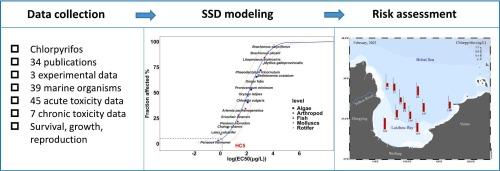
Chlorpyrifos, a widely used organophosphorus insecticide, poses a potential hazard to marine ecosystems due to its toxicity to aquatic organisms. However, the ecological risks of chlorpyrifos to marine organisms remain unclear. This study employed species sensitivity distributions (SSDs) to assess the ecotoxicological effects of chlorpyrifos on marine ecosystems, with a focus study in Laizhou Bay, China. Our results revealed the hazardous concentration for 5 % of species (HC5) for indigenous, non-indigenous, and all marine species were 1.341, 0.0231, and 0.0872 μg/L, respectively. The predicted no-effect concentrations (PNECs) demonstrate significant temporal variation, with short-term values of 0.6705, 0.0116, and 0.0436 μg/L, and long-term values of 0.0838, 0.0015, and 0.0055 μg/L for indigenous, non-indigenous, and all species, respectively. Non-indigenous species exhibited higher sensitivity to chlorpyrifos than indigenous species. Risk assessment based on risk quotients (RQs) revealed distinct temporal patterns: short-term RQs ranged from 0.001 to 0.094 across different species groups, while long-term RQs showed higher values ranging from 0.004 to 0.727. These findings indicated minimal short-term ecological risk, but moderate long-term risk, particularly for non-indigenous species. Our study provides compelling evidence that chlorpyrifos poses a potential threat to the ecosystem of Laizhou Bay. These findings offer crucial scientific data for establishing water quality standards for chlorpyrifos in China and developing effective management strategies for pesticide pollution in marine environments.
期刊介绍:
The ultimate aim of Ecological Indicators is to integrate the monitoring and assessment of ecological and environmental indicators with management practices. The journal provides a forum for the discussion of the applied scientific development and review of traditional indicator approaches as well as for theoretical, modelling and quantitative applications such as index development. Research into the following areas will be published.
• All aspects of ecological and environmental indicators and indices.
• New indicators, and new approaches and methods for indicator development, testing and use.
• Development and modelling of indices, e.g. application of indicator suites across multiple scales and resources.
• Analysis and research of resource, system- and scale-specific indicators.
• Methods for integration of social and other valuation metrics for the production of scientifically rigorous and politically-relevant assessments using indicator-based monitoring and assessment programs.
• How research indicators can be transformed into direct application for management purposes.
• Broader assessment objectives and methods, e.g. biodiversity, biological integrity, and sustainability, through the use of indicators.
• Resource-specific indicators such as landscape, agroecosystems, forests, wetlands, etc.




 京公网安备 11010802042870号
京ICP备2023020795号-1
京公网安备 11010802042870号
京ICP备2023020795号-1

 分享
分享
 求助内容:
求助内容: 应助结果提醒方式:
 扫码关注我们
