Yiying Yue , Yun Bai , Di Wang , Wanli Cheng , Qinglin Wu , Guangping Han , Jianchun Jiang
{"title":"四功能MXene介导的光催化太阳能驱动界面蒸发材料的构建:MXene对海水蒸发和降解的调控策略","authors":"Yiying Yue , Yun Bai , Di Wang , Wanli Cheng , Qinglin Wu , Guangping Han , Jianchun Jiang","doi":"10.1016/j.desal.2025.118785","DOIUrl":null,"url":null,"abstract":"<div><div>Solar-driven desalination is a promising approach for alleviating water shortages. However, the low evaporation rate severely restricts the widespread application of solar evaporation materials. In this study, an MXene was developed as a cross-linker and photothermal material and then combined with BiOBr to create a photoinitiator and photocatalyst for synthesizing MXene-based aerogels. Owing to MXene contents influenced the pore size and light-absorption ability of aerogel, and further significantly impacted the water transmission and photothermal conversion properties of aerogel, the water evaporation rate could be elevated by regulating the content of MXene. The optimal aerogel exhibited excellent light-absorption capacity (~92 %), super-hydrophilicity (water contact angle reaching 0° in less than 1 s), low thermal conductivity (0.03212 W m<sup>−1</sup> K<sup>−1</sup>), appropriate pore-size distribution (concentrated in the 9.6–30.8 μm range) and high toughness. Under 100 mW cm<sup>−2</sup> irradiation, the water evaporation rate and photothermal conversion efficiency of the optimal aerogel were 1.73 kg m<sup>−2</sup> h<sup>−1</sup> and 88.36 %, respectively. Furthermore, no significant salt accumulation was observed at the surface even after 10 h of cyclic evaporation. When seawater was contaminated with organic pollutant (e.g. rhodamine B (RhB)), the aerogel achieved photo-decolorization efficiency of 99.12 % and salt ions removal rate of 99.5 %. Therefore, the obtained aerogel with integrated high evaporation rates and photocatalytic characteristic meets the trend of “multi-function integration” and is expected to offer an effective solution for addressing the global water scarcity issue.</div></div>","PeriodicalId":299,"journal":{"name":"Desalination","volume":"606 ","pages":"Article 118785"},"PeriodicalIF":9.8000,"publicationDate":"2025-07-01","publicationTypes":"Journal Article","fieldsOfStudy":null,"isOpenAccess":false,"openAccessPdf":"","citationCount":"0","resultStr":"{\"title\":\"Construction of a quadra-functional MXene-mediated photocatalytic solar-driven interfacial evaporation materials: The regulation strategy of MXene in enhancing seawater evaporation and degradation\",\"authors\":\"Yiying Yue , Yun Bai , Di Wang , Wanli Cheng , Qinglin Wu , Guangping Han , Jianchun Jiang\",\"doi\":\"10.1016/j.desal.2025.118785\",\"DOIUrl\":null,\"url\":null,\"abstract\":\"<div><div>Solar-driven desalination is a promising approach for alleviating water shortages. However, the low evaporation rate severely restricts the widespread application of solar evaporation materials. In this study, an MXene was developed as a cross-linker and photothermal material and then combined with BiOBr to create a photoinitiator and photocatalyst for synthesizing MXene-based aerogels. Owing to MXene contents influenced the pore size and light-absorption ability of aerogel, and further significantly impacted the water transmission and photothermal conversion properties of aerogel, the water evaporation rate could be elevated by regulating the content of MXene. The optimal aerogel exhibited excellent light-absorption capacity (~92 %), super-hydrophilicity (water contact angle reaching 0° in less than 1 s), low thermal conductivity (0.03212 W m<sup>−1</sup> K<sup>−1</sup>), appropriate pore-size distribution (concentrated in the 9.6–30.8 μm range) and high toughness. Under 100 mW cm<sup>−2</sup> irradiation, the water evaporation rate and photothermal conversion efficiency of the optimal aerogel were 1.73 kg m<sup>−2</sup> h<sup>−1</sup> and 88.36 %, respectively. Furthermore, no significant salt accumulation was observed at the surface even after 10 h of cyclic evaporation. When seawater was contaminated with organic pollutant (e.g. rhodamine B (RhB)), the aerogel achieved photo-decolorization efficiency of 99.12 % and salt ions removal rate of 99.5 %. Therefore, the obtained aerogel with integrated high evaporation rates and photocatalytic characteristic meets the trend of “multi-function integration” and is expected to offer an effective solution for addressing the global water scarcity issue.</div></div>\",\"PeriodicalId\":299,\"journal\":{\"name\":\"Desalination\",\"volume\":\"606 \",\"pages\":\"Article 118785\"},\"PeriodicalIF\":9.8000,\"publicationDate\":\"2025-07-01\",\"publicationTypes\":\"Journal Article\",\"fieldsOfStudy\":null,\"isOpenAccess\":false,\"openAccessPdf\":\"\",\"citationCount\":\"0\",\"resultStr\":null,\"platform\":\"Semanticscholar\",\"paperid\":null,\"PeriodicalName\":\"Desalination\",\"FirstCategoryId\":\"5\",\"ListUrlMain\":\"https://www.sciencedirect.com/science/article/pii/S0011916425002607\",\"RegionNum\":1,\"RegionCategory\":\"工程技术\",\"ArticlePicture\":[],\"TitleCN\":null,\"AbstractTextCN\":null,\"PMCID\":null,\"EPubDate\":\"2025/3/6 0:00:00\",\"PubModel\":\"Epub\",\"JCR\":\"Q1\",\"JCRName\":\"ENGINEERING, CHEMICAL\",\"Score\":null,\"Total\":0}","platform":"Semanticscholar","paperid":null,"PeriodicalName":"Desalination","FirstCategoryId":"5","ListUrlMain":"https://www.sciencedirect.com/science/article/pii/S0011916425002607","RegionNum":1,"RegionCategory":"工程技术","ArticlePicture":[],"TitleCN":null,"AbstractTextCN":null,"PMCID":null,"EPubDate":"2025/3/6 0:00:00","PubModel":"Epub","JCR":"Q1","JCRName":"ENGINEERING, CHEMICAL","Score":null,"Total":0}
引用次数: 0
摘要
太阳能驱动的海水淡化是缓解水资源短缺的一种很有前途的方法。然而,蒸发速率低严重制约了太阳能蒸发材料的广泛应用。本研究开发了MXene作为交联剂和光热材料,然后与BiOBr结合,制备了用于合成MXene基气凝胶的光引发剂和光催化剂。由于MXene的含量影响气凝胶的孔径和吸光能力,进而显著影响气凝胶的透水性和光热转化性能,因此调节MXene的含量可以提高气凝胶的水分蒸发速率。最佳气凝胶具有优异的光吸收能力(~ 92%)、超亲水性(水接触角在1 s内达到0°)、低导热系数(0.03212 W m−1 K−1)、合适的孔径分布(集中在9.6 ~ 30.8 μm范围内)和高韧性。在100 mW cm−2辐照下,最佳气凝胶的水分蒸发速率为1.73 kg m−2 h−1,光热转换效率为88.36%。循环蒸发10 h后,地表未见明显的盐积累。当海水被有机污染物(如罗丹明B (RhB))污染时,气凝胶的光脱色效率为99.12%,盐离子去除率为99.5%。因此,所制备的具有高蒸发速率和光催化特性的气凝胶符合“多功能一体化”的发展趋势,有望为解决全球水资源短缺问题提供有效的解决方案。
Construction of a quadra-functional MXene-mediated photocatalytic solar-driven interfacial evaporation materials: The regulation strategy of MXene in enhancing seawater evaporation and degradation
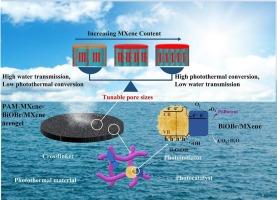
Solar-driven desalination is a promising approach for alleviating water shortages. However, the low evaporation rate severely restricts the widespread application of solar evaporation materials. In this study, an MXene was developed as a cross-linker and photothermal material and then combined with BiOBr to create a photoinitiator and photocatalyst for synthesizing MXene-based aerogels. Owing to MXene contents influenced the pore size and light-absorption ability of aerogel, and further significantly impacted the water transmission and photothermal conversion properties of aerogel, the water evaporation rate could be elevated by regulating the content of MXene. The optimal aerogel exhibited excellent light-absorption capacity (~92 %), super-hydrophilicity (water contact angle reaching 0° in less than 1 s), low thermal conductivity (0.03212 W m−1 K−1), appropriate pore-size distribution (concentrated in the 9.6–30.8 μm range) and high toughness. Under 100 mW cm−2 irradiation, the water evaporation rate and photothermal conversion efficiency of the optimal aerogel were 1.73 kg m−2 h−1 and 88.36 %, respectively. Furthermore, no significant salt accumulation was observed at the surface even after 10 h of cyclic evaporation. When seawater was contaminated with organic pollutant (e.g. rhodamine B (RhB)), the aerogel achieved photo-decolorization efficiency of 99.12 % and salt ions removal rate of 99.5 %. Therefore, the obtained aerogel with integrated high evaporation rates and photocatalytic characteristic meets the trend of “multi-function integration” and is expected to offer an effective solution for addressing the global water scarcity issue.
期刊介绍:
Desalination is a scholarly journal that focuses on the field of desalination materials, processes, and associated technologies. It encompasses a wide range of disciplines and aims to publish exceptional papers in this area.
The journal invites submissions that explicitly revolve around water desalting and its applications to various sources such as seawater, groundwater, and wastewater. It particularly encourages research on diverse desalination methods including thermal, membrane, sorption, and hybrid processes.
By providing a platform for innovative studies, Desalination aims to advance the understanding and development of desalination technologies, promoting sustainable solutions for water scarcity challenges.




 京公网安备 11010802042870号
京ICP备2023020795号-1
京公网安备 11010802042870号
京ICP备2023020795号-1

 分享
分享
 求助内容:
求助内容: 应助结果提醒方式:
 扫码关注我们
