Bailey Lovett , Patrick Cahill , Javier Atalah , Julien Vignier , Lauren Fletcher , Juliette Butler , Hannah Appleton , Olivier Champeau , Matthew Reardon , Eugene Georgiades , Yasmin Gabay , Daniel Kluza , Abraham Growcott , Abel Gamarra , Ian Davidson
{"title":"铜基海洋生长预防系统(MGPS)的推荐剂量是否对船舶生物安全有效?","authors":"Bailey Lovett , Patrick Cahill , Javier Atalah , Julien Vignier , Lauren Fletcher , Juliette Butler , Hannah Appleton , Olivier Champeau , Matthew Reardon , Eugene Georgiades , Yasmin Gabay , Daniel Kluza , Abraham Growcott , Abel Gamarra , Ian Davidson","doi":"10.1016/j.marpolbul.2025.117771","DOIUrl":null,"url":null,"abstract":"<div><div>Biofouling within vessel sea chests and internal seawater systems (ISS) presents a range of operational and biosecurity issues. Marine Growth Prevention Systems (MGPS) are designed to prevent biofouling accumulation in these areas, however independent data regarding their efficacy is scarce. Sacrificial copper anode MGPS, which operate by releasing reactive copper ions, have the dominant market share. In this study, we tested copper dosages generated using cupric chloride to mimic cupric ion (Cu<sup>2+</sup>) generation by copper anode-based MGPS. We assessed the effect of copper dosages, including those recommended by MGPS manufacturers, on mortality of larval biofouling species (<em>Ciona savignyi</em> and <em>Crassostrea gigas</em>) and mature biofouling communities under various environmental conditions. Minimum inhibitory concentrations (MICs) were 2–3 orders of magnitude higher than MGPS manufacturer-reported dosages for both larval and mature biofouling. Efficacy varied with exposure regime, organic matter load, biofouling species, and organism development stage. Based on our results, short-term copper MGPS dosing according to current manufacturer recommendations appears insufficient to manage biosecurity risks within sea chests and ISS.</div></div>","PeriodicalId":18215,"journal":{"name":"Marine pollution bulletin","volume":"214 ","pages":"Article 117771"},"PeriodicalIF":4.9000,"publicationDate":"2025-05-01","publicationTypes":"Journal Article","fieldsOfStudy":null,"isOpenAccess":false,"openAccessPdf":"","citationCount":"0","resultStr":"{\"title\":\"Are recommended dosages of copper-based Marine Growth Prevention Systems (MGPS) effective for vessel biosecurity?\",\"authors\":\"Bailey Lovett , Patrick Cahill , Javier Atalah , Julien Vignier , Lauren Fletcher , Juliette Butler , Hannah Appleton , Olivier Champeau , Matthew Reardon , Eugene Georgiades , Yasmin Gabay , Daniel Kluza , Abraham Growcott , Abel Gamarra , Ian Davidson\",\"doi\":\"10.1016/j.marpolbul.2025.117771\",\"DOIUrl\":null,\"url\":null,\"abstract\":\"<div><div>Biofouling within vessel sea chests and internal seawater systems (ISS) presents a range of operational and biosecurity issues. Marine Growth Prevention Systems (MGPS) are designed to prevent biofouling accumulation in these areas, however independent data regarding their efficacy is scarce. Sacrificial copper anode MGPS, which operate by releasing reactive copper ions, have the dominant market share. In this study, we tested copper dosages generated using cupric chloride to mimic cupric ion (Cu<sup>2+</sup>) generation by copper anode-based MGPS. We assessed the effect of copper dosages, including those recommended by MGPS manufacturers, on mortality of larval biofouling species (<em>Ciona savignyi</em> and <em>Crassostrea gigas</em>) and mature biofouling communities under various environmental conditions. Minimum inhibitory concentrations (MICs) were 2–3 orders of magnitude higher than MGPS manufacturer-reported dosages for both larval and mature biofouling. Efficacy varied with exposure regime, organic matter load, biofouling species, and organism development stage. Based on our results, short-term copper MGPS dosing according to current manufacturer recommendations appears insufficient to manage biosecurity risks within sea chests and ISS.</div></div>\",\"PeriodicalId\":18215,\"journal\":{\"name\":\"Marine pollution bulletin\",\"volume\":\"214 \",\"pages\":\"Article 117771\"},\"PeriodicalIF\":4.9000,\"publicationDate\":\"2025-05-01\",\"publicationTypes\":\"Journal Article\",\"fieldsOfStudy\":null,\"isOpenAccess\":false,\"openAccessPdf\":\"\",\"citationCount\":\"0\",\"resultStr\":null,\"platform\":\"Semanticscholar\",\"paperid\":null,\"PeriodicalName\":\"Marine pollution bulletin\",\"FirstCategoryId\":\"93\",\"ListUrlMain\":\"https://www.sciencedirect.com/science/article/pii/S0025326X25002462\",\"RegionNum\":3,\"RegionCategory\":\"环境科学与生态学\",\"ArticlePicture\":[],\"TitleCN\":null,\"AbstractTextCN\":null,\"PMCID\":null,\"EPubDate\":\"2025/3/7 0:00:00\",\"PubModel\":\"Epub\",\"JCR\":\"Q1\",\"JCRName\":\"ENVIRONMENTAL SCIENCES\",\"Score\":null,\"Total\":0}","platform":"Semanticscholar","paperid":null,"PeriodicalName":"Marine pollution bulletin","FirstCategoryId":"93","ListUrlMain":"https://www.sciencedirect.com/science/article/pii/S0025326X25002462","RegionNum":3,"RegionCategory":"环境科学与生态学","ArticlePicture":[],"TitleCN":null,"AbstractTextCN":null,"PMCID":null,"EPubDate":"2025/3/7 0:00:00","PubModel":"Epub","JCR":"Q1","JCRName":"ENVIRONMENTAL SCIENCES","Score":null,"Total":0}
Are recommended dosages of copper-based Marine Growth Prevention Systems (MGPS) effective for vessel biosecurity?
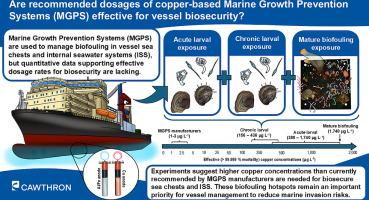
Biofouling within vessel sea chests and internal seawater systems (ISS) presents a range of operational and biosecurity issues. Marine Growth Prevention Systems (MGPS) are designed to prevent biofouling accumulation in these areas, however independent data regarding their efficacy is scarce. Sacrificial copper anode MGPS, which operate by releasing reactive copper ions, have the dominant market share. In this study, we tested copper dosages generated using cupric chloride to mimic cupric ion (Cu2+) generation by copper anode-based MGPS. We assessed the effect of copper dosages, including those recommended by MGPS manufacturers, on mortality of larval biofouling species (Ciona savignyi and Crassostrea gigas) and mature biofouling communities under various environmental conditions. Minimum inhibitory concentrations (MICs) were 2–3 orders of magnitude higher than MGPS manufacturer-reported dosages for both larval and mature biofouling. Efficacy varied with exposure regime, organic matter load, biofouling species, and organism development stage. Based on our results, short-term copper MGPS dosing according to current manufacturer recommendations appears insufficient to manage biosecurity risks within sea chests and ISS.
期刊介绍:
Marine Pollution Bulletin is concerned with the rational use of maritime and marine resources in estuaries, the seas and oceans, as well as with documenting marine pollution and introducing new forms of measurement and analysis. A wide range of topics are discussed as news, comment, reviews and research reports, not only on effluent disposal and pollution control, but also on the management, economic aspects and protection of the marine environment in general.




 京公网安备 11010802042870号
京ICP备2023020795号-1
京公网安备 11010802042870号
京ICP备2023020795号-1

 分享
分享
 求助内容:
求助内容: 应助结果提醒方式:
 扫码关注我们
