A.A. Escriba-Flores , X. Fernández-Francos , F. Ferrando , A. Fabregat-Sanjuan
{"title":"偶联剂对3D打印双固化环氧/丙烯酸酯体系动力学和力学性能影响的评价","authors":"A.A. Escriba-Flores , X. Fernández-Francos , F. Ferrando , A. Fabregat-Sanjuan","doi":"10.1016/j.eurpolymj.2025.113878","DOIUrl":null,"url":null,"abstract":"<div><div>In recent years, the use of vat photopolymerization in additive manufacturing technology has created a prominent potential in the world manufacturing industry due to its adaptability and quick production capabilities. However, a challenge faced by this technology is creating large-sized parts and ensuring the geometric versatility of processed parts. The physical and mechanical properties of existing materials limit their processing, affecting their final applications. Moreover, dual-curing systems allow new possibilities to 3D printing if shape geometry is changed after the first curing stage and fixed in the second curing stage. This study aims to address these challenges by developing a dual-curing system involving epoxy/acrylic resins. We assess the kinetic and mechanical behavior, focusing on variations in the network coupling agent. The initial curing stage of a low viscous formulation, achieved through processing on a DLP 3D printer (partially cured), produces a flexible material allowing deformations up to 160 %. The second curing stage, achieved through thermal treatment, transforms the material into a rigid system with an impressive maximum tensile strength close to 80 MPa. We compare the contribution of the bonding agent in partial and total cured states. Comprehensive mechanical tests have been performed, including tension and shear evaluations. Results have been favorably aligned with relevant literature. The dual-curing approach shows promise in expanding 3D printing vat photopolymerization applications, providing new design and manufacturing possibilities by enhancing material availability. Our findings emphasize the benefits of the dual-curing system, including low viscosity, shape manipulation during intermediate curing that allows complex geometries with fast procedures and without the need of supports and exceptional strength and durability achieved in the final curing phase. Results on mechanical characterization in joints show that dual curing resins could be attractive in applications where different parts must be joined and precise alignment and structural integrity are crucial. The main reason for that is the interaction with the bonding agent in each state of the dual curing.</div></div>","PeriodicalId":315,"journal":{"name":"European Polymer Journal","volume":"229 ","pages":"Article 113878"},"PeriodicalIF":6.8000,"publicationDate":"2025-04-16","publicationTypes":"Journal Article","fieldsOfStudy":null,"isOpenAccess":false,"openAccessPdf":"","citationCount":"0","resultStr":"{\"title\":\"Evaluation of the effect of coupling agent on the kinetic and mechanical properties of a 3D printable dual curing epoxy/acrylate system\",\"authors\":\"A.A. Escriba-Flores , X. Fernández-Francos , F. Ferrando , A. Fabregat-Sanjuan\",\"doi\":\"10.1016/j.eurpolymj.2025.113878\",\"DOIUrl\":null,\"url\":null,\"abstract\":\"<div><div>In recent years, the use of vat photopolymerization in additive manufacturing technology has created a prominent potential in the world manufacturing industry due to its adaptability and quick production capabilities. However, a challenge faced by this technology is creating large-sized parts and ensuring the geometric versatility of processed parts. The physical and mechanical properties of existing materials limit their processing, affecting their final applications. Moreover, dual-curing systems allow new possibilities to 3D printing if shape geometry is changed after the first curing stage and fixed in the second curing stage. This study aims to address these challenges by developing a dual-curing system involving epoxy/acrylic resins. We assess the kinetic and mechanical behavior, focusing on variations in the network coupling agent. The initial curing stage of a low viscous formulation, achieved through processing on a DLP 3D printer (partially cured), produces a flexible material allowing deformations up to 160 %. The second curing stage, achieved through thermal treatment, transforms the material into a rigid system with an impressive maximum tensile strength close to 80 MPa. We compare the contribution of the bonding agent in partial and total cured states. Comprehensive mechanical tests have been performed, including tension and shear evaluations. Results have been favorably aligned with relevant literature. The dual-curing approach shows promise in expanding 3D printing vat photopolymerization applications, providing new design and manufacturing possibilities by enhancing material availability. Our findings emphasize the benefits of the dual-curing system, including low viscosity, shape manipulation during intermediate curing that allows complex geometries with fast procedures and without the need of supports and exceptional strength and durability achieved in the final curing phase. Results on mechanical characterization in joints show that dual curing resins could be attractive in applications where different parts must be joined and precise alignment and structural integrity are crucial. The main reason for that is the interaction with the bonding agent in each state of the dual curing.</div></div>\",\"PeriodicalId\":315,\"journal\":{\"name\":\"European Polymer Journal\",\"volume\":\"229 \",\"pages\":\"Article 113878\"},\"PeriodicalIF\":6.8000,\"publicationDate\":\"2025-04-16\",\"publicationTypes\":\"Journal Article\",\"fieldsOfStudy\":null,\"isOpenAccess\":false,\"openAccessPdf\":\"\",\"citationCount\":\"0\",\"resultStr\":null,\"platform\":\"Semanticscholar\",\"paperid\":null,\"PeriodicalName\":\"European Polymer Journal\",\"FirstCategoryId\":\"92\",\"ListUrlMain\":\"https://www.sciencedirect.com/science/article/pii/S0014305725001661\",\"RegionNum\":2,\"RegionCategory\":\"化学\",\"ArticlePicture\":[],\"TitleCN\":null,\"AbstractTextCN\":null,\"PMCID\":null,\"EPubDate\":\"2025/3/2 0:00:00\",\"PubModel\":\"Epub\",\"JCR\":\"Q1\",\"JCRName\":\"POLYMER SCIENCE\",\"Score\":null,\"Total\":0}","platform":"Semanticscholar","paperid":null,"PeriodicalName":"European Polymer Journal","FirstCategoryId":"92","ListUrlMain":"https://www.sciencedirect.com/science/article/pii/S0014305725001661","RegionNum":2,"RegionCategory":"化学","ArticlePicture":[],"TitleCN":null,"AbstractTextCN":null,"PMCID":null,"EPubDate":"2025/3/2 0:00:00","PubModel":"Epub","JCR":"Q1","JCRName":"POLYMER SCIENCE","Score":null,"Total":0}
Evaluation of the effect of coupling agent on the kinetic and mechanical properties of a 3D printable dual curing epoxy/acrylate system
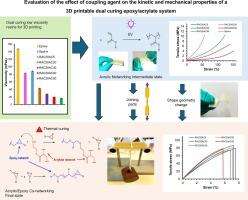
In recent years, the use of vat photopolymerization in additive manufacturing technology has created a prominent potential in the world manufacturing industry due to its adaptability and quick production capabilities. However, a challenge faced by this technology is creating large-sized parts and ensuring the geometric versatility of processed parts. The physical and mechanical properties of existing materials limit their processing, affecting their final applications. Moreover, dual-curing systems allow new possibilities to 3D printing if shape geometry is changed after the first curing stage and fixed in the second curing stage. This study aims to address these challenges by developing a dual-curing system involving epoxy/acrylic resins. We assess the kinetic and mechanical behavior, focusing on variations in the network coupling agent. The initial curing stage of a low viscous formulation, achieved through processing on a DLP 3D printer (partially cured), produces a flexible material allowing deformations up to 160 %. The second curing stage, achieved through thermal treatment, transforms the material into a rigid system with an impressive maximum tensile strength close to 80 MPa. We compare the contribution of the bonding agent in partial and total cured states. Comprehensive mechanical tests have been performed, including tension and shear evaluations. Results have been favorably aligned with relevant literature. The dual-curing approach shows promise in expanding 3D printing vat photopolymerization applications, providing new design and manufacturing possibilities by enhancing material availability. Our findings emphasize the benefits of the dual-curing system, including low viscosity, shape manipulation during intermediate curing that allows complex geometries with fast procedures and without the need of supports and exceptional strength and durability achieved in the final curing phase. Results on mechanical characterization in joints show that dual curing resins could be attractive in applications where different parts must be joined and precise alignment and structural integrity are crucial. The main reason for that is the interaction with the bonding agent in each state of the dual curing.
期刊介绍:
European Polymer Journal is dedicated to publishing work on fundamental and applied polymer chemistry and macromolecular materials. The journal covers all aspects of polymer synthesis, including polymerization mechanisms and chemical functional transformations, with a focus on novel polymers and the relationships between molecular structure and polymer properties. In addition, we welcome submissions on bio-based or renewable polymers, stimuli-responsive systems and polymer bio-hybrids. European Polymer Journal also publishes research on the biomedical application of polymers, including drug delivery and regenerative medicine. The main scope is covered but not limited to the following core research areas:
Polymer synthesis and functionalization
• Novel synthetic routes for polymerization, functional modification, controlled/living polymerization and precision polymers.
Stimuli-responsive polymers
• Including shape memory and self-healing polymers.
Supramolecular polymers and self-assembly
• Molecular recognition and higher order polymer structures.
Renewable and sustainable polymers
• Bio-based, biodegradable and anti-microbial polymers and polymeric bio-nanocomposites.
Polymers at interfaces and surfaces
• Chemistry and engineering of surfaces with biological relevance, including patterning, antifouling polymers and polymers for membrane applications.
Biomedical applications and nanomedicine
• Polymers for regenerative medicine, drug delivery molecular release and gene therapy
The scope of European Polymer Journal no longer includes Polymer Physics.




 京公网安备 11010802042870号
京ICP备2023020795号-1
京公网安备 11010802042870号
京ICP备2023020795号-1

 分享
分享
 求助内容:
求助内容: 应助结果提醒方式:
 扫码关注我们
