Ruizhi Yang , Haotian Deng , Yadong Zhao , Hanbin Lin , Yan Song , Luping Zhao , Wenhua Miao , Bin Zheng
{"title":"创新食品原料植物油体界面工程研究进展","authors":"Ruizhi Yang , Haotian Deng , Yadong Zhao , Hanbin Lin , Yan Song , Luping Zhao , Wenhua Miao , Bin Zheng","doi":"10.1016/j.tifs.2025.104954","DOIUrl":null,"url":null,"abstract":"<div><h3>Background</h3><div>Plant oil body (POB) is discrete subcellular organelles for storing lipids in seeds, designed by natural evolution of the plant body. The phospholipid-protein composite interface layer wraps around the oil core, which resists extreme changes in physical and chemical environment, maintaining relative stability. Despite the widespread use of POB as food ingredients in recent years, the variations in the composition across different sources, the mechanisms regulating the interface, and the interfacial behaviors contributing to the multi-phase system remain inadequately understood. Consequently, a systematic and theoretical review of the recent advances in interfacial engineering of POB for better performance in food systems is demanded.</div></div><div><h3>Scope and approach</h3><div>This paper reviews the effects of POB from various sources, including woody and herbaceous plants, on interfacial engineering, structural characteristics, and application performance in food systems. The discussion includes the reinforcement or degradation of the interface layer of POB through various types of interface engineering strategies, aiming at customizing the production of POB-based food ingredients. Moreover, the potential future applications of POB in the food industry are summarized.</div></div><div><h3>Key findings and conclusions</h3><div>The surface layer of POB is regulated by various interfacial engineering techniques, which alter the physical, chemical, and functional properties of the entire emulsion system, thereby facilitating the preparation of diverse food ingredients. This approach holds significant promise for applications in the development of plant-based dairy products, serving as fat substitutes and functioning as carriers for bioactive substances, as well as in the formulation of emulsion gels and edible films.</div></div>","PeriodicalId":441,"journal":{"name":"Trends in Food Science & Technology","volume":"159 ","pages":"Article 104954"},"PeriodicalIF":15.4000,"publicationDate":"2025-05-01","publicationTypes":"Journal Article","fieldsOfStudy":null,"isOpenAccess":false,"openAccessPdf":"","citationCount":"0","resultStr":"{\"title\":\"Interface engineering of plant oil body for an innovative food ingredient: A review\",\"authors\":\"Ruizhi Yang , Haotian Deng , Yadong Zhao , Hanbin Lin , Yan Song , Luping Zhao , Wenhua Miao , Bin Zheng\",\"doi\":\"10.1016/j.tifs.2025.104954\",\"DOIUrl\":null,\"url\":null,\"abstract\":\"<div><h3>Background</h3><div>Plant oil body (POB) is discrete subcellular organelles for storing lipids in seeds, designed by natural evolution of the plant body. The phospholipid-protein composite interface layer wraps around the oil core, which resists extreme changes in physical and chemical environment, maintaining relative stability. Despite the widespread use of POB as food ingredients in recent years, the variations in the composition across different sources, the mechanisms regulating the interface, and the interfacial behaviors contributing to the multi-phase system remain inadequately understood. Consequently, a systematic and theoretical review of the recent advances in interfacial engineering of POB for better performance in food systems is demanded.</div></div><div><h3>Scope and approach</h3><div>This paper reviews the effects of POB from various sources, including woody and herbaceous plants, on interfacial engineering, structural characteristics, and application performance in food systems. The discussion includes the reinforcement or degradation of the interface layer of POB through various types of interface engineering strategies, aiming at customizing the production of POB-based food ingredients. Moreover, the potential future applications of POB in the food industry are summarized.</div></div><div><h3>Key findings and conclusions</h3><div>The surface layer of POB is regulated by various interfacial engineering techniques, which alter the physical, chemical, and functional properties of the entire emulsion system, thereby facilitating the preparation of diverse food ingredients. This approach holds significant promise for applications in the development of plant-based dairy products, serving as fat substitutes and functioning as carriers for bioactive substances, as well as in the formulation of emulsion gels and edible films.</div></div>\",\"PeriodicalId\":441,\"journal\":{\"name\":\"Trends in Food Science & Technology\",\"volume\":\"159 \",\"pages\":\"Article 104954\"},\"PeriodicalIF\":15.4000,\"publicationDate\":\"2025-05-01\",\"publicationTypes\":\"Journal Article\",\"fieldsOfStudy\":null,\"isOpenAccess\":false,\"openAccessPdf\":\"\",\"citationCount\":\"0\",\"resultStr\":null,\"platform\":\"Semanticscholar\",\"paperid\":null,\"PeriodicalName\":\"Trends in Food Science & Technology\",\"FirstCategoryId\":\"97\",\"ListUrlMain\":\"https://www.sciencedirect.com/science/article/pii/S0924224425000901\",\"RegionNum\":1,\"RegionCategory\":\"农林科学\",\"ArticlePicture\":[],\"TitleCN\":null,\"AbstractTextCN\":null,\"PMCID\":null,\"EPubDate\":\"2025/3/1 0:00:00\",\"PubModel\":\"Epub\",\"JCR\":\"Q1\",\"JCRName\":\"FOOD SCIENCE & TECHNOLOGY\",\"Score\":null,\"Total\":0}","platform":"Semanticscholar","paperid":null,"PeriodicalName":"Trends in Food Science & Technology","FirstCategoryId":"97","ListUrlMain":"https://www.sciencedirect.com/science/article/pii/S0924224425000901","RegionNum":1,"RegionCategory":"农林科学","ArticlePicture":[],"TitleCN":null,"AbstractTextCN":null,"PMCID":null,"EPubDate":"2025/3/1 0:00:00","PubModel":"Epub","JCR":"Q1","JCRName":"FOOD SCIENCE & TECHNOLOGY","Score":null,"Total":0}
Interface engineering of plant oil body for an innovative food ingredient: A review
Background
Plant oil body (POB) is discrete subcellular organelles for storing lipids in seeds, designed by natural evolution of the plant body. The phospholipid-protein composite interface layer wraps around the oil core, which resists extreme changes in physical and chemical environment, maintaining relative stability. Despite the widespread use of POB as food ingredients in recent years, the variations in the composition across different sources, the mechanisms regulating the interface, and the interfacial behaviors contributing to the multi-phase system remain inadequately understood. Consequently, a systematic and theoretical review of the recent advances in interfacial engineering of POB for better performance in food systems is demanded.
Scope and approach
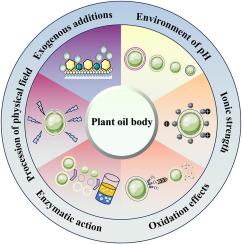
This paper reviews the effects of POB from various sources, including woody and herbaceous plants, on interfacial engineering, structural characteristics, and application performance in food systems. The discussion includes the reinforcement or degradation of the interface layer of POB through various types of interface engineering strategies, aiming at customizing the production of POB-based food ingredients. Moreover, the potential future applications of POB in the food industry are summarized.
Key findings and conclusions
The surface layer of POB is regulated by various interfacial engineering techniques, which alter the physical, chemical, and functional properties of the entire emulsion system, thereby facilitating the preparation of diverse food ingredients. This approach holds significant promise for applications in the development of plant-based dairy products, serving as fat substitutes and functioning as carriers for bioactive substances, as well as in the formulation of emulsion gels and edible films.
期刊介绍:
Trends in Food Science & Technology is a prestigious international journal that specializes in peer-reviewed articles covering the latest advancements in technology, food science, and human nutrition. It serves as a bridge between specialized primary journals and general trade magazines, providing readable and scientifically rigorous reviews and commentaries on current research developments and their potential applications in the food industry.
Unlike traditional journals, Trends in Food Science & Technology does not publish original research papers. Instead, it focuses on critical and comprehensive reviews to offer valuable insights for professionals in the field. By bringing together cutting-edge research and industry applications, this journal plays a vital role in disseminating knowledge and facilitating advancements in the food science and technology sector.




 京公网安备 11010802042870号
京ICP备2023020795号-1
京公网安备 11010802042870号
京ICP备2023020795号-1

 分享
分享
 求助内容:
求助内容: 应助结果提醒方式:
 扫码关注我们
