Xiaorong Jin, Yimei Zhang, Min Zhou, Qian Mei, Yangjuan Bai, Qiulan Hu, Wei Wei, Xiong Zhang, Fang Ma
{"title":"评估慢性心力衰竭患者及其护理人员健康素养与移动医疗使用意愿之间关系的行为者-伴侣相互依赖中介模型:横断面研究","authors":"Xiaorong Jin, Yimei Zhang, Min Zhou, Qian Mei, Yangjuan Bai, Qiulan Hu, Wei Wei, Xiong Zhang, Fang Ma","doi":"10.2196/63805","DOIUrl":null,"url":null,"abstract":"<p><strong>Background: </strong>Chronic heart failure (CHF) has become a serious threat to the health of the global population. Self-management is the key to treating CHF, and the emergence of mobile health (mHealth) has provided new ideas for the self-management of CHF. Despite the many potential benefits of mHealth, public utilization of mHealth apps is low, and poor health literacy (HL) is a key barrier to mHealth use. However, the mechanism of the influence is unclear.</p><p><strong>Objective: </strong>The aim of this study is to explore the dyadic associations between HL and mHealth usage intentions in dyads of patients with CHF and their caregivers, and the mediating role of mHealth perceived usefulness and perceived ease of use in these associations.</p><p><strong>Methods: </strong>This study had a cross-sectional research design, with a sample of 312 dyads of patients with CHF who had been hospitalized in the cardiology departments of 2 tertiary care hospitals in China from March to October 2023 and their caregivers. A general information questionnaire, the Chinese version of the Heart Failure-Specific Health Literacy Scale, and the mHealth Intention to Use Scale were used to conduct the survey; the data were analyzed using the actor-partner interdependence mediation model.</p><p><strong>Results: </strong>The results of the actor-partner interdependent mediation analysis of HL, perceived usefulness of mHealth, and mHealth use intention among patients with CHF and their caregivers showed that all of the model's actor effects were valid (β=.26-0.45; P<.001), the partner effects were partially valid (β=.08-0.20; P<.05), and the mediation effects were valid (β=.002-0.242, 95% CI 0.003-0.321; P<.05). Actor-partner interdependent mediation analyses of HL, perceived ease of use of mHealth, and mHealth use intention among patients with CHF and caregivers showed that the model's actor effect partially held (β=.17-0.71; P<.01), the partner effect partially held (β=.15; P<.01), and the mediation effect partially held (β=.355-0.584, 95% CI 0.234-0.764; P<.001).</p><p><strong>Conclusions: </strong>Our study proposes that the HL of patients with CHF and their caregivers positively contributes to their own intention to use mHealth, suggesting that the use of mHealth by patients with CHF can be promoted by improving the HL of patients and caregivers. Our findings also suggest that the perceived usefulness of patients with CHF and caregivers affects patients' mHealth use intention, and therefore patients with CHF and their caregivers should be involved throughout the mHealth development process to improve the usability of mHealth for both patients and caregivers. This study emphasizes the key role of patients' perception that mHealth is easy to use in facilitating their use of mHealth. Therefore, it is recommended that the development of mHealth should focus on simplifying operational procedures and providing relevant operational training according to the needs of the patients when necessary.</p>","PeriodicalId":14756,"journal":{"name":"JMIR mHealth and uHealth","volume":"13 ","pages":"e63805"},"PeriodicalIF":6.2000,"publicationDate":"2025-03-06","publicationTypes":"Journal Article","fieldsOfStudy":null,"isOpenAccess":false,"openAccessPdf":"https://www.ncbi.nlm.nih.gov/pmc/articles/PMC11905925/pdf/","citationCount":"0","resultStr":"{\"title\":\"An Actor-Partner Interdependence Mediation Model for Assessing the Association Between Health Literacy and mHealth Use Intention in Dyads of Patients With Chronic Heart Failure and Their Caregivers: Cross-Sectional Study.\",\"authors\":\"Xiaorong Jin, Yimei Zhang, Min Zhou, Qian Mei, Yangjuan Bai, Qiulan Hu, Wei Wei, Xiong Zhang, Fang Ma\",\"doi\":\"10.2196/63805\",\"DOIUrl\":null,\"url\":null,\"abstract\":\"<p><strong>Background: </strong>Chronic heart failure (CHF) has become a serious threat to the health of the global population. Self-management is the key to treating CHF, and the emergence of mobile health (mHealth) has provided new ideas for the self-management of CHF. Despite the many potential benefits of mHealth, public utilization of mHealth apps is low, and poor health literacy (HL) is a key barrier to mHealth use. However, the mechanism of the influence is unclear.</p><p><strong>Objective: </strong>The aim of this study is to explore the dyadic associations between HL and mHealth usage intentions in dyads of patients with CHF and their caregivers, and the mediating role of mHealth perceived usefulness and perceived ease of use in these associations.</p><p><strong>Methods: </strong>This study had a cross-sectional research design, with a sample of 312 dyads of patients with CHF who had been hospitalized in the cardiology departments of 2 tertiary care hospitals in China from March to October 2023 and their caregivers. A general information questionnaire, the Chinese version of the Heart Failure-Specific Health Literacy Scale, and the mHealth Intention to Use Scale were used to conduct the survey; the data were analyzed using the actor-partner interdependence mediation model.</p><p><strong>Results: </strong>The results of the actor-partner interdependent mediation analysis of HL, perceived usefulness of mHealth, and mHealth use intention among patients with CHF and their caregivers showed that all of the model's actor effects were valid (β=.26-0.45; P<.001), the partner effects were partially valid (β=.08-0.20; P<.05), and the mediation effects were valid (β=.002-0.242, 95% CI 0.003-0.321; P<.05). Actor-partner interdependent mediation analyses of HL, perceived ease of use of mHealth, and mHealth use intention among patients with CHF and caregivers showed that the model's actor effect partially held (β=.17-0.71; P<.01), the partner effect partially held (β=.15; P<.01), and the mediation effect partially held (β=.355-0.584, 95% CI 0.234-0.764; P<.001).</p><p><strong>Conclusions: </strong>Our study proposes that the HL of patients with CHF and their caregivers positively contributes to their own intention to use mHealth, suggesting that the use of mHealth by patients with CHF can be promoted by improving the HL of patients and caregivers. Our findings also suggest that the perceived usefulness of patients with CHF and caregivers affects patients' mHealth use intention, and therefore patients with CHF and their caregivers should be involved throughout the mHealth development process to improve the usability of mHealth for both patients and caregivers. This study emphasizes the key role of patients' perception that mHealth is easy to use in facilitating their use of mHealth. Therefore, it is recommended that the development of mHealth should focus on simplifying operational procedures and providing relevant operational training according to the needs of the patients when necessary.</p>\",\"PeriodicalId\":14756,\"journal\":{\"name\":\"JMIR mHealth and uHealth\",\"volume\":\"13 \",\"pages\":\"e63805\"},\"PeriodicalIF\":6.2000,\"publicationDate\":\"2025-03-06\",\"publicationTypes\":\"Journal Article\",\"fieldsOfStudy\":null,\"isOpenAccess\":false,\"openAccessPdf\":\"https://www.ncbi.nlm.nih.gov/pmc/articles/PMC11905925/pdf/\",\"citationCount\":\"0\",\"resultStr\":null,\"platform\":\"Semanticscholar\",\"paperid\":null,\"PeriodicalName\":\"JMIR mHealth and uHealth\",\"FirstCategoryId\":\"3\",\"ListUrlMain\":\"https://doi.org/10.2196/63805\",\"RegionNum\":2,\"RegionCategory\":\"医学\",\"ArticlePicture\":[],\"TitleCN\":null,\"AbstractTextCN\":null,\"PMCID\":null,\"EPubDate\":\"\",\"PubModel\":\"\",\"JCR\":\"Q1\",\"JCRName\":\"HEALTH CARE SCIENCES & SERVICES\",\"Score\":null,\"Total\":0}","platform":"Semanticscholar","paperid":null,"PeriodicalName":"JMIR mHealth and uHealth","FirstCategoryId":"3","ListUrlMain":"https://doi.org/10.2196/63805","RegionNum":2,"RegionCategory":"医学","ArticlePicture":[],"TitleCN":null,"AbstractTextCN":null,"PMCID":null,"EPubDate":"","PubModel":"","JCR":"Q1","JCRName":"HEALTH CARE SCIENCES & SERVICES","Score":null,"Total":0}
An Actor-Partner Interdependence Mediation Model for Assessing the Association Between Health Literacy and mHealth Use Intention in Dyads of Patients With Chronic Heart Failure and Their Caregivers: Cross-Sectional Study.
Background: Chronic heart failure (CHF) has become a serious threat to the health of the global population. Self-management is the key to treating CHF, and the emergence of mobile health (mHealth) has provided new ideas for the self-management of CHF. Despite the many potential benefits of mHealth, public utilization of mHealth apps is low, and poor health literacy (HL) is a key barrier to mHealth use. However, the mechanism of the influence is unclear.
Objective: The aim of this study is to explore the dyadic associations between HL and mHealth usage intentions in dyads of patients with CHF and their caregivers, and the mediating role of mHealth perceived usefulness and perceived ease of use in these associations.
Methods: This study had a cross-sectional research design, with a sample of 312 dyads of patients with CHF who had been hospitalized in the cardiology departments of 2 tertiary care hospitals in China from March to October 2023 and their caregivers. A general information questionnaire, the Chinese version of the Heart Failure-Specific Health Literacy Scale, and the mHealth Intention to Use Scale were used to conduct the survey; the data were analyzed using the actor-partner interdependence mediation model.
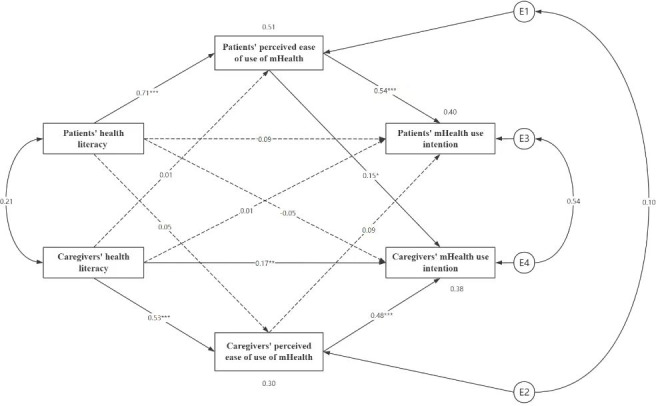
Results: The results of the actor-partner interdependent mediation analysis of HL, perceived usefulness of mHealth, and mHealth use intention among patients with CHF and their caregivers showed that all of the model's actor effects were valid (β=.26-0.45; P<.001), the partner effects were partially valid (β=.08-0.20; P<.05), and the mediation effects were valid (β=.002-0.242, 95% CI 0.003-0.321; P<.05). Actor-partner interdependent mediation analyses of HL, perceived ease of use of mHealth, and mHealth use intention among patients with CHF and caregivers showed that the model's actor effect partially held (β=.17-0.71; P<.01), the partner effect partially held (β=.15; P<.01), and the mediation effect partially held (β=.355-0.584, 95% CI 0.234-0.764; P<.001).
Conclusions: Our study proposes that the HL of patients with CHF and their caregivers positively contributes to their own intention to use mHealth, suggesting that the use of mHealth by patients with CHF can be promoted by improving the HL of patients and caregivers. Our findings also suggest that the perceived usefulness of patients with CHF and caregivers affects patients' mHealth use intention, and therefore patients with CHF and their caregivers should be involved throughout the mHealth development process to improve the usability of mHealth for both patients and caregivers. This study emphasizes the key role of patients' perception that mHealth is easy to use in facilitating their use of mHealth. Therefore, it is recommended that the development of mHealth should focus on simplifying operational procedures and providing relevant operational training according to the needs of the patients when necessary.
期刊介绍:
JMIR mHealth and uHealth (JMU, ISSN 2291-5222) is a spin-off journal of JMIR, the leading eHealth journal (Impact Factor 2016: 5.175). JMIR mHealth and uHealth is indexed in PubMed, PubMed Central, and Science Citation Index Expanded (SCIE), and in June 2017 received a stunning inaugural Impact Factor of 4.636.
The journal focusses on health and biomedical applications in mobile and tablet computing, pervasive and ubiquitous computing, wearable computing and domotics.
JMIR mHealth and uHealth publishes since 2013 and was the first mhealth journal in Pubmed. It publishes even faster and has a broader scope with including papers which are more technical or more formative/developmental than what would be published in the Journal of Medical Internet Research.





 京公网安备 11010802042870号
京ICP备2023020795号-1
京公网安备 11010802042870号
京ICP备2023020795号-1

 分享
分享
 求助内容:
求助内容: 应助结果提醒方式:
 扫码关注我们
