Ulf Tiemann, Chenglei Tian, Florian Hermann, Martin Proks, Emilie Skovgaard, Ivan Kulik, Yilin Di, Jakub Sedzinski, Henrik Semb
{"title":"胰腺α细胞和β细胞命运的选择是由顶基极性动力学指导的","authors":"Ulf Tiemann, Chenglei Tian, Florian Hermann, Martin Proks, Emilie Skovgaard, Ivan Kulik, Yilin Di, Jakub Sedzinski, Henrik Semb","doi":"10.1016/j.devcel.2025.02.008","DOIUrl":null,"url":null,"abstract":"A central question in cell and developmental biology is how extracellular cues control the differentiation of multipotent progenitors in a dynamically changing niche. Here, we identify apical-basal polarity as the main regulator of the differentiation of multipotent pancreatic Neurogenin3<sup>+</sup> endocrine progenitors (EPs) into the beta or alpha cell fates. We show that human EPs dynamically change their apical-basal polarity status. Whereas polarized EPs are predisposed to differentiate into beta cells rather than alpha cells, inhibiting apical-basal polarity selectively suppresses beta cell differentiation. Single-cell RNA sequencing and complementary mechanistic data demonstrate that apical-basal polarity in human EPs promotes beta cell specification via cyclic AMP (cAMP)/PKA-cAMP response element binding protein (CREB)-EGR1-mediated inhibition of ARX expression, while reduced cAMP levels in non-polarized human EPs maintain expression of ARX, leading to alpha cell differentiation. These findings identify the apical-basal polarity status of multipotent EPs as a critical epithelial feature that determines their fate into the alpha or beta cell lineages.","PeriodicalId":11157,"journal":{"name":"Developmental cell","volume":"29 1","pages":""},"PeriodicalIF":8.7000,"publicationDate":"2025-03-07","publicationTypes":"Journal Article","fieldsOfStudy":null,"isOpenAccess":false,"openAccessPdf":"","citationCount":"0","resultStr":"{\"title\":\"Pancreatic alpha and beta cell fate choice is directed by apical-basal polarity dynamics\",\"authors\":\"Ulf Tiemann, Chenglei Tian, Florian Hermann, Martin Proks, Emilie Skovgaard, Ivan Kulik, Yilin Di, Jakub Sedzinski, Henrik Semb\",\"doi\":\"10.1016/j.devcel.2025.02.008\",\"DOIUrl\":null,\"url\":null,\"abstract\":\"A central question in cell and developmental biology is how extracellular cues control the differentiation of multipotent progenitors in a dynamically changing niche. Here, we identify apical-basal polarity as the main regulator of the differentiation of multipotent pancreatic Neurogenin3<sup>+</sup> endocrine progenitors (EPs) into the beta or alpha cell fates. We show that human EPs dynamically change their apical-basal polarity status. Whereas polarized EPs are predisposed to differentiate into beta cells rather than alpha cells, inhibiting apical-basal polarity selectively suppresses beta cell differentiation. Single-cell RNA sequencing and complementary mechanistic data demonstrate that apical-basal polarity in human EPs promotes beta cell specification via cyclic AMP (cAMP)/PKA-cAMP response element binding protein (CREB)-EGR1-mediated inhibition of ARX expression, while reduced cAMP levels in non-polarized human EPs maintain expression of ARX, leading to alpha cell differentiation. These findings identify the apical-basal polarity status of multipotent EPs as a critical epithelial feature that determines their fate into the alpha or beta cell lineages.\",\"PeriodicalId\":11157,\"journal\":{\"name\":\"Developmental cell\",\"volume\":\"29 1\",\"pages\":\"\"},\"PeriodicalIF\":8.7000,\"publicationDate\":\"2025-03-07\",\"publicationTypes\":\"Journal Article\",\"fieldsOfStudy\":null,\"isOpenAccess\":false,\"openAccessPdf\":\"\",\"citationCount\":\"0\",\"resultStr\":null,\"platform\":\"Semanticscholar\",\"paperid\":null,\"PeriodicalName\":\"Developmental cell\",\"FirstCategoryId\":\"99\",\"ListUrlMain\":\"https://doi.org/10.1016/j.devcel.2025.02.008\",\"RegionNum\":1,\"RegionCategory\":\"生物学\",\"ArticlePicture\":[],\"TitleCN\":null,\"AbstractTextCN\":null,\"PMCID\":null,\"EPubDate\":\"\",\"PubModel\":\"\",\"JCR\":\"Q1\",\"JCRName\":\"CELL BIOLOGY\",\"Score\":null,\"Total\":0}","platform":"Semanticscholar","paperid":null,"PeriodicalName":"Developmental cell","FirstCategoryId":"99","ListUrlMain":"https://doi.org/10.1016/j.devcel.2025.02.008","RegionNum":1,"RegionCategory":"生物学","ArticlePicture":[],"TitleCN":null,"AbstractTextCN":null,"PMCID":null,"EPubDate":"","PubModel":"","JCR":"Q1","JCRName":"CELL BIOLOGY","Score":null,"Total":0}
Pancreatic alpha and beta cell fate choice is directed by apical-basal polarity dynamics
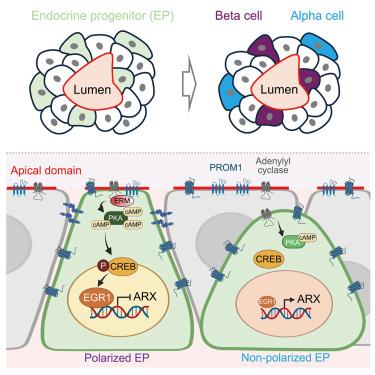
A central question in cell and developmental biology is how extracellular cues control the differentiation of multipotent progenitors in a dynamically changing niche. Here, we identify apical-basal polarity as the main regulator of the differentiation of multipotent pancreatic Neurogenin3+ endocrine progenitors (EPs) into the beta or alpha cell fates. We show that human EPs dynamically change their apical-basal polarity status. Whereas polarized EPs are predisposed to differentiate into beta cells rather than alpha cells, inhibiting apical-basal polarity selectively suppresses beta cell differentiation. Single-cell RNA sequencing and complementary mechanistic data demonstrate that apical-basal polarity in human EPs promotes beta cell specification via cyclic AMP (cAMP)/PKA-cAMP response element binding protein (CREB)-EGR1-mediated inhibition of ARX expression, while reduced cAMP levels in non-polarized human EPs maintain expression of ARX, leading to alpha cell differentiation. These findings identify the apical-basal polarity status of multipotent EPs as a critical epithelial feature that determines their fate into the alpha or beta cell lineages.
期刊介绍:
Developmental Cell, established in 2001, is a comprehensive journal that explores a wide range of topics in cell and developmental biology. Our publication encompasses work across various disciplines within biology, with a particular emphasis on investigating the intersections between cell biology, developmental biology, and other related fields. Our primary objective is to present research conducted through a cell biological perspective, addressing the essential mechanisms governing cell function, cellular interactions, and responses to the environment. Moreover, we focus on understanding the collective behavior of cells, culminating in the formation of tissues, organs, and whole organisms, while also investigating the consequences of any malfunctions in these intricate processes.




 京公网安备 11010802042870号
京ICP备2023020795号-1
京公网安备 11010802042870号
京ICP备2023020795号-1

 分享
分享
 求助内容:
求助内容: 应助结果提醒方式:
 扫码关注我们
