Wenjun Yi, Shuyue Zhu, Meicheng Fu, Nan Gu, Junli Qi, Siyu Liu, Mengjun Zhu, Ping Wang, Xin Chen, Yi Zhang, Hongyu Zhang, Yao Xu, Junyi Du, Peng Xiong, Zhaohua Dong, Luobing Dong, Qiong Liu, Xiujian Li
{"title":"接力投影显微望远镜","authors":"Wenjun Yi, Shuyue Zhu, Meicheng Fu, Nan Gu, Junli Qi, Siyu Liu, Mengjun Zhu, Ping Wang, Xin Chen, Yi Zhang, Hongyu Zhang, Yao Xu, Junyi Du, Peng Xiong, Zhaohua Dong, Luobing Dong, Qiong Liu, Xiujian Li","doi":"10.1038/s41377-025-01800-6","DOIUrl":null,"url":null,"abstract":"<p>The fundamental trade-off between spatial resolution and imaging distance poses a significant challenge for current imaging techniques, such as those used in modern biomedical diagnosis and remote sensing. Here, we introduce a new conceptual method for imaging dynamic amplitude-phase-mixed objects, termed relay-projection microscopic telescopy (rPMT), which fundamentally challenges conventional light collection techniques by employing non-line-of-sight light collection through square-law relay-projection mechanisms. We successfully resolved tin<u>y</u> features measuring 2.76 μm, 22.10 μm, and 35.08 μm for objects positioned at distances of 1019.0 mm, 26.4 m, and 96.0 m, respectively, from single-shot spatial power spectrum images captured on the relay screen; these results demonstrate that the resolution capabilities of rPMT significantly surpass the Abbe diffraction limit of the 25 mm-aperture camera lens at the respective distances, achieving resolution improvement factors of 7.9, 25.4, and 58.2. The rPMT exhibits long-distance, wide-range, high-resolution imaging capabilities that exceed the diffraction limit of the camera lens and the focusing range limit, even when the objects are obscured by a scattering medium. The rPMT enables telescopic imaging from centimeters to beyond hundreds of meters with micrometer-scale resolution using simple devices, including a laser diode, a portable camera, and a diffusely reflecting whiteboard. Unlike contemporary high-resolution imaging techniques, our method does not require labeling reagents, wavefront modulation, synthetic receive aperture, or ptychography scanning, which significantly reduce the complexity of the imaging system and enhance the application practicality. This method holds particular promise for in-vivo label-free dynamic biomedical microscopic imaging diagnosis and remote surveillance of small objects.</p>","PeriodicalId":18069,"journal":{"name":"Light-Science & Applications","volume":"14 1","pages":""},"PeriodicalIF":23.4000,"publicationDate":"2025-03-07","publicationTypes":"Journal Article","fieldsOfStudy":null,"isOpenAccess":false,"openAccessPdf":"","citationCount":"0","resultStr":"{\"title\":\"Relay-projection microscopic telescopy\",\"authors\":\"Wenjun Yi, Shuyue Zhu, Meicheng Fu, Nan Gu, Junli Qi, Siyu Liu, Mengjun Zhu, Ping Wang, Xin Chen, Yi Zhang, Hongyu Zhang, Yao Xu, Junyi Du, Peng Xiong, Zhaohua Dong, Luobing Dong, Qiong Liu, Xiujian Li\",\"doi\":\"10.1038/s41377-025-01800-6\",\"DOIUrl\":null,\"url\":null,\"abstract\":\"<p>The fundamental trade-off between spatial resolution and imaging distance poses a significant challenge for current imaging techniques, such as those used in modern biomedical diagnosis and remote sensing. Here, we introduce a new conceptual method for imaging dynamic amplitude-phase-mixed objects, termed relay-projection microscopic telescopy (rPMT), which fundamentally challenges conventional light collection techniques by employing non-line-of-sight light collection through square-law relay-projection mechanisms. We successfully resolved tin<u>y</u> features measuring 2.76 μm, 22.10 μm, and 35.08 μm for objects positioned at distances of 1019.0 mm, 26.4 m, and 96.0 m, respectively, from single-shot spatial power spectrum images captured on the relay screen; these results demonstrate that the resolution capabilities of rPMT significantly surpass the Abbe diffraction limit of the 25 mm-aperture camera lens at the respective distances, achieving resolution improvement factors of 7.9, 25.4, and 58.2. The rPMT exhibits long-distance, wide-range, high-resolution imaging capabilities that exceed the diffraction limit of the camera lens and the focusing range limit, even when the objects are obscured by a scattering medium. The rPMT enables telescopic imaging from centimeters to beyond hundreds of meters with micrometer-scale resolution using simple devices, including a laser diode, a portable camera, and a diffusely reflecting whiteboard. Unlike contemporary high-resolution imaging techniques, our method does not require labeling reagents, wavefront modulation, synthetic receive aperture, or ptychography scanning, which significantly reduce the complexity of the imaging system and enhance the application practicality. This method holds particular promise for in-vivo label-free dynamic biomedical microscopic imaging diagnosis and remote surveillance of small objects.</p>\",\"PeriodicalId\":18069,\"journal\":{\"name\":\"Light-Science & Applications\",\"volume\":\"14 1\",\"pages\":\"\"},\"PeriodicalIF\":23.4000,\"publicationDate\":\"2025-03-07\",\"publicationTypes\":\"Journal Article\",\"fieldsOfStudy\":null,\"isOpenAccess\":false,\"openAccessPdf\":\"\",\"citationCount\":\"0\",\"resultStr\":null,\"platform\":\"Semanticscholar\",\"paperid\":null,\"PeriodicalName\":\"Light-Science & Applications\",\"FirstCategoryId\":\"1089\",\"ListUrlMain\":\"https://doi.org/10.1038/s41377-025-01800-6\",\"RegionNum\":0,\"RegionCategory\":null,\"ArticlePicture\":[],\"TitleCN\":null,\"AbstractTextCN\":null,\"PMCID\":null,\"EPubDate\":\"\",\"PubModel\":\"\",\"JCR\":\"Q1\",\"JCRName\":\"OPTICS\",\"Score\":null,\"Total\":0}","platform":"Semanticscholar","paperid":null,"PeriodicalName":"Light-Science & Applications","FirstCategoryId":"1089","ListUrlMain":"https://doi.org/10.1038/s41377-025-01800-6","RegionNum":0,"RegionCategory":null,"ArticlePicture":[],"TitleCN":null,"AbstractTextCN":null,"PMCID":null,"EPubDate":"","PubModel":"","JCR":"Q1","JCRName":"OPTICS","Score":null,"Total":0}
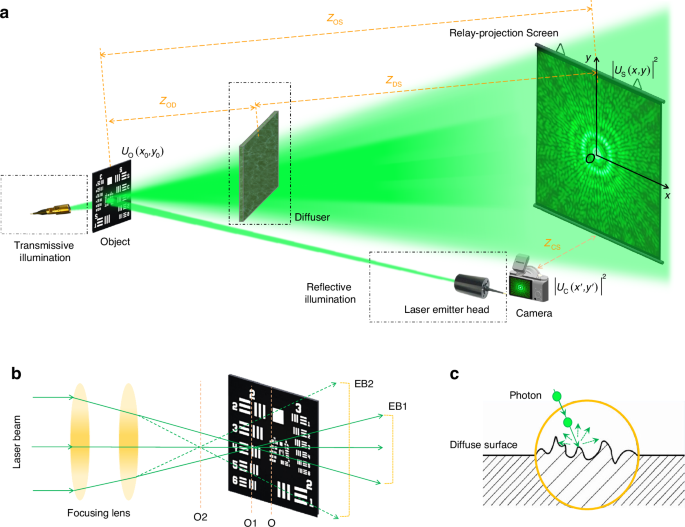
The fundamental trade-off between spatial resolution and imaging distance poses a significant challenge for current imaging techniques, such as those used in modern biomedical diagnosis and remote sensing. Here, we introduce a new conceptual method for imaging dynamic amplitude-phase-mixed objects, termed relay-projection microscopic telescopy (rPMT), which fundamentally challenges conventional light collection techniques by employing non-line-of-sight light collection through square-law relay-projection mechanisms. We successfully resolved tiny features measuring 2.76 μm, 22.10 μm, and 35.08 μm for objects positioned at distances of 1019.0 mm, 26.4 m, and 96.0 m, respectively, from single-shot spatial power spectrum images captured on the relay screen; these results demonstrate that the resolution capabilities of rPMT significantly surpass the Abbe diffraction limit of the 25 mm-aperture camera lens at the respective distances, achieving resolution improvement factors of 7.9, 25.4, and 58.2. The rPMT exhibits long-distance, wide-range, high-resolution imaging capabilities that exceed the diffraction limit of the camera lens and the focusing range limit, even when the objects are obscured by a scattering medium. The rPMT enables telescopic imaging from centimeters to beyond hundreds of meters with micrometer-scale resolution using simple devices, including a laser diode, a portable camera, and a diffusely reflecting whiteboard. Unlike contemporary high-resolution imaging techniques, our method does not require labeling reagents, wavefront modulation, synthetic receive aperture, or ptychography scanning, which significantly reduce the complexity of the imaging system and enhance the application practicality. This method holds particular promise for in-vivo label-free dynamic biomedical microscopic imaging diagnosis and remote surveillance of small objects.




 京公网安备 11010802042870号
京ICP备2023020795号-1
京公网安备 11010802042870号
京ICP备2023020795号-1

 分享
分享
 求助内容:
求助内容: 应助结果提醒方式:
 扫码关注我们
