Mohini Tiwari, Dr. Indranil Lahiri, Dr. Pethaiyan Jeevanandam
{"title":"α-Co(OH)2 中的 Co2+ 配位工程及其转化为 Co3O4 纳米粒子在不对称超级电容器中的应用。","authors":"Mohini Tiwari, Dr. Indranil Lahiri, Dr. Pethaiyan Jeevanandam","doi":"10.1002/cssc.202402033","DOIUrl":null,"url":null,"abstract":"<p>Owing to their unique redox behaviour and structural versatility, cobalt hydroxide/cobalt oxide-based nanomaterials have emerged as promising materials for energy storage. However, the interrelation between coordination environment of Co<sup>2+</sup> and its effect on their electrochemical behaviour remains unexplored. α-Co(OH)₂ contains Co<sup>2+</sup> in octahedral coordination (Co<sup>2+</sup><sub>Oh</sub>). However, careful engineering of Co<sup>2+</sup> coordination to tetrahedral (Co<sup>2+</sup><sub>Td</sub>) can significantly affect the supercapacitive performance. Herein, a simple homogeneous precipitation method is used to achieve this transformation. At low concentration of Co salt (5 mmol), pink-coloured α-Co(OH)₂ nanoflakes (Co(OH)₂-PP) are formed with only Co<sup>2+</sup><sub>Oh</sub>, whereas at higher concentration of cobalt salt (50 mmol), blue colored α-Co(OH)₂ nanorods (Co(OH)₂-BP) are formed with both Co<sup>2+</sup><sub>Oh</sub> and Co<sup>2+</sup><sub>Td</sub>. The maximum specific capacity reached 167.5 C g<sup>−1</sup> for Co(OH)₂-BP which showed ~200 % increment as compared to α-Co(OH)₂-PP at 10 mV s<sup>−1</sup>. The enhancement results from favourable transformation of Co<sup>2+</sup><sub>Td</sub> to electroactive Co<sup>3+</sup> in CoOOH, high surface area (99 m<sup>2</sup> g<sup>−1</sup>) and small crystallite size (23.5 nm) of Co(OH)₂-BP. α-Co(OH)₂ was thermally decomposed to obtain Co<sub>3</sub>O<sub>4</sub> nanoparticles. The specific capacity of Co₃O₄ nanoparticles derived from Co(OH)₂-BP and Co(OH)₂-PP are 136.3 C g<sup>−1</sup> and 110.7 C g<sup>−1</sup>, respectively, the fomer showing only a marginal increase in specific capacity. An asymmetric supercapacitor device based on Co(OH)₂-BP//rGO exhibits peak energy density of 14.6 W h kg<sup>−1</sup> and peak power density of ~12 kW kg<sup>−1</sup>. The insights from this study will significantly impact the development of advanced energy storage materials.</p>","PeriodicalId":149,"journal":{"name":"ChemSusChem","volume":"18 10","pages":""},"PeriodicalIF":6.6000,"publicationDate":"2025-03-07","publicationTypes":"Journal Article","fieldsOfStudy":null,"isOpenAccess":false,"openAccessPdf":"","citationCount":"0","resultStr":"{\"title\":\"Engineering Co2+ Coordination in α-Co(OH)2 and its Conversion to Co3O4 Nanoparticles for Application in Asymmetric Supercapacitors\",\"authors\":\"Mohini Tiwari, Dr. Indranil Lahiri, Dr. Pethaiyan Jeevanandam\",\"doi\":\"10.1002/cssc.202402033\",\"DOIUrl\":null,\"url\":null,\"abstract\":\"<p>Owing to their unique redox behaviour and structural versatility, cobalt hydroxide/cobalt oxide-based nanomaterials have emerged as promising materials for energy storage. However, the interrelation between coordination environment of Co<sup>2+</sup> and its effect on their electrochemical behaviour remains unexplored. α-Co(OH)₂ contains Co<sup>2+</sup> in octahedral coordination (Co<sup>2+</sup><sub>Oh</sub>). However, careful engineering of Co<sup>2+</sup> coordination to tetrahedral (Co<sup>2+</sup><sub>Td</sub>) can significantly affect the supercapacitive performance. Herein, a simple homogeneous precipitation method is used to achieve this transformation. At low concentration of Co salt (5 mmol), pink-coloured α-Co(OH)₂ nanoflakes (Co(OH)₂-PP) are formed with only Co<sup>2+</sup><sub>Oh</sub>, whereas at higher concentration of cobalt salt (50 mmol), blue colored α-Co(OH)₂ nanorods (Co(OH)₂-BP) are formed with both Co<sup>2+</sup><sub>Oh</sub> and Co<sup>2+</sup><sub>Td</sub>. The maximum specific capacity reached 167.5 C g<sup>−1</sup> for Co(OH)₂-BP which showed ~200 % increment as compared to α-Co(OH)₂-PP at 10 mV s<sup>−1</sup>. The enhancement results from favourable transformation of Co<sup>2+</sup><sub>Td</sub> to electroactive Co<sup>3+</sup> in CoOOH, high surface area (99 m<sup>2</sup> g<sup>−1</sup>) and small crystallite size (23.5 nm) of Co(OH)₂-BP. α-Co(OH)₂ was thermally decomposed to obtain Co<sub>3</sub>O<sub>4</sub> nanoparticles. The specific capacity of Co₃O₄ nanoparticles derived from Co(OH)₂-BP and Co(OH)₂-PP are 136.3 C g<sup>−1</sup> and 110.7 C g<sup>−1</sup>, respectively, the fomer showing only a marginal increase in specific capacity. An asymmetric supercapacitor device based on Co(OH)₂-BP//rGO exhibits peak energy density of 14.6 W h kg<sup>−1</sup> and peak power density of ~12 kW kg<sup>−1</sup>. The insights from this study will significantly impact the development of advanced energy storage materials.</p>\",\"PeriodicalId\":149,\"journal\":{\"name\":\"ChemSusChem\",\"volume\":\"18 10\",\"pages\":\"\"},\"PeriodicalIF\":6.6000,\"publicationDate\":\"2025-03-07\",\"publicationTypes\":\"Journal Article\",\"fieldsOfStudy\":null,\"isOpenAccess\":false,\"openAccessPdf\":\"\",\"citationCount\":\"0\",\"resultStr\":null,\"platform\":\"Semanticscholar\",\"paperid\":null,\"PeriodicalName\":\"ChemSusChem\",\"FirstCategoryId\":\"92\",\"ListUrlMain\":\"https://chemistry-europe.onlinelibrary.wiley.com/doi/10.1002/cssc.202402033\",\"RegionNum\":2,\"RegionCategory\":\"化学\",\"ArticlePicture\":[],\"TitleCN\":null,\"AbstractTextCN\":null,\"PMCID\":null,\"EPubDate\":\"\",\"PubModel\":\"\",\"JCR\":\"Q1\",\"JCRName\":\"CHEMISTRY, MULTIDISCIPLINARY\",\"Score\":null,\"Total\":0}","platform":"Semanticscholar","paperid":null,"PeriodicalName":"ChemSusChem","FirstCategoryId":"92","ListUrlMain":"https://chemistry-europe.onlinelibrary.wiley.com/doi/10.1002/cssc.202402033","RegionNum":2,"RegionCategory":"化学","ArticlePicture":[],"TitleCN":null,"AbstractTextCN":null,"PMCID":null,"EPubDate":"","PubModel":"","JCR":"Q1","JCRName":"CHEMISTRY, MULTIDISCIPLINARY","Score":null,"Total":0}
引用次数: 0
摘要
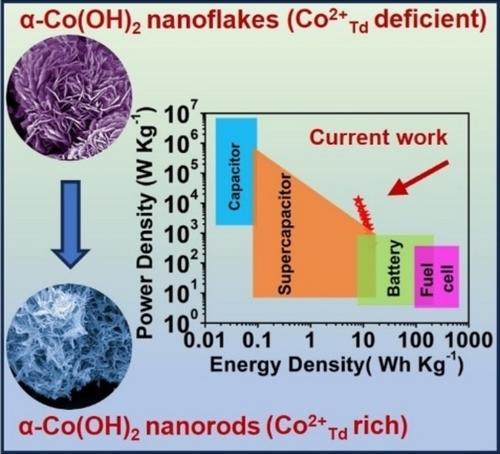
由于其独特的氧化还原性能和结构的通用性,氢氧化钴/氧化钴基纳米材料已成为一种很有前途的储能材料。Co2+配位环境与电化学行为之间的关系尚不清楚。α-Co(OH) 2在八面体配位中含有Co2+ (Co2+ OH)。工程Co2+配位到四面体(Co2+Td)对超级电容性能有显著影响。本文采用一种简单的均匀沉淀法来实现这种转换。在低浓度Co盐(5 mmol)下,仅由Co2+ OH形成粉红色的α-Co(OH) 2纳米片(Co(OH) 2 -PP),而在较高浓度(50 mmol)下,由Co2+ OH和Co2+Td形成蓝色的α-Co(OH) 2纳米棒(Co(OH) 2 -BP)。在10 mV s-1下,Co(OH)₂-BP的最大比容量达到167.5 C g-1,比α-Co(OH)₂-PP增加了约200%。α-Co(OH) 2热分解得到Co3O4纳米颗粒。由Co(OH)₂-BP和Co(OH)₂-PP制备的Co₃O₄纳米颗粒比容量分别为136.3 C g-1和110.7 C g-1,比容量略有提高。基于Co(OH) 2 -BP/rGO的非对称超级电容器器件的峰值能量密度为14.6 W h kg-1,峰值功率密度为~12 kW kg-1。这项研究的见解将对先进储能材料的发展产生重大影响。
Engineering Co2+ Coordination in α-Co(OH)2 and its Conversion to Co3O4 Nanoparticles for Application in Asymmetric Supercapacitors
Owing to their unique redox behaviour and structural versatility, cobalt hydroxide/cobalt oxide-based nanomaterials have emerged as promising materials for energy storage. However, the interrelation between coordination environment of Co2+ and its effect on their electrochemical behaviour remains unexplored. α-Co(OH)₂ contains Co2+ in octahedral coordination (Co2+Oh). However, careful engineering of Co2+ coordination to tetrahedral (Co2+Td) can significantly affect the supercapacitive performance. Herein, a simple homogeneous precipitation method is used to achieve this transformation. At low concentration of Co salt (5 mmol), pink-coloured α-Co(OH)₂ nanoflakes (Co(OH)₂-PP) are formed with only Co2+Oh, whereas at higher concentration of cobalt salt (50 mmol), blue colored α-Co(OH)₂ nanorods (Co(OH)₂-BP) are formed with both Co2+Oh and Co2+Td. The maximum specific capacity reached 167.5 C g−1 for Co(OH)₂-BP which showed ~200 % increment as compared to α-Co(OH)₂-PP at 10 mV s−1. The enhancement results from favourable transformation of Co2+Td to electroactive Co3+ in CoOOH, high surface area (99 m2 g−1) and small crystallite size (23.5 nm) of Co(OH)₂-BP. α-Co(OH)₂ was thermally decomposed to obtain Co3O4 nanoparticles. The specific capacity of Co₃O₄ nanoparticles derived from Co(OH)₂-BP and Co(OH)₂-PP are 136.3 C g−1 and 110.7 C g−1, respectively, the fomer showing only a marginal increase in specific capacity. An asymmetric supercapacitor device based on Co(OH)₂-BP//rGO exhibits peak energy density of 14.6 W h kg−1 and peak power density of ~12 kW kg−1. The insights from this study will significantly impact the development of advanced energy storage materials.
期刊介绍:
ChemSusChem
Impact Factor (2016): 7.226
Scope:
Interdisciplinary journal
Focuses on research at the interface of chemistry and sustainability
Features the best research on sustainability and energy
Areas Covered:
Chemistry
Materials Science
Chemical Engineering
Biotechnology






 京公网安备 11010802042870号
京ICP备2023020795号-1
京公网安备 11010802042870号
京ICP备2023020795号-1

 分享
分享
 求助内容:
求助内容: 应助结果提醒方式:
 扫码关注我们
