Guo-Qing Gong, Cheng-Cheng Huang, Hui-Yu Jin, Zhao Zhang, Chang-Liang Yang, Guang Yang, Hui-Fang Lu, Yue-Bin Yang, Jing-Yuan Cao, Rui-Yao Chen, Li-Wang, Yi-Ming Ji, Yi Sun, Yu Lu
{"title":"KCNQ4基因突变(c.701A > G;p.His234Arg)中国非综合征性耳聋家庭研究[j]。","authors":"Guo-Qing Gong, Cheng-Cheng Huang, Hui-Yu Jin, Zhao Zhang, Chang-Liang Yang, Guang Yang, Hui-Fang Lu, Yue-Bin Yang, Jing-Yuan Cao, Rui-Yao Chen, Li-Wang, Yi-Ming Ji, Yi Sun, Yu Lu","doi":"10.1002/mgg3.70075","DOIUrl":null,"url":null,"abstract":"<p><strong>Background: </strong>KCNQ4 is a common genetic cause of nonsyndromic autosomal dominant hearing loss. We have identified the family in China with a KCNQ4 (c.701A>G; p.His234Arg) missense variation. In this study, a survey and analysis were performed to investigate the audiological and genetic characteristics of the Chinese family.</p><p><strong>Methods: </strong>The medical history of family members was collected, and the family members underwent pure tone audiometry, acoustic immittance, and physical examination. The proband was additionally examined by ABR (auditory brainstem response) and DPOAE (distortion product otoacoustic emission). DNA samples from family members were collected, and the possible causative gene of the proband was detected by whole-exome sequencing (WES), which was verified by Sanger sequencing in family members.</p><p><strong>Results: </strong>The inheritance pattern of the family was an autosomal dominant nonsyndromic type. The hearing loss was characterized by postlingual deafness, high-frequency hearing loss in the early stage, gradually involving the full frequency. About 32-40 years of age, the hearing gradually became stable, the decline rate slowed down, and the final degree of hearing loss was severe. WES results showed that the KCNQ4 gene had a missense variation (c.701A>G; p.His234Arg).</p><p><strong>Conclusion: </strong>This family has autosomal dominant nonsyndromic hereditary hearing loss caused by a variation in the KCNQ4 gene, characterized by high-frequency hearing loss.</p>","PeriodicalId":18852,"journal":{"name":"Molecular Genetics & Genomic Medicine","volume":"13 3","pages":"e70075"},"PeriodicalIF":1.6000,"publicationDate":"2025-03-01","publicationTypes":"Journal Article","fieldsOfStudy":null,"isOpenAccess":false,"openAccessPdf":"https://www.ncbi.nlm.nih.gov/pmc/articles/PMC11886983/pdf/","citationCount":"0","resultStr":"{\"title\":\"A KCNQ4 Gene Variant (c.701A > G; p.His234Arg) in a Chinese Family With Nonsyndromic Deafness 2A.\",\"authors\":\"Guo-Qing Gong, Cheng-Cheng Huang, Hui-Yu Jin, Zhao Zhang, Chang-Liang Yang, Guang Yang, Hui-Fang Lu, Yue-Bin Yang, Jing-Yuan Cao, Rui-Yao Chen, Li-Wang, Yi-Ming Ji, Yi Sun, Yu Lu\",\"doi\":\"10.1002/mgg3.70075\",\"DOIUrl\":null,\"url\":null,\"abstract\":\"<p><strong>Background: </strong>KCNQ4 is a common genetic cause of nonsyndromic autosomal dominant hearing loss. We have identified the family in China with a KCNQ4 (c.701A>G; p.His234Arg) missense variation. In this study, a survey and analysis were performed to investigate the audiological and genetic characteristics of the Chinese family.</p><p><strong>Methods: </strong>The medical history of family members was collected, and the family members underwent pure tone audiometry, acoustic immittance, and physical examination. The proband was additionally examined by ABR (auditory brainstem response) and DPOAE (distortion product otoacoustic emission). DNA samples from family members were collected, and the possible causative gene of the proband was detected by whole-exome sequencing (WES), which was verified by Sanger sequencing in family members.</p><p><strong>Results: </strong>The inheritance pattern of the family was an autosomal dominant nonsyndromic type. The hearing loss was characterized by postlingual deafness, high-frequency hearing loss in the early stage, gradually involving the full frequency. About 32-40 years of age, the hearing gradually became stable, the decline rate slowed down, and the final degree of hearing loss was severe. WES results showed that the KCNQ4 gene had a missense variation (c.701A>G; p.His234Arg).</p><p><strong>Conclusion: </strong>This family has autosomal dominant nonsyndromic hereditary hearing loss caused by a variation in the KCNQ4 gene, characterized by high-frequency hearing loss.</p>\",\"PeriodicalId\":18852,\"journal\":{\"name\":\"Molecular Genetics & Genomic Medicine\",\"volume\":\"13 3\",\"pages\":\"e70075\"},\"PeriodicalIF\":1.6000,\"publicationDate\":\"2025-03-01\",\"publicationTypes\":\"Journal Article\",\"fieldsOfStudy\":null,\"isOpenAccess\":false,\"openAccessPdf\":\"https://www.ncbi.nlm.nih.gov/pmc/articles/PMC11886983/pdf/\",\"citationCount\":\"0\",\"resultStr\":null,\"platform\":\"Semanticscholar\",\"paperid\":null,\"PeriodicalName\":\"Molecular Genetics & Genomic Medicine\",\"FirstCategoryId\":\"3\",\"ListUrlMain\":\"https://doi.org/10.1002/mgg3.70075\",\"RegionNum\":4,\"RegionCategory\":\"医学\",\"ArticlePicture\":[],\"TitleCN\":null,\"AbstractTextCN\":null,\"PMCID\":null,\"EPubDate\":\"\",\"PubModel\":\"\",\"JCR\":\"Q4\",\"JCRName\":\"GENETICS & HEREDITY\",\"Score\":null,\"Total\":0}","platform":"Semanticscholar","paperid":null,"PeriodicalName":"Molecular Genetics & Genomic Medicine","FirstCategoryId":"3","ListUrlMain":"https://doi.org/10.1002/mgg3.70075","RegionNum":4,"RegionCategory":"医学","ArticlePicture":[],"TitleCN":null,"AbstractTextCN":null,"PMCID":null,"EPubDate":"","PubModel":"","JCR":"Q4","JCRName":"GENETICS & HEREDITY","Score":null,"Total":0}
A KCNQ4 Gene Variant (c.701A > G; p.His234Arg) in a Chinese Family With Nonsyndromic Deafness 2A.
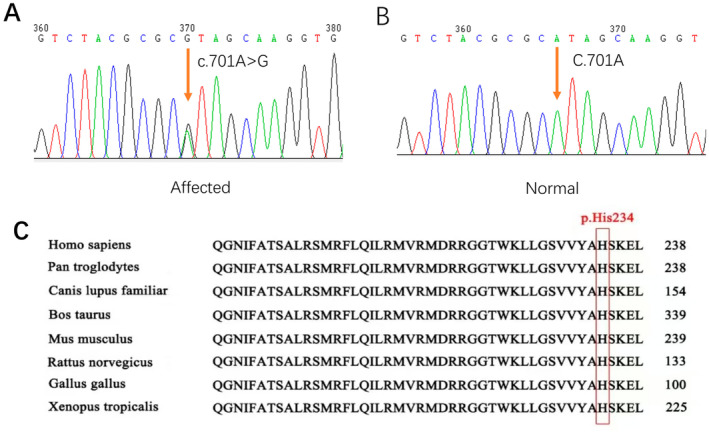
Background: KCNQ4 is a common genetic cause of nonsyndromic autosomal dominant hearing loss. We have identified the family in China with a KCNQ4 (c.701A>G; p.His234Arg) missense variation. In this study, a survey and analysis were performed to investigate the audiological and genetic characteristics of the Chinese family.
Methods: The medical history of family members was collected, and the family members underwent pure tone audiometry, acoustic immittance, and physical examination. The proband was additionally examined by ABR (auditory brainstem response) and DPOAE (distortion product otoacoustic emission). DNA samples from family members were collected, and the possible causative gene of the proband was detected by whole-exome sequencing (WES), which was verified by Sanger sequencing in family members.
Results: The inheritance pattern of the family was an autosomal dominant nonsyndromic type. The hearing loss was characterized by postlingual deafness, high-frequency hearing loss in the early stage, gradually involving the full frequency. About 32-40 years of age, the hearing gradually became stable, the decline rate slowed down, and the final degree of hearing loss was severe. WES results showed that the KCNQ4 gene had a missense variation (c.701A>G; p.His234Arg).
Conclusion: This family has autosomal dominant nonsyndromic hereditary hearing loss caused by a variation in the KCNQ4 gene, characterized by high-frequency hearing loss.
期刊介绍:
Molecular Genetics & Genomic Medicine is a peer-reviewed journal for rapid dissemination of quality research related to the dynamically developing areas of human, molecular and medical genetics. The journal publishes original research articles covering findings in phenotypic, molecular, biological, and genomic aspects of genomic variation, inherited disorders and birth defects. The broad publishing spectrum of Molecular Genetics & Genomic Medicine includes rare and common disorders from diagnosis to treatment. Examples of appropriate articles include reports of novel disease genes, functional studies of genetic variants, in-depth genotype-phenotype studies, genomic analysis of inherited disorders, molecular diagnostic methods, medical bioinformatics, ethical, legal, and social implications (ELSI), and approaches to clinical diagnosis. Molecular Genetics & Genomic Medicine provides a scientific home for next generation sequencing studies of rare and common disorders, which will make research in this fascinating area easily and rapidly accessible to the scientific community. This will serve as the basis for translating next generation sequencing studies into individualized diagnostics and therapeutics, for day-to-day medical care.
Molecular Genetics & Genomic Medicine publishes original research articles, reviews, and research methods papers, along with invited editorials and commentaries. Original research papers must report well-conducted research with conclusions supported by the data presented.






 京公网安备 11010802042870号
京ICP备2023020795号-1
京公网安备 11010802042870号
京ICP备2023020795号-1

 分享
分享
 求助内容:
求助内容: 应助结果提醒方式:
 扫码关注我们
