Jingru Su , Hong Wang , Dingsheng Luo , Yalei Yang , Shilong Ma , Penghui Wu , Xinyang Wang
{"title":"基于机器学习模型的内蒙古温带典型草原放牧强度估算","authors":"Jingru Su , Hong Wang , Dingsheng Luo , Yalei Yang , Shilong Ma , Penghui Wu , Xinyang Wang","doi":"10.1016/j.ecolind.2025.113318","DOIUrl":null,"url":null,"abstract":"<div><div>Grasslands are essential components of terrestrial ecosystems and provide a broad range of biodiversity and ecosystem services for humans. Grasslands have been degraded to varying degrees owing to overgrazing. A scientific understanding of grazing intensity (GI) is essential for the continuous development of meadow ecosystems. This study aimed to estimate the GI of temperate typical grasslands in Inner Mongolia using machine learning algorithms. We used the extreme gradient boosting (XGBoost), random forest (RF), mogrifier long short term memory (MogLSTM), and batch attention module MogLSTM Kolmogorov–Arnold network (BMogLSTM-KAN) models improved by MogLSTM, modeled using field-measured GI and GI influencing factors. The GI impact factors included the aboveground biomass (AGB), normalized difference vegetation index (NDVI), enhanced vegetation index (EVI), digital elevation model (DEM), slope, aspect, monthly mean temperature and precipitation, distance to river (DTR), and distance to settlement (DTS). The results indicated that all four machine learning algorithms performed effectively in estimating the steppe GI, with determination coefficients (R<sup>2</sup>) exceeding 0.84. The BMogLSTM-KAN model demonstrated the highest performance, with an R<sup>2</sup> of 0.93, and a root mean square error (RMSE) of 0.68, indicating its high accuracy and stability in estimating the steppe GI. In addition, the GI spatial distribution map revealed that the GI of temperate typical grasslands in Inner Mongolia was low in the northeast and high in the southwest. These results offer a significant reference for the scientific protection and sustainable management of temperate typical grasslands in Inner Mongolia.</div></div>","PeriodicalId":11459,"journal":{"name":"Ecological Indicators","volume":"172 ","pages":"Article 113318"},"PeriodicalIF":7.0000,"publicationDate":"2025-03-01","publicationTypes":"Journal Article","fieldsOfStudy":null,"isOpenAccess":false,"openAccessPdf":"","citationCount":"0","resultStr":"{\"title\":\"Grazing intensity estimation in temperate typical grasslands of Inner Mongolia using machine learning models\",\"authors\":\"Jingru Su , Hong Wang , Dingsheng Luo , Yalei Yang , Shilong Ma , Penghui Wu , Xinyang Wang\",\"doi\":\"10.1016/j.ecolind.2025.113318\",\"DOIUrl\":null,\"url\":null,\"abstract\":\"<div><div>Grasslands are essential components of terrestrial ecosystems and provide a broad range of biodiversity and ecosystem services for humans. Grasslands have been degraded to varying degrees owing to overgrazing. A scientific understanding of grazing intensity (GI) is essential for the continuous development of meadow ecosystems. This study aimed to estimate the GI of temperate typical grasslands in Inner Mongolia using machine learning algorithms. We used the extreme gradient boosting (XGBoost), random forest (RF), mogrifier long short term memory (MogLSTM), and batch attention module MogLSTM Kolmogorov–Arnold network (BMogLSTM-KAN) models improved by MogLSTM, modeled using field-measured GI and GI influencing factors. The GI impact factors included the aboveground biomass (AGB), normalized difference vegetation index (NDVI), enhanced vegetation index (EVI), digital elevation model (DEM), slope, aspect, monthly mean temperature and precipitation, distance to river (DTR), and distance to settlement (DTS). The results indicated that all four machine learning algorithms performed effectively in estimating the steppe GI, with determination coefficients (R<sup>2</sup>) exceeding 0.84. The BMogLSTM-KAN model demonstrated the highest performance, with an R<sup>2</sup> of 0.93, and a root mean square error (RMSE) of 0.68, indicating its high accuracy and stability in estimating the steppe GI. In addition, the GI spatial distribution map revealed that the GI of temperate typical grasslands in Inner Mongolia was low in the northeast and high in the southwest. These results offer a significant reference for the scientific protection and sustainable management of temperate typical grasslands in Inner Mongolia.</div></div>\",\"PeriodicalId\":11459,\"journal\":{\"name\":\"Ecological Indicators\",\"volume\":\"172 \",\"pages\":\"Article 113318\"},\"PeriodicalIF\":7.0000,\"publicationDate\":\"2025-03-01\",\"publicationTypes\":\"Journal Article\",\"fieldsOfStudy\":null,\"isOpenAccess\":false,\"openAccessPdf\":\"\",\"citationCount\":\"0\",\"resultStr\":null,\"platform\":\"Semanticscholar\",\"paperid\":null,\"PeriodicalName\":\"Ecological Indicators\",\"FirstCategoryId\":\"93\",\"ListUrlMain\":\"https://www.sciencedirect.com/science/article/pii/S1470160X25002493\",\"RegionNum\":2,\"RegionCategory\":\"环境科学与生态学\",\"ArticlePicture\":[],\"TitleCN\":null,\"AbstractTextCN\":null,\"PMCID\":null,\"EPubDate\":\"2025/3/9 0:00:00\",\"PubModel\":\"Epub\",\"JCR\":\"Q1\",\"JCRName\":\"ENVIRONMENTAL SCIENCES\",\"Score\":null,\"Total\":0}","platform":"Semanticscholar","paperid":null,"PeriodicalName":"Ecological Indicators","FirstCategoryId":"93","ListUrlMain":"https://www.sciencedirect.com/science/article/pii/S1470160X25002493","RegionNum":2,"RegionCategory":"环境科学与生态学","ArticlePicture":[],"TitleCN":null,"AbstractTextCN":null,"PMCID":null,"EPubDate":"2025/3/9 0:00:00","PubModel":"Epub","JCR":"Q1","JCRName":"ENVIRONMENTAL SCIENCES","Score":null,"Total":0}
Grazing intensity estimation in temperate typical grasslands of Inner Mongolia using machine learning models
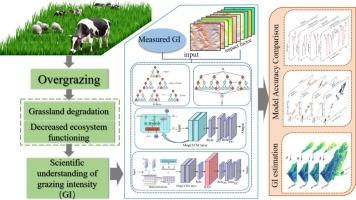
Grasslands are essential components of terrestrial ecosystems and provide a broad range of biodiversity and ecosystem services for humans. Grasslands have been degraded to varying degrees owing to overgrazing. A scientific understanding of grazing intensity (GI) is essential for the continuous development of meadow ecosystems. This study aimed to estimate the GI of temperate typical grasslands in Inner Mongolia using machine learning algorithms. We used the extreme gradient boosting (XGBoost), random forest (RF), mogrifier long short term memory (MogLSTM), and batch attention module MogLSTM Kolmogorov–Arnold network (BMogLSTM-KAN) models improved by MogLSTM, modeled using field-measured GI and GI influencing factors. The GI impact factors included the aboveground biomass (AGB), normalized difference vegetation index (NDVI), enhanced vegetation index (EVI), digital elevation model (DEM), slope, aspect, monthly mean temperature and precipitation, distance to river (DTR), and distance to settlement (DTS). The results indicated that all four machine learning algorithms performed effectively in estimating the steppe GI, with determination coefficients (R2) exceeding 0.84. The BMogLSTM-KAN model demonstrated the highest performance, with an R2 of 0.93, and a root mean square error (RMSE) of 0.68, indicating its high accuracy and stability in estimating the steppe GI. In addition, the GI spatial distribution map revealed that the GI of temperate typical grasslands in Inner Mongolia was low in the northeast and high in the southwest. These results offer a significant reference for the scientific protection and sustainable management of temperate typical grasslands in Inner Mongolia.
期刊介绍:
The ultimate aim of Ecological Indicators is to integrate the monitoring and assessment of ecological and environmental indicators with management practices. The journal provides a forum for the discussion of the applied scientific development and review of traditional indicator approaches as well as for theoretical, modelling and quantitative applications such as index development. Research into the following areas will be published.
• All aspects of ecological and environmental indicators and indices.
• New indicators, and new approaches and methods for indicator development, testing and use.
• Development and modelling of indices, e.g. application of indicator suites across multiple scales and resources.
• Analysis and research of resource, system- and scale-specific indicators.
• Methods for integration of social and other valuation metrics for the production of scientifically rigorous and politically-relevant assessments using indicator-based monitoring and assessment programs.
• How research indicators can be transformed into direct application for management purposes.
• Broader assessment objectives and methods, e.g. biodiversity, biological integrity, and sustainability, through the use of indicators.
• Resource-specific indicators such as landscape, agroecosystems, forests, wetlands, etc.




 京公网安备 11010802042870号
京ICP备2023020795号-1
京公网安备 11010802042870号
京ICP备2023020795号-1

 分享
分享
 求助内容:
求助内容: 应助结果提醒方式:
 扫码关注我们
