{"title":"用图像减法揭示哈特曼管内尘埃颗粒的湍流","authors":"Luca Marmo , Olivier Dufaud , Fausto Franchini , Enrico Danzi","doi":"10.1016/j.powtec.2025.120871","DOIUrl":null,"url":null,"abstract":"<div><div>The present work investigates the dynamics of dust clouds in space and time when dispersed inside the modified Hartmann tube commonly used for explosibility screening and Minimum Ignition Energy (MIE) measurement. This study focuses on the fluid dynamics of the dust cloud in the space between the electrodes where the ignition occurs since fundamental properties of the dust motion, such as the cloud turbulence (intensity and variation), are known to affect both the ignition sensitivity and explosion severity significantly. An imaging re-elaboration method based on an algorithm (Image-Subtraction Method, ISM) is presented and adopted in the basics of the present research. To clarify the cloud dynamics, a novel approach is proposed here, using LabVIEW® specific algorithms, namely Particle Analysis and optical flow detection methods, which allow the tracking of the motion and the velocity vectors of dust clusters identified in the cloud flow. Concurrently, measuring the intensity of concentration changes between the electrodes (luminance change of the video frames in time and space) and cloud velocity, which likely represents the turbulence, is possible. Different types of dust (iron, starch, silica) were used at different dispersion conditions (dispersion pressure and dust amount). The cloud motion was recorded, and videos were analyzed through LabVIEW® to explore the parameters affecting dust turbulence (powder-specific gravity, particle size distribution, and air blast intensity). The outcomes of this work will help characterize the flow of a dust cloud inside a tube before its ignition and better define the optimal testing conditions for MIE determination.</div></div>","PeriodicalId":407,"journal":{"name":"Powder Technology","volume":"457 ","pages":"Article 120871"},"PeriodicalIF":4.6000,"publicationDate":"2025-05-15","publicationTypes":"Journal Article","fieldsOfStudy":null,"isOpenAccess":false,"openAccessPdf":"","citationCount":"0","resultStr":"{\"title\":\"Uncovering turbulence of dust particles in the Hartmann tube through the Image-Subtraction Method\",\"authors\":\"Luca Marmo , Olivier Dufaud , Fausto Franchini , Enrico Danzi\",\"doi\":\"10.1016/j.powtec.2025.120871\",\"DOIUrl\":null,\"url\":null,\"abstract\":\"<div><div>The present work investigates the dynamics of dust clouds in space and time when dispersed inside the modified Hartmann tube commonly used for explosibility screening and Minimum Ignition Energy (MIE) measurement. This study focuses on the fluid dynamics of the dust cloud in the space between the electrodes where the ignition occurs since fundamental properties of the dust motion, such as the cloud turbulence (intensity and variation), are known to affect both the ignition sensitivity and explosion severity significantly. An imaging re-elaboration method based on an algorithm (Image-Subtraction Method, ISM) is presented and adopted in the basics of the present research. To clarify the cloud dynamics, a novel approach is proposed here, using LabVIEW® specific algorithms, namely Particle Analysis and optical flow detection methods, which allow the tracking of the motion and the velocity vectors of dust clusters identified in the cloud flow. Concurrently, measuring the intensity of concentration changes between the electrodes (luminance change of the video frames in time and space) and cloud velocity, which likely represents the turbulence, is possible. Different types of dust (iron, starch, silica) were used at different dispersion conditions (dispersion pressure and dust amount). The cloud motion was recorded, and videos were analyzed through LabVIEW® to explore the parameters affecting dust turbulence (powder-specific gravity, particle size distribution, and air blast intensity). The outcomes of this work will help characterize the flow of a dust cloud inside a tube before its ignition and better define the optimal testing conditions for MIE determination.</div></div>\",\"PeriodicalId\":407,\"journal\":{\"name\":\"Powder Technology\",\"volume\":\"457 \",\"pages\":\"Article 120871\"},\"PeriodicalIF\":4.6000,\"publicationDate\":\"2025-05-15\",\"publicationTypes\":\"Journal Article\",\"fieldsOfStudy\":null,\"isOpenAccess\":false,\"openAccessPdf\":\"\",\"citationCount\":\"0\",\"resultStr\":null,\"platform\":\"Semanticscholar\",\"paperid\":null,\"PeriodicalName\":\"Powder Technology\",\"FirstCategoryId\":\"5\",\"ListUrlMain\":\"https://www.sciencedirect.com/science/article/pii/S0032591025002669\",\"RegionNum\":2,\"RegionCategory\":\"工程技术\",\"ArticlePicture\":[],\"TitleCN\":null,\"AbstractTextCN\":null,\"PMCID\":null,\"EPubDate\":\"2025/3/1 0:00:00\",\"PubModel\":\"Epub\",\"JCR\":\"Q2\",\"JCRName\":\"ENGINEERING, CHEMICAL\",\"Score\":null,\"Total\":0}","platform":"Semanticscholar","paperid":null,"PeriodicalName":"Powder Technology","FirstCategoryId":"5","ListUrlMain":"https://www.sciencedirect.com/science/article/pii/S0032591025002669","RegionNum":2,"RegionCategory":"工程技术","ArticlePicture":[],"TitleCN":null,"AbstractTextCN":null,"PMCID":null,"EPubDate":"2025/3/1 0:00:00","PubModel":"Epub","JCR":"Q2","JCRName":"ENGINEERING, CHEMICAL","Score":null,"Total":0}
Uncovering turbulence of dust particles in the Hartmann tube through the Image-Subtraction Method
The present work investigates the dynamics of dust clouds in space and time when dispersed inside the modified Hartmann tube commonly used for explosibility screening and Minimum Ignition Energy (MIE) measurement. This study focuses on the fluid dynamics of the dust cloud in the space between the electrodes where the ignition occurs since fundamental properties of the dust motion, such as the cloud turbulence (intensity and variation), are known to affect both the ignition sensitivity and explosion severity significantly. An imaging re-elaboration method based on an algorithm (Image-Subtraction Method, ISM) is presented and adopted in the basics of the present research. To clarify the cloud dynamics, a novel approach is proposed here, using LabVIEW® specific algorithms, namely Particle Analysis and optical flow detection methods, which allow the tracking of the motion and the velocity vectors of dust clusters identified in the cloud flow. Concurrently, measuring the intensity of concentration changes between the electrodes (luminance change of the video frames in time and space) and cloud velocity, which likely represents the turbulence, is possible. Different types of dust (iron, starch, silica) were used at different dispersion conditions (dispersion pressure and dust amount). The cloud motion was recorded, and videos were analyzed through LabVIEW® to explore the parameters affecting dust turbulence (powder-specific gravity, particle size distribution, and air blast intensity). The outcomes of this work will help characterize the flow of a dust cloud inside a tube before its ignition and better define the optimal testing conditions for MIE determination.
期刊介绍:
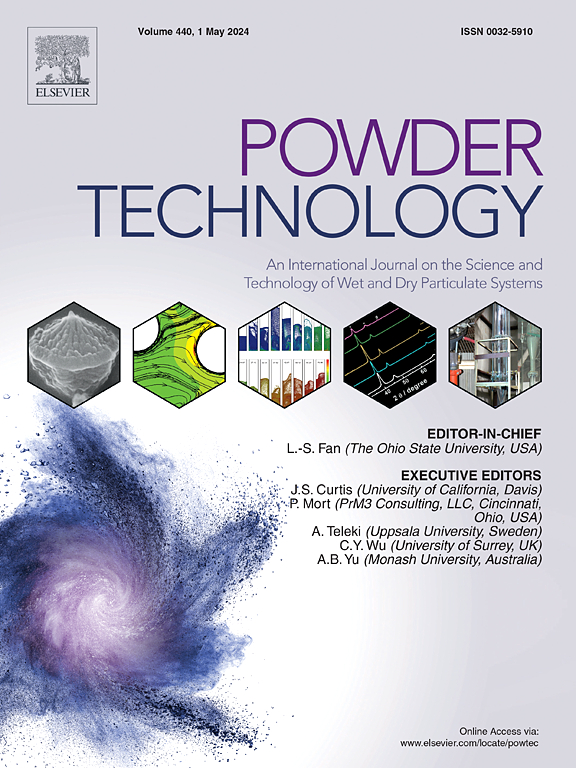
Powder Technology is an International Journal on the Science and Technology of Wet and Dry Particulate Systems. Powder Technology publishes papers on all aspects of the formation of particles and their characterisation and on the study of systems containing particulate solids. No limitation is imposed on the size of the particles, which may range from nanometre scale, as in pigments or aerosols, to that of mined or quarried materials. The following list of topics is not intended to be comprehensive, but rather to indicate typical subjects which fall within the scope of the journal's interests:
Formation and synthesis of particles by precipitation and other methods.
Modification of particles by agglomeration, coating, comminution and attrition.
Characterisation of the size, shape, surface area, pore structure and strength of particles and agglomerates (including the origins and effects of inter particle forces).
Packing, failure, flow and permeability of assemblies of particles.
Particle-particle interactions and suspension rheology.
Handling and processing operations such as slurry flow, fluidization, pneumatic conveying.
Interactions between particles and their environment, including delivery of particulate products to the body.
Applications of particle technology in production of pharmaceuticals, chemicals, foods, pigments, structural, and functional materials and in environmental and energy related matters.
For materials-oriented contributions we are looking for articles revealing the effect of particle/powder characteristics (size, morphology and composition, in that order) on material performance or functionality and, ideally, comparison to any industrial standard.





 京公网安备 11010802042870号
京ICP备2023020795号-1
京公网安备 11010802042870号
京ICP备2023020795号-1

 分享
分享
 求助内容:
求助内容: 应助结果提醒方式:
 扫码关注我们
