{"title":"稳定巯基功能化磁性纳米颗粒的制备及其对环境水中砷(III)的磁固相萃取作用","authors":"Mianzhi Wang, Man He, Beibei Chen, Bin Hu","doi":"10.1016/j.microc.2025.113268","DOIUrl":null,"url":null,"abstract":"<div><div>Thiol-based materials exhibit good adsorption properties for sulfophilic elements, such as As(III). However, these materials are prone to oxidation in air, leading to poor storage stability, which limits their practical application. To address this problem, using cystamine dihydrochloride (CA) as the functional reagent and glycidyl methacrylate (GMA) modified magnetic nanoparticles (MNPs) as the core, MNPs of Fe<sub>3</sub>O<sub>4</sub>@SiO<sub>2</sub>@GMA-CA was synthesized via an amino-epoxy click chemistry reaction, and the thiol-functionalized MNPs of Fe<sub>3</sub>O<sub>4</sub>@SiO<sub>2</sub>@GMA-CA-SH was obtained after breaking the disulfide bond of CA. The material exhibits great storage stability when preserved in the form of Fe<sub>3</sub>O<sub>4</sub>@SiO<sub>2</sub>@GMA-CA, and the Fe<sub>3</sub>O<sub>4</sub>@SiO<sub>2</sub>@GMA-CA-SH possesses strong magnetism and high adsorption selectivity for As(III). With the use of Fe<sub>3</sub>O<sub>4</sub>@SiO<sub>2</sub>@GMA-CA-SH as the adsorbent, a new method of magnetic solid phase extraction (MSPE) combined with inductively coupled plasma optical emission spectrometry (ICP-OES) was established for the speciation analysis of As(III) and As(V) in environmental water samples. Various experimental parameters affecting the MSPE have been optimized. Under the optimal conditions, the limit of detection (LOD) of the developed MSPE-ICP-OES method was 0.050 μg L<sup>−1</sup>, the relative standard deviation was 2.8 %, and the enrichment factor was 150-fold. The accuracy of the method was validated through the analysis of the Certified Reference Materials of GBW08666 and GBW08667. The established method was successfully applied to the speciation analysis of inorganic arsenic in potential arsenic-contaminated environmental water samples, demonstrating a great application potential in real-world sample analysis.</div></div>","PeriodicalId":391,"journal":{"name":"Microchemical Journal","volume":"212 ","pages":"Article 113268"},"PeriodicalIF":4.9000,"publicationDate":"2025-05-01","publicationTypes":"Journal Article","fieldsOfStudy":null,"isOpenAccess":false,"openAccessPdf":"","citationCount":"0","resultStr":"{\"title\":\"Preparation of stable thiol-functionalized magnetic nanoparticles for magnetic solid phase extraction of As(III) in environmental waters\",\"authors\":\"Mianzhi Wang, Man He, Beibei Chen, Bin Hu\",\"doi\":\"10.1016/j.microc.2025.113268\",\"DOIUrl\":null,\"url\":null,\"abstract\":\"<div><div>Thiol-based materials exhibit good adsorption properties for sulfophilic elements, such as As(III). However, these materials are prone to oxidation in air, leading to poor storage stability, which limits their practical application. To address this problem, using cystamine dihydrochloride (CA) as the functional reagent and glycidyl methacrylate (GMA) modified magnetic nanoparticles (MNPs) as the core, MNPs of Fe<sub>3</sub>O<sub>4</sub>@SiO<sub>2</sub>@GMA-CA was synthesized via an amino-epoxy click chemistry reaction, and the thiol-functionalized MNPs of Fe<sub>3</sub>O<sub>4</sub>@SiO<sub>2</sub>@GMA-CA-SH was obtained after breaking the disulfide bond of CA. The material exhibits great storage stability when preserved in the form of Fe<sub>3</sub>O<sub>4</sub>@SiO<sub>2</sub>@GMA-CA, and the Fe<sub>3</sub>O<sub>4</sub>@SiO<sub>2</sub>@GMA-CA-SH possesses strong magnetism and high adsorption selectivity for As(III). With the use of Fe<sub>3</sub>O<sub>4</sub>@SiO<sub>2</sub>@GMA-CA-SH as the adsorbent, a new method of magnetic solid phase extraction (MSPE) combined with inductively coupled plasma optical emission spectrometry (ICP-OES) was established for the speciation analysis of As(III) and As(V) in environmental water samples. Various experimental parameters affecting the MSPE have been optimized. Under the optimal conditions, the limit of detection (LOD) of the developed MSPE-ICP-OES method was 0.050 μg L<sup>−1</sup>, the relative standard deviation was 2.8 %, and the enrichment factor was 150-fold. The accuracy of the method was validated through the analysis of the Certified Reference Materials of GBW08666 and GBW08667. The established method was successfully applied to the speciation analysis of inorganic arsenic in potential arsenic-contaminated environmental water samples, demonstrating a great application potential in real-world sample analysis.</div></div>\",\"PeriodicalId\":391,\"journal\":{\"name\":\"Microchemical Journal\",\"volume\":\"212 \",\"pages\":\"Article 113268\"},\"PeriodicalIF\":4.9000,\"publicationDate\":\"2025-05-01\",\"publicationTypes\":\"Journal Article\",\"fieldsOfStudy\":null,\"isOpenAccess\":false,\"openAccessPdf\":\"\",\"citationCount\":\"0\",\"resultStr\":null,\"platform\":\"Semanticscholar\",\"paperid\":null,\"PeriodicalName\":\"Microchemical Journal\",\"FirstCategoryId\":\"92\",\"ListUrlMain\":\"https://www.sciencedirect.com/science/article/pii/S0026265X2500623X\",\"RegionNum\":2,\"RegionCategory\":\"化学\",\"ArticlePicture\":[],\"TitleCN\":null,\"AbstractTextCN\":null,\"PMCID\":null,\"EPubDate\":\"2025/3/6 0:00:00\",\"PubModel\":\"Epub\",\"JCR\":\"Q1\",\"JCRName\":\"CHEMISTRY, ANALYTICAL\",\"Score\":null,\"Total\":0}","platform":"Semanticscholar","paperid":null,"PeriodicalName":"Microchemical Journal","FirstCategoryId":"92","ListUrlMain":"https://www.sciencedirect.com/science/article/pii/S0026265X2500623X","RegionNum":2,"RegionCategory":"化学","ArticlePicture":[],"TitleCN":null,"AbstractTextCN":null,"PMCID":null,"EPubDate":"2025/3/6 0:00:00","PubModel":"Epub","JCR":"Q1","JCRName":"CHEMISTRY, ANALYTICAL","Score":null,"Total":0}
Preparation of stable thiol-functionalized magnetic nanoparticles for magnetic solid phase extraction of As(III) in environmental waters
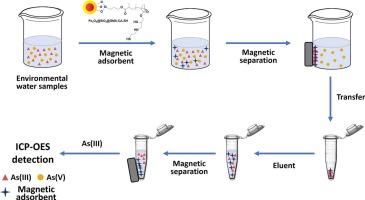
Thiol-based materials exhibit good adsorption properties for sulfophilic elements, such as As(III). However, these materials are prone to oxidation in air, leading to poor storage stability, which limits their practical application. To address this problem, using cystamine dihydrochloride (CA) as the functional reagent and glycidyl methacrylate (GMA) modified magnetic nanoparticles (MNPs) as the core, MNPs of Fe3O4@SiO2@GMA-CA was synthesized via an amino-epoxy click chemistry reaction, and the thiol-functionalized MNPs of Fe3O4@SiO2@GMA-CA-SH was obtained after breaking the disulfide bond of CA. The material exhibits great storage stability when preserved in the form of Fe3O4@SiO2@GMA-CA, and the Fe3O4@SiO2@GMA-CA-SH possesses strong magnetism and high adsorption selectivity for As(III). With the use of Fe3O4@SiO2@GMA-CA-SH as the adsorbent, a new method of magnetic solid phase extraction (MSPE) combined with inductively coupled plasma optical emission spectrometry (ICP-OES) was established for the speciation analysis of As(III) and As(V) in environmental water samples. Various experimental parameters affecting the MSPE have been optimized. Under the optimal conditions, the limit of detection (LOD) of the developed MSPE-ICP-OES method was 0.050 μg L−1, the relative standard deviation was 2.8 %, and the enrichment factor was 150-fold. The accuracy of the method was validated through the analysis of the Certified Reference Materials of GBW08666 and GBW08667. The established method was successfully applied to the speciation analysis of inorganic arsenic in potential arsenic-contaminated environmental water samples, demonstrating a great application potential in real-world sample analysis.
期刊介绍:
The Microchemical Journal is a peer reviewed journal devoted to all aspects and phases of analytical chemistry and chemical analysis. The Microchemical Journal publishes articles which are at the forefront of modern analytical chemistry and cover innovations in the techniques to the finest possible limits. This includes fundamental aspects, instrumentation, new developments, innovative and novel methods and applications including environmental and clinical field.
Traditional classical analytical methods such as spectrophotometry and titrimetry as well as established instrumentation methods such as flame and graphite furnace atomic absorption spectrometry, gas chromatography, and modified glassy or carbon electrode electrochemical methods will be considered, provided they show significant improvements and novelty compared to the established methods.




 京公网安备 11010802042870号
京ICP备2023020795号-1
京公网安备 11010802042870号
京ICP备2023020795号-1

 分享
分享
 求助内容:
求助内容: 应助结果提醒方式:
 扫码关注我们
