{"title":"工业炉用带罩式氧射流的超音速气粒喷枪数值研究","authors":"Qijia Yang, Shiliang Yang, Wengui Peng, Hua Wang","doi":"10.1016/j.applthermaleng.2025.126154","DOIUrl":null,"url":null,"abstract":"<div><div>Supersonic gas-particle two-phase flow has been pivotal in fields such as metallurgy, materials processing, and environmental engineering, where they enhance processes like steelmaking, cold spraying, and fluidized bed operations. This study numerically analyzes a supersonic gas-particle lance with a shrouding jet used in industrial furnaces, within an Eulerian-Lagrangian framework. After model validation, this study elucidates the mechanisms of gas jet and particle distribution characteristics of supersonic shrouding gas-particle flows under varying shrouding jet flow rates and temperatures. The findings suggest that higher flow rates and elevated temperatures of shrouding jet significantly extend the length of the supersonic region and enhance jet spraying efficiency. The axial velocity of injected particles positively correlates with shrouding parameters. At the free domain outlet, compared to a shrouding flow rate of 0.4 kg/s, particle speed increases by factors of 1.30, 1.52, and 1.75 at flow rates of 0.8 kg/s, 1.2 kg/s, and 1.6 kg/s, respectively. Furthermore, at shrouding temperatures of 500 K, 700 K, and 900 K, particle speed is 1.17, 1.34, and 1.48 times higher than that at 300 K. Increasing the shrouding jet flow rate enhances particle aggregation, steepening the slope of the radial particle cumulative frequency distribution, while temperature increases promote a more uniform particle distribution. Additionally, increasing flow rates enlarges the particle Reynolds number, intensifying gas–solid interactions, and enhances heat transfer between phases. The radial distribution of particles can be precisely controlled by adjusting the shrouding flow rate. This study bridges the knowledge gap by providing a comprehensive analysis of shrouding effects on gas–solid interactions, offering theoretical insights and practical guidance for optimizing lance design and improving energy efficiency in industrial furnace applications.</div></div>","PeriodicalId":8201,"journal":{"name":"Applied Thermal Engineering","volume":"269 ","pages":"Article 126154"},"PeriodicalIF":6.9000,"publicationDate":"2025-06-15","publicationTypes":"Journal Article","fieldsOfStudy":null,"isOpenAccess":false,"openAccessPdf":"","citationCount":"0","resultStr":"{\"title\":\"Numerical investigation of supersonic gas-particle lance with shrouded oxygen jets for industrial furnaces\",\"authors\":\"Qijia Yang, Shiliang Yang, Wengui Peng, Hua Wang\",\"doi\":\"10.1016/j.applthermaleng.2025.126154\",\"DOIUrl\":null,\"url\":null,\"abstract\":\"<div><div>Supersonic gas-particle two-phase flow has been pivotal in fields such as metallurgy, materials processing, and environmental engineering, where they enhance processes like steelmaking, cold spraying, and fluidized bed operations. This study numerically analyzes a supersonic gas-particle lance with a shrouding jet used in industrial furnaces, within an Eulerian-Lagrangian framework. After model validation, this study elucidates the mechanisms of gas jet and particle distribution characteristics of supersonic shrouding gas-particle flows under varying shrouding jet flow rates and temperatures. The findings suggest that higher flow rates and elevated temperatures of shrouding jet significantly extend the length of the supersonic region and enhance jet spraying efficiency. The axial velocity of injected particles positively correlates with shrouding parameters. At the free domain outlet, compared to a shrouding flow rate of 0.4 kg/s, particle speed increases by factors of 1.30, 1.52, and 1.75 at flow rates of 0.8 kg/s, 1.2 kg/s, and 1.6 kg/s, respectively. Furthermore, at shrouding temperatures of 500 K, 700 K, and 900 K, particle speed is 1.17, 1.34, and 1.48 times higher than that at 300 K. Increasing the shrouding jet flow rate enhances particle aggregation, steepening the slope of the radial particle cumulative frequency distribution, while temperature increases promote a more uniform particle distribution. Additionally, increasing flow rates enlarges the particle Reynolds number, intensifying gas–solid interactions, and enhances heat transfer between phases. The radial distribution of particles can be precisely controlled by adjusting the shrouding flow rate. This study bridges the knowledge gap by providing a comprehensive analysis of shrouding effects on gas–solid interactions, offering theoretical insights and practical guidance for optimizing lance design and improving energy efficiency in industrial furnace applications.</div></div>\",\"PeriodicalId\":8201,\"journal\":{\"name\":\"Applied Thermal Engineering\",\"volume\":\"269 \",\"pages\":\"Article 126154\"},\"PeriodicalIF\":6.9000,\"publicationDate\":\"2025-06-15\",\"publicationTypes\":\"Journal Article\",\"fieldsOfStudy\":null,\"isOpenAccess\":false,\"openAccessPdf\":\"\",\"citationCount\":\"0\",\"resultStr\":null,\"platform\":\"Semanticscholar\",\"paperid\":null,\"PeriodicalName\":\"Applied Thermal Engineering\",\"FirstCategoryId\":\"5\",\"ListUrlMain\":\"https://www.sciencedirect.com/science/article/pii/S135943112500746X\",\"RegionNum\":2,\"RegionCategory\":\"工程技术\",\"ArticlePicture\":[],\"TitleCN\":null,\"AbstractTextCN\":null,\"PMCID\":null,\"EPubDate\":\"2025/3/4 0:00:00\",\"PubModel\":\"Epub\",\"JCR\":\"Q2\",\"JCRName\":\"ENERGY & FUELS\",\"Score\":null,\"Total\":0}","platform":"Semanticscholar","paperid":null,"PeriodicalName":"Applied Thermal Engineering","FirstCategoryId":"5","ListUrlMain":"https://www.sciencedirect.com/science/article/pii/S135943112500746X","RegionNum":2,"RegionCategory":"工程技术","ArticlePicture":[],"TitleCN":null,"AbstractTextCN":null,"PMCID":null,"EPubDate":"2025/3/4 0:00:00","PubModel":"Epub","JCR":"Q2","JCRName":"ENERGY & FUELS","Score":null,"Total":0}
Numerical investigation of supersonic gas-particle lance with shrouded oxygen jets for industrial furnaces
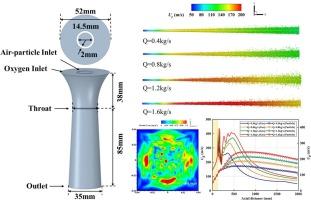
Supersonic gas-particle two-phase flow has been pivotal in fields such as metallurgy, materials processing, and environmental engineering, where they enhance processes like steelmaking, cold spraying, and fluidized bed operations. This study numerically analyzes a supersonic gas-particle lance with a shrouding jet used in industrial furnaces, within an Eulerian-Lagrangian framework. After model validation, this study elucidates the mechanisms of gas jet and particle distribution characteristics of supersonic shrouding gas-particle flows under varying shrouding jet flow rates and temperatures. The findings suggest that higher flow rates and elevated temperatures of shrouding jet significantly extend the length of the supersonic region and enhance jet spraying efficiency. The axial velocity of injected particles positively correlates with shrouding parameters. At the free domain outlet, compared to a shrouding flow rate of 0.4 kg/s, particle speed increases by factors of 1.30, 1.52, and 1.75 at flow rates of 0.8 kg/s, 1.2 kg/s, and 1.6 kg/s, respectively. Furthermore, at shrouding temperatures of 500 K, 700 K, and 900 K, particle speed is 1.17, 1.34, and 1.48 times higher than that at 300 K. Increasing the shrouding jet flow rate enhances particle aggregation, steepening the slope of the radial particle cumulative frequency distribution, while temperature increases promote a more uniform particle distribution. Additionally, increasing flow rates enlarges the particle Reynolds number, intensifying gas–solid interactions, and enhances heat transfer between phases. The radial distribution of particles can be precisely controlled by adjusting the shrouding flow rate. This study bridges the knowledge gap by providing a comprehensive analysis of shrouding effects on gas–solid interactions, offering theoretical insights and practical guidance for optimizing lance design and improving energy efficiency in industrial furnace applications.
期刊介绍:
Applied Thermal Engineering disseminates novel research related to the design, development and demonstration of components, devices, equipment, technologies and systems involving thermal processes for the production, storage, utilization and conservation of energy, with a focus on engineering application.
The journal publishes high-quality and high-impact Original Research Articles, Review Articles, Short Communications and Letters to the Editor on cutting-edge innovations in research, and recent advances or issues of interest to the thermal engineering community.




 京公网安备 11010802042870号
京ICP备2023020795号-1
京公网安备 11010802042870号
京ICP备2023020795号-1

 分享
分享
 求助内容:
求助内容: 应助结果提醒方式:
 扫码关注我们
