Hikaru Suzuki, Guodong Tong, Pabitra Nath, Yuki Hiruta, Daniel Citterio
{"title":"基于CRISPR/Cas12a信号放大的折纸免疫分析装置","authors":"Hikaru Suzuki, Guodong Tong, Pabitra Nath, Yuki Hiruta, Daniel Citterio","doi":"10.1021/acssensors.4c02733","DOIUrl":null,"url":null,"abstract":"In clinical diagnosis, the determination of target proteins at low concentration levels is generally performed by immunoassays, such as the enzyme-linked immunosorbent assay (ELISA), which is a time-consuming process. To date, paper-based ELISA platforms enabling faster and less expensive analysis have been developed, but their important issue for clinical applications is the limited sensitivity compared to conventional ELISA. To address this challenge, this paper introduces a simple, rapid, and highly sensitive detection method for non-nucleic acid targets achieved by integrating the CRISPR/Cas12a system into paper-based ELISA. An origami-type paper-based device enabling simple assay operation has been designed, and the detection of targets on the paper substrates is based on observing the fluorescence signal induced by the CRISPR/Cas12a enzyme cleaving a probe single-stranded DNA (ssDNA) labeled with fluorophore and quencher (FQ reporter). To enhance sensitivity, antibodies labeled with a network of multiple DNA activating the CRISPR/Cas12a enzyme have been utilized as detection antibodies. As a result, the developed device successfully boosted the detection sensitivity for both human IgG and the hepatitis B virus surface antigen (HBsAg). In particular, the limit of detection (LOD) for HBsAg was estimated to be 12 pg/mL, representing over 10-fold higher sensitivity compared with commercially available HBsAg ELISA kits (LOD: 200 pg/mL). In addition, the fluorescence response toward porcine whole blood samples containing different HBsAg concentrations was also confirmed by capturing images with a smartphone, followed by quantitative data analysis. These results demonstrate the potential applicability of the proposed platform for clinical tests at the point of care.","PeriodicalId":24,"journal":{"name":"ACS Sensors","volume":"8 1","pages":""},"PeriodicalIF":10.9000,"publicationDate":"2025-03-09","publicationTypes":"Journal Article","fieldsOfStudy":null,"isOpenAccess":false,"openAccessPdf":"","citationCount":"0","resultStr":"{\"title\":\"Origami Paper-Based Immunoassay Device with CRISPR/Cas12a Signal Amplification\",\"authors\":\"Hikaru Suzuki, Guodong Tong, Pabitra Nath, Yuki Hiruta, Daniel Citterio\",\"doi\":\"10.1021/acssensors.4c02733\",\"DOIUrl\":null,\"url\":null,\"abstract\":\"In clinical diagnosis, the determination of target proteins at low concentration levels is generally performed by immunoassays, such as the enzyme-linked immunosorbent assay (ELISA), which is a time-consuming process. To date, paper-based ELISA platforms enabling faster and less expensive analysis have been developed, but their important issue for clinical applications is the limited sensitivity compared to conventional ELISA. To address this challenge, this paper introduces a simple, rapid, and highly sensitive detection method for non-nucleic acid targets achieved by integrating the CRISPR/Cas12a system into paper-based ELISA. An origami-type paper-based device enabling simple assay operation has been designed, and the detection of targets on the paper substrates is based on observing the fluorescence signal induced by the CRISPR/Cas12a enzyme cleaving a probe single-stranded DNA (ssDNA) labeled with fluorophore and quencher (FQ reporter). To enhance sensitivity, antibodies labeled with a network of multiple DNA activating the CRISPR/Cas12a enzyme have been utilized as detection antibodies. As a result, the developed device successfully boosted the detection sensitivity for both human IgG and the hepatitis B virus surface antigen (HBsAg). In particular, the limit of detection (LOD) for HBsAg was estimated to be 12 pg/mL, representing over 10-fold higher sensitivity compared with commercially available HBsAg ELISA kits (LOD: 200 pg/mL). In addition, the fluorescence response toward porcine whole blood samples containing different HBsAg concentrations was also confirmed by capturing images with a smartphone, followed by quantitative data analysis. These results demonstrate the potential applicability of the proposed platform for clinical tests at the point of care.\",\"PeriodicalId\":24,\"journal\":{\"name\":\"ACS Sensors\",\"volume\":\"8 1\",\"pages\":\"\"},\"PeriodicalIF\":10.9000,\"publicationDate\":\"2025-03-09\",\"publicationTypes\":\"Journal Article\",\"fieldsOfStudy\":null,\"isOpenAccess\":false,\"openAccessPdf\":\"\",\"citationCount\":\"0\",\"resultStr\":null,\"platform\":\"Semanticscholar\",\"paperid\":null,\"PeriodicalName\":\"ACS Sensors\",\"FirstCategoryId\":\"92\",\"ListUrlMain\":\"https://doi.org/10.1021/acssensors.4c02733\",\"RegionNum\":1,\"RegionCategory\":\"化学\",\"ArticlePicture\":[],\"TitleCN\":null,\"AbstractTextCN\":null,\"PMCID\":null,\"EPubDate\":\"\",\"PubModel\":\"\",\"JCR\":\"Q1\",\"JCRName\":\"CHEMISTRY, ANALYTICAL\",\"Score\":null,\"Total\":0}","platform":"Semanticscholar","paperid":null,"PeriodicalName":"ACS Sensors","FirstCategoryId":"92","ListUrlMain":"https://doi.org/10.1021/acssensors.4c02733","RegionNum":1,"RegionCategory":"化学","ArticlePicture":[],"TitleCN":null,"AbstractTextCN":null,"PMCID":null,"EPubDate":"","PubModel":"","JCR":"Q1","JCRName":"CHEMISTRY, ANALYTICAL","Score":null,"Total":0}
Origami Paper-Based Immunoassay Device with CRISPR/Cas12a Signal Amplification
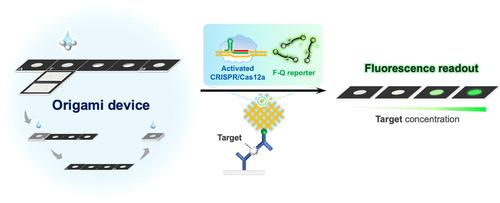
In clinical diagnosis, the determination of target proteins at low concentration levels is generally performed by immunoassays, such as the enzyme-linked immunosorbent assay (ELISA), which is a time-consuming process. To date, paper-based ELISA platforms enabling faster and less expensive analysis have been developed, but their important issue for clinical applications is the limited sensitivity compared to conventional ELISA. To address this challenge, this paper introduces a simple, rapid, and highly sensitive detection method for non-nucleic acid targets achieved by integrating the CRISPR/Cas12a system into paper-based ELISA. An origami-type paper-based device enabling simple assay operation has been designed, and the detection of targets on the paper substrates is based on observing the fluorescence signal induced by the CRISPR/Cas12a enzyme cleaving a probe single-stranded DNA (ssDNA) labeled with fluorophore and quencher (FQ reporter). To enhance sensitivity, antibodies labeled with a network of multiple DNA activating the CRISPR/Cas12a enzyme have been utilized as detection antibodies. As a result, the developed device successfully boosted the detection sensitivity for both human IgG and the hepatitis B virus surface antigen (HBsAg). In particular, the limit of detection (LOD) for HBsAg was estimated to be 12 pg/mL, representing over 10-fold higher sensitivity compared with commercially available HBsAg ELISA kits (LOD: 200 pg/mL). In addition, the fluorescence response toward porcine whole blood samples containing different HBsAg concentrations was also confirmed by capturing images with a smartphone, followed by quantitative data analysis. These results demonstrate the potential applicability of the proposed platform for clinical tests at the point of care.
期刊介绍:
ACS Sensors is a peer-reviewed research journal that focuses on the dissemination of new and original knowledge in the field of sensor science, particularly those that selectively sense chemical or biological species or processes. The journal covers a broad range of topics, including but not limited to biosensors, chemical sensors, gas sensors, intracellular sensors, single molecule sensors, cell chips, and microfluidic devices. It aims to publish articles that address conceptual advances in sensing technology applicable to various types of analytes or application papers that report on the use of existing sensing concepts in new ways or for new analytes.




 京公网安备 11010802042870号
京ICP备2023020795号-1
京公网安备 11010802042870号
京ICP备2023020795号-1

 分享
分享
 求助内容:
求助内容: 应助结果提醒方式:
 扫码关注我们
