Lucas M Horton, Ted C Schroeder, Marshall N Streeter, John P Hutcheson, David G Renter
{"title":"经济风险和净收益分布的随机模型为饲养场的牛在不同的终点销售。","authors":"Lucas M Horton, Ted C Schroeder, Marshall N Streeter, John P Hutcheson, David G Renter","doi":"10.1093/jas/skaf074","DOIUrl":null,"url":null,"abstract":"<p><p>Feedlot cattle in the United States have been progressively fed to heavier, more extreme endpoints (EPs) in recent decades. The primary objective was to evaluate economic risk associated with extending days-on-feed (DOF) by characterizing net return distributions of feedlot steers fed to later EPs, compared to current industry standards. Stochastic simulation modeling was employed to simulate a variety of conditions, including cattle performance, health, carcass characteristics, and economic market variability at the pen-level. The model was parameterized using data from a large commercial feedlot trial and industry reports. The trial involved cattle harvested at four EPs (EP1, EP2, EP3, EP4), each separated by 14 DOF. EP1 represented the industry standard, with live and carcass weights reflective of industry averages from 2021 to mid-2024. The model's final outcome was net return difference-the difference in net returns for EP2, EP3, and EP4 compared to if pens had alternatively been marketed at EP1 under a given set of simulated conditions. Conditional random forest models were used to compute variable importance scores to determine the most influential factors on net return differences. Results indicated that as steers were fed to later EPs, net return distributions widened, reflecting increased economic risk. Steers marketed on a dressed (carcass) basis using a grid for premiums and discounts showed a higher frequency of negative net returns compared to a live marketing basis, primarily due to discounts for Yield Grade and heavyweight carcasses. Across both sale basis, negative net returns became more frequent with increasing EPs. The most influential variable was the difference in fed cattle prices received between later-fed EPs and EP1, accounting for price changes when delaying marketing. Other important economic factors included base-fed cattle prices, corn prices, and the Quality Grade grid when grid marketing. Mortality risk was the most important noneconomic variable, while other animal performance variables, such as weight and carcass traits, were of marginal to minimal importance. These findings highlight the dominant role of economic factors on net returns when feeding steers to later EPs, emphasizing the need to prioritize market conditions in EP management decisions.</p>","PeriodicalId":14895,"journal":{"name":"Journal of animal science","volume":" ","pages":""},"PeriodicalIF":2.9000,"publicationDate":"2025-01-04","publicationTypes":"Journal Article","fieldsOfStudy":null,"isOpenAccess":false,"openAccessPdf":"https://www.ncbi.nlm.nih.gov/pmc/articles/PMC12124255/pdf/","citationCount":"0","resultStr":"{\"title\":\"Stochastic modeling of economic risk and net return distributions for feedlot steers marketed at alternative endpoints.\",\"authors\":\"Lucas M Horton, Ted C Schroeder, Marshall N Streeter, John P Hutcheson, David G Renter\",\"doi\":\"10.1093/jas/skaf074\",\"DOIUrl\":null,\"url\":null,\"abstract\":\"<p><p>Feedlot cattle in the United States have been progressively fed to heavier, more extreme endpoints (EPs) in recent decades. The primary objective was to evaluate economic risk associated with extending days-on-feed (DOF) by characterizing net return distributions of feedlot steers fed to later EPs, compared to current industry standards. Stochastic simulation modeling was employed to simulate a variety of conditions, including cattle performance, health, carcass characteristics, and economic market variability at the pen-level. The model was parameterized using data from a large commercial feedlot trial and industry reports. The trial involved cattle harvested at four EPs (EP1, EP2, EP3, EP4), each separated by 14 DOF. EP1 represented the industry standard, with live and carcass weights reflective of industry averages from 2021 to mid-2024. The model's final outcome was net return difference-the difference in net returns for EP2, EP3, and EP4 compared to if pens had alternatively been marketed at EP1 under a given set of simulated conditions. Conditional random forest models were used to compute variable importance scores to determine the most influential factors on net return differences. Results indicated that as steers were fed to later EPs, net return distributions widened, reflecting increased economic risk. Steers marketed on a dressed (carcass) basis using a grid for premiums and discounts showed a higher frequency of negative net returns compared to a live marketing basis, primarily due to discounts for Yield Grade and heavyweight carcasses. Across both sale basis, negative net returns became more frequent with increasing EPs. The most influential variable was the difference in fed cattle prices received between later-fed EPs and EP1, accounting for price changes when delaying marketing. Other important economic factors included base-fed cattle prices, corn prices, and the Quality Grade grid when grid marketing. Mortality risk was the most important noneconomic variable, while other animal performance variables, such as weight and carcass traits, were of marginal to minimal importance. These findings highlight the dominant role of economic factors on net returns when feeding steers to later EPs, emphasizing the need to prioritize market conditions in EP management decisions.</p>\",\"PeriodicalId\":14895,\"journal\":{\"name\":\"Journal of animal science\",\"volume\":\" \",\"pages\":\"\"},\"PeriodicalIF\":2.9000,\"publicationDate\":\"2025-01-04\",\"publicationTypes\":\"Journal Article\",\"fieldsOfStudy\":null,\"isOpenAccess\":false,\"openAccessPdf\":\"https://www.ncbi.nlm.nih.gov/pmc/articles/PMC12124255/pdf/\",\"citationCount\":\"0\",\"resultStr\":null,\"platform\":\"Semanticscholar\",\"paperid\":null,\"PeriodicalName\":\"Journal of animal science\",\"FirstCategoryId\":\"97\",\"ListUrlMain\":\"https://doi.org/10.1093/jas/skaf074\",\"RegionNum\":2,\"RegionCategory\":\"农林科学\",\"ArticlePicture\":[],\"TitleCN\":null,\"AbstractTextCN\":null,\"PMCID\":null,\"EPubDate\":\"\",\"PubModel\":\"\",\"JCR\":\"Q1\",\"JCRName\":\"AGRICULTURE, DAIRY & ANIMAL SCIENCE\",\"Score\":null,\"Total\":0}","platform":"Semanticscholar","paperid":null,"PeriodicalName":"Journal of animal science","FirstCategoryId":"97","ListUrlMain":"https://doi.org/10.1093/jas/skaf074","RegionNum":2,"RegionCategory":"农林科学","ArticlePicture":[],"TitleCN":null,"AbstractTextCN":null,"PMCID":null,"EPubDate":"","PubModel":"","JCR":"Q1","JCRName":"AGRICULTURE, DAIRY & ANIMAL SCIENCE","Score":null,"Total":0}
Stochastic modeling of economic risk and net return distributions for feedlot steers marketed at alternative endpoints.
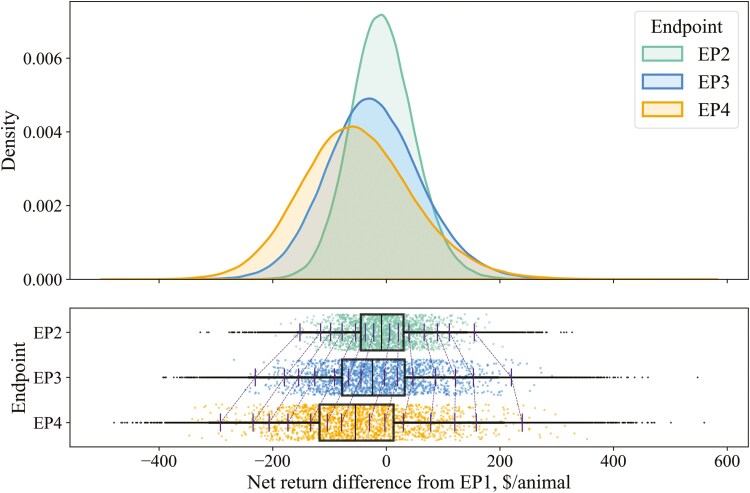
Feedlot cattle in the United States have been progressively fed to heavier, more extreme endpoints (EPs) in recent decades. The primary objective was to evaluate economic risk associated with extending days-on-feed (DOF) by characterizing net return distributions of feedlot steers fed to later EPs, compared to current industry standards. Stochastic simulation modeling was employed to simulate a variety of conditions, including cattle performance, health, carcass characteristics, and economic market variability at the pen-level. The model was parameterized using data from a large commercial feedlot trial and industry reports. The trial involved cattle harvested at four EPs (EP1, EP2, EP3, EP4), each separated by 14 DOF. EP1 represented the industry standard, with live and carcass weights reflective of industry averages from 2021 to mid-2024. The model's final outcome was net return difference-the difference in net returns for EP2, EP3, and EP4 compared to if pens had alternatively been marketed at EP1 under a given set of simulated conditions. Conditional random forest models were used to compute variable importance scores to determine the most influential factors on net return differences. Results indicated that as steers were fed to later EPs, net return distributions widened, reflecting increased economic risk. Steers marketed on a dressed (carcass) basis using a grid for premiums and discounts showed a higher frequency of negative net returns compared to a live marketing basis, primarily due to discounts for Yield Grade and heavyweight carcasses. Across both sale basis, negative net returns became more frequent with increasing EPs. The most influential variable was the difference in fed cattle prices received between later-fed EPs and EP1, accounting for price changes when delaying marketing. Other important economic factors included base-fed cattle prices, corn prices, and the Quality Grade grid when grid marketing. Mortality risk was the most important noneconomic variable, while other animal performance variables, such as weight and carcass traits, were of marginal to minimal importance. These findings highlight the dominant role of economic factors on net returns when feeding steers to later EPs, emphasizing the need to prioritize market conditions in EP management decisions.
期刊介绍:
The Journal of Animal Science (JAS) is the premier journal for animal science and serves as the leading source of new knowledge and perspective in this area. JAS publishes more than 500 fully reviewed research articles, invited reviews, technical notes, and letters to the editor each year.
Articles published in JAS encompass a broad range of research topics in animal production and fundamental aspects of genetics, nutrition, physiology, and preparation and utilization of animal products. Articles typically report research with beef cattle, companion animals, goats, horses, pigs, and sheep; however, studies involving other farm animals, aquatic and wildlife species, and laboratory animal species that address fundamental questions related to livestock and companion animal biology will be considered for publication.






 京公网安备 11010802042870号
京ICP备2023020795号-1
京公网安备 11010802042870号
京ICP备2023020795号-1

 分享
分享
 求助内容:
求助内容: 应助结果提醒方式:
 扫码关注我们
