Antonio Caronni, Maurizio Amadei, Lorenzo Diana, Gaia Sangalli, Stefano Scarano, Laura Perucca, Viviana Rota, Nadia Bolognini
{"title":"在帕金森氏症中,双重任务降低了在站立行走和行走时转身测试阶段的步态平稳性。","authors":"Antonio Caronni, Maurizio Amadei, Lorenzo Diana, Gaia Sangalli, Stefano Scarano, Laura Perucca, Viviana Rota, Nadia Bolognini","doi":"10.1186/s13102-025-01068-8","DOIUrl":null,"url":null,"abstract":"<p><strong>Background: </strong>Dual-task walking is used as a treatment, for gait assessment, and as an outcome measure in Parkinson's disease (PD). Movement smoothness, i.e. its non-intermittency, is a movement cardinal feature. This study assesses whether dual-tasking reduces gait smoothness in PD alongside reducing speed, one of its well-known effects.</p><p><strong>Methods: </strong>The Timed Up and Go (TUG) test, instrumented with an inertial sensor fixed to the back, was administered to 33 PD patients (15 females; age: median = 71 years; IQR = 10) to assess two walking types: straight-walking and turning-while-walking. The TUG test was completed in single-task and two dual-task modalities: cognitive (doing successive subtractions) and motor (holding a water glass). The angular speed spectral arc length metric (SPARC) and the Ln-DimensionLess Jerk (LDLJ), two smoothness measures quantifying the peaks and dips in the speed profile, were measured, along with the trunk angular velocity and the foot strikes number. ANOVA was used for hypothesis testing and estimated marginal means for post-hoc tests and effect sizes (ES).</p><p><strong>Results: </strong>In straight-walking and turning, cognitive and motor dual tasks decreased gait speed (ES range = [0.476, 1.379]; p < 0.01) and increased the step number (ES = [0.402, 0.927]; p < 0.05). SPARC (ES = [0.221, 0.493]; p < 0.05) and angular LDLJ (ES = [0.451, 0.929]; p < 0.01) were lower in the two dual-task conditions in both phases, indicating reduced gait smoothness than in single-task. This worsening of gait smoothness was partially confirmed after ruling out the dual-task effect on speed and step number. In particular, anterior-posterior SPARC during turning was still low in cognitive (ES = 0.351; p < 0.01) and motor (ES = 0.283; p < 0.05) dual tasks.</p><p><strong>Conclusions: </strong>In PD, dual-tasking decreases gait speed and increases the step number when walking straight and turning while walking. Independently of these effects, dual-tasking also reduces gait smoothness. As an independent feature of movement, when dual-task walking is the outcome measure, improving smoothness may represent a novel treatment aim in PD. As long as it is instrumented with an inertial sensor, the TUG test is valuable for studying different walking types.</p><p><strong>Trial registration: </strong>NCT05904171 (ClinicalTrials.gov; date registration: 2023-06-06).</p>","PeriodicalId":48585,"journal":{"name":"BMC Sports Science Medicine and Rehabilitation","volume":"17 1","pages":"42"},"PeriodicalIF":2.8000,"publicationDate":"2025-03-07","publicationTypes":"Journal Article","fieldsOfStudy":null,"isOpenAccess":false,"openAccessPdf":"https://www.ncbi.nlm.nih.gov/pmc/articles/PMC11887220/pdf/","citationCount":"0","resultStr":"{\"title\":\"In Parkinson's disease, dual-tasking reduces gait smoothness during the straight-walking and turning-while-walking phases of the Timed Up and Go test.\",\"authors\":\"Antonio Caronni, Maurizio Amadei, Lorenzo Diana, Gaia Sangalli, Stefano Scarano, Laura Perucca, Viviana Rota, Nadia Bolognini\",\"doi\":\"10.1186/s13102-025-01068-8\",\"DOIUrl\":null,\"url\":null,\"abstract\":\"<p><strong>Background: </strong>Dual-task walking is used as a treatment, for gait assessment, and as an outcome measure in Parkinson's disease (PD). Movement smoothness, i.e. its non-intermittency, is a movement cardinal feature. This study assesses whether dual-tasking reduces gait smoothness in PD alongside reducing speed, one of its well-known effects.</p><p><strong>Methods: </strong>The Timed Up and Go (TUG) test, instrumented with an inertial sensor fixed to the back, was administered to 33 PD patients (15 females; age: median = 71 years; IQR = 10) to assess two walking types: straight-walking and turning-while-walking. The TUG test was completed in single-task and two dual-task modalities: cognitive (doing successive subtractions) and motor (holding a water glass). The angular speed spectral arc length metric (SPARC) and the Ln-DimensionLess Jerk (LDLJ), two smoothness measures quantifying the peaks and dips in the speed profile, were measured, along with the trunk angular velocity and the foot strikes number. ANOVA was used for hypothesis testing and estimated marginal means for post-hoc tests and effect sizes (ES).</p><p><strong>Results: </strong>In straight-walking and turning, cognitive and motor dual tasks decreased gait speed (ES range = [0.476, 1.379]; p < 0.01) and increased the step number (ES = [0.402, 0.927]; p < 0.05). SPARC (ES = [0.221, 0.493]; p < 0.05) and angular LDLJ (ES = [0.451, 0.929]; p < 0.01) were lower in the two dual-task conditions in both phases, indicating reduced gait smoothness than in single-task. This worsening of gait smoothness was partially confirmed after ruling out the dual-task effect on speed and step number. In particular, anterior-posterior SPARC during turning was still low in cognitive (ES = 0.351; p < 0.01) and motor (ES = 0.283; p < 0.05) dual tasks.</p><p><strong>Conclusions: </strong>In PD, dual-tasking decreases gait speed and increases the step number when walking straight and turning while walking. Independently of these effects, dual-tasking also reduces gait smoothness. As an independent feature of movement, when dual-task walking is the outcome measure, improving smoothness may represent a novel treatment aim in PD. As long as it is instrumented with an inertial sensor, the TUG test is valuable for studying different walking types.</p><p><strong>Trial registration: </strong>NCT05904171 (ClinicalTrials.gov; date registration: 2023-06-06).</p>\",\"PeriodicalId\":48585,\"journal\":{\"name\":\"BMC Sports Science Medicine and Rehabilitation\",\"volume\":\"17 1\",\"pages\":\"42\"},\"PeriodicalIF\":2.8000,\"publicationDate\":\"2025-03-07\",\"publicationTypes\":\"Journal Article\",\"fieldsOfStudy\":null,\"isOpenAccess\":false,\"openAccessPdf\":\"https://www.ncbi.nlm.nih.gov/pmc/articles/PMC11887220/pdf/\",\"citationCount\":\"0\",\"resultStr\":null,\"platform\":\"Semanticscholar\",\"paperid\":null,\"PeriodicalName\":\"BMC Sports Science Medicine and Rehabilitation\",\"FirstCategoryId\":\"3\",\"ListUrlMain\":\"https://doi.org/10.1186/s13102-025-01068-8\",\"RegionNum\":3,\"RegionCategory\":\"医学\",\"ArticlePicture\":[],\"TitleCN\":null,\"AbstractTextCN\":null,\"PMCID\":null,\"EPubDate\":\"\",\"PubModel\":\"\",\"JCR\":\"Q1\",\"JCRName\":\"REHABILITATION\",\"Score\":null,\"Total\":0}","platform":"Semanticscholar","paperid":null,"PeriodicalName":"BMC Sports Science Medicine and Rehabilitation","FirstCategoryId":"3","ListUrlMain":"https://doi.org/10.1186/s13102-025-01068-8","RegionNum":3,"RegionCategory":"医学","ArticlePicture":[],"TitleCN":null,"AbstractTextCN":null,"PMCID":null,"EPubDate":"","PubModel":"","JCR":"Q1","JCRName":"REHABILITATION","Score":null,"Total":0}
In Parkinson's disease, dual-tasking reduces gait smoothness during the straight-walking and turning-while-walking phases of the Timed Up and Go test.
Background: Dual-task walking is used as a treatment, for gait assessment, and as an outcome measure in Parkinson's disease (PD). Movement smoothness, i.e. its non-intermittency, is a movement cardinal feature. This study assesses whether dual-tasking reduces gait smoothness in PD alongside reducing speed, one of its well-known effects.
Methods: The Timed Up and Go (TUG) test, instrumented with an inertial sensor fixed to the back, was administered to 33 PD patients (15 females; age: median = 71 years; IQR = 10) to assess two walking types: straight-walking and turning-while-walking. The TUG test was completed in single-task and two dual-task modalities: cognitive (doing successive subtractions) and motor (holding a water glass). The angular speed spectral arc length metric (SPARC) and the Ln-DimensionLess Jerk (LDLJ), two smoothness measures quantifying the peaks and dips in the speed profile, were measured, along with the trunk angular velocity and the foot strikes number. ANOVA was used for hypothesis testing and estimated marginal means for post-hoc tests and effect sizes (ES).
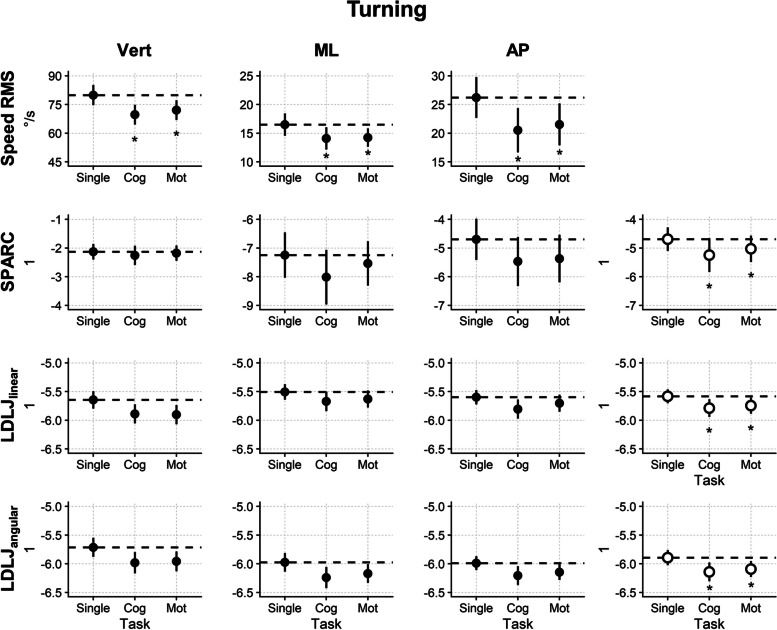
Results: In straight-walking and turning, cognitive and motor dual tasks decreased gait speed (ES range = [0.476, 1.379]; p < 0.01) and increased the step number (ES = [0.402, 0.927]; p < 0.05). SPARC (ES = [0.221, 0.493]; p < 0.05) and angular LDLJ (ES = [0.451, 0.929]; p < 0.01) were lower in the two dual-task conditions in both phases, indicating reduced gait smoothness than in single-task. This worsening of gait smoothness was partially confirmed after ruling out the dual-task effect on speed and step number. In particular, anterior-posterior SPARC during turning was still low in cognitive (ES = 0.351; p < 0.01) and motor (ES = 0.283; p < 0.05) dual tasks.
Conclusions: In PD, dual-tasking decreases gait speed and increases the step number when walking straight and turning while walking. Independently of these effects, dual-tasking also reduces gait smoothness. As an independent feature of movement, when dual-task walking is the outcome measure, improving smoothness may represent a novel treatment aim in PD. As long as it is instrumented with an inertial sensor, the TUG test is valuable for studying different walking types.
Trial registration: NCT05904171 (ClinicalTrials.gov; date registration: 2023-06-06).
期刊介绍:
BMC Sports Science, Medicine and Rehabilitation is an open access, peer reviewed journal that considers articles on all aspects of sports medicine and the exercise sciences, including rehabilitation, traumatology, cardiology, physiology, and nutrition.





 京公网安备 11010802042870号
京ICP备2023020795号-1
京公网安备 11010802042870号
京ICP备2023020795号-1

 分享
分享
 求助内容:
求助内容: 应助结果提醒方式:
 扫码关注我们
