Clinton M Holt, Alexis K Janke, Parastoo Amlashi, Parker J Jamieson, Toma M Marinov, Ivelin S Georgiev
{"title":"对比学习使表位重叠预测靶向抗体发现。","authors":"Clinton M Holt, Alexis K Janke, Parastoo Amlashi, Parker J Jamieson, Toma M Marinov, Ivelin S Georgiev","doi":"10.1101/2025.02.25.640114","DOIUrl":null,"url":null,"abstract":"<p><p>Computational epitope prediction remains an unmet need for therapeutic antibody development. We present three complementary approaches for predicting epitope relationships from antibody amino acid sequences. First, we analyze ~18 million antibody pairs targeting ~250 protein families and establish that a threshold of >70% CDRH3 sequence identity among antibodies sharing both heavy and light chain V-genes reliably predicts overlapping-epitope antibody pairs. Next, we develop a supervised contrastive fine-tuning framework for antibody large language models which results in embeddings that better correlate with epitope information than those from pretrained models. Applying this contrastive learning approach to SARS-CoV-2 receptor binding domain antibodies, we achieve 82.7% balanced accuracy in distinguishing same-epitope versus different-epitope antibody pairs and demonstrate the ability to predict relative levels of structural overlap from learning on functional epitope bins (Spearman <i>ρ</i> = 0.25). Finally, we create AbLang-PDB, a generalized model for predicting overlapping-epitope antibodies for a broad range of protein families. AbLang-PDB achieves five-fold improvement in average precision for predicting overlapping-epitope antibody pairs compared to sequence-based methods, and effectively predicts the amount of epitope overlap among overlapping-epitope pairs (<i>ρ</i> = 0.81). In an antibody discovery campaign searching for overlapping-epitope antibodies to the HIV-1 broadly neutralizing antibody 8ANC195, 70% of computationally selected candidates demonstrated HIV-1 specificity, with 50% showing competitive binding with 8ANC195. Together, the computational models presented here provide powerful tools for epitope-targeted antibody discovery, while demonstrating the efficacy of contrastive learning for improving epitope-representation.</p>","PeriodicalId":519960,"journal":{"name":"bioRxiv : the preprint server for biology","volume":" ","pages":""},"PeriodicalIF":0.0000,"publicationDate":"2025-04-01","publicationTypes":"Journal Article","fieldsOfStudy":null,"isOpenAccess":false,"openAccessPdf":"https://www.ncbi.nlm.nih.gov/pmc/articles/PMC11888244/pdf/","citationCount":"0","resultStr":"{\"title\":\"Contrastive Learning Enables Epitope Overlap Predictions for Targeted Antibody Discovery.\",\"authors\":\"Clinton M Holt, Alexis K Janke, Parastoo Amlashi, Parker J Jamieson, Toma M Marinov, Ivelin S Georgiev\",\"doi\":\"10.1101/2025.02.25.640114\",\"DOIUrl\":null,\"url\":null,\"abstract\":\"<p><p>Computational epitope prediction remains an unmet need for therapeutic antibody development. We present three complementary approaches for predicting epitope relationships from antibody amino acid sequences. First, we analyze ~18 million antibody pairs targeting ~250 protein families and establish that a threshold of >70% CDRH3 sequence identity among antibodies sharing both heavy and light chain V-genes reliably predicts overlapping-epitope antibody pairs. Next, we develop a supervised contrastive fine-tuning framework for antibody large language models which results in embeddings that better correlate with epitope information than those from pretrained models. Applying this contrastive learning approach to SARS-CoV-2 receptor binding domain antibodies, we achieve 82.7% balanced accuracy in distinguishing same-epitope versus different-epitope antibody pairs and demonstrate the ability to predict relative levels of structural overlap from learning on functional epitope bins (Spearman <i>ρ</i> = 0.25). Finally, we create AbLang-PDB, a generalized model for predicting overlapping-epitope antibodies for a broad range of protein families. AbLang-PDB achieves five-fold improvement in average precision for predicting overlapping-epitope antibody pairs compared to sequence-based methods, and effectively predicts the amount of epitope overlap among overlapping-epitope pairs (<i>ρ</i> = 0.81). In an antibody discovery campaign searching for overlapping-epitope antibodies to the HIV-1 broadly neutralizing antibody 8ANC195, 70% of computationally selected candidates demonstrated HIV-1 specificity, with 50% showing competitive binding with 8ANC195. Together, the computational models presented here provide powerful tools for epitope-targeted antibody discovery, while demonstrating the efficacy of contrastive learning for improving epitope-representation.</p>\",\"PeriodicalId\":519960,\"journal\":{\"name\":\"bioRxiv : the preprint server for biology\",\"volume\":\" \",\"pages\":\"\"},\"PeriodicalIF\":0.0000,\"publicationDate\":\"2025-04-01\",\"publicationTypes\":\"Journal Article\",\"fieldsOfStudy\":null,\"isOpenAccess\":false,\"openAccessPdf\":\"https://www.ncbi.nlm.nih.gov/pmc/articles/PMC11888244/pdf/\",\"citationCount\":\"0\",\"resultStr\":null,\"platform\":\"Semanticscholar\",\"paperid\":null,\"PeriodicalName\":\"bioRxiv : the preprint server for biology\",\"FirstCategoryId\":\"1085\",\"ListUrlMain\":\"https://doi.org/10.1101/2025.02.25.640114\",\"RegionNum\":0,\"RegionCategory\":null,\"ArticlePicture\":[],\"TitleCN\":null,\"AbstractTextCN\":null,\"PMCID\":null,\"EPubDate\":\"\",\"PubModel\":\"\",\"JCR\":\"\",\"JCRName\":\"\",\"Score\":null,\"Total\":0}","platform":"Semanticscholar","paperid":null,"PeriodicalName":"bioRxiv : the preprint server for biology","FirstCategoryId":"1085","ListUrlMain":"https://doi.org/10.1101/2025.02.25.640114","RegionNum":0,"RegionCategory":null,"ArticlePicture":[],"TitleCN":null,"AbstractTextCN":null,"PMCID":null,"EPubDate":"","PubModel":"","JCR":"","JCRName":"","Score":null,"Total":0}
Contrastive Learning Enables Epitope Overlap Predictions for Targeted Antibody Discovery.
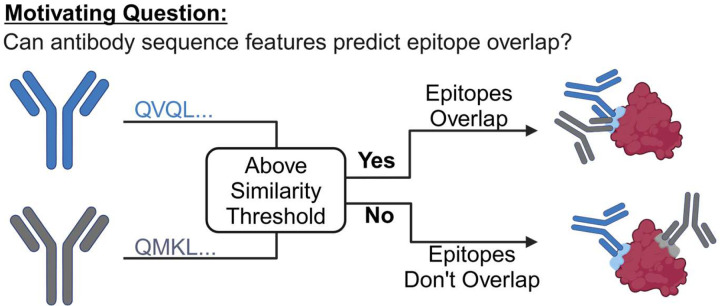
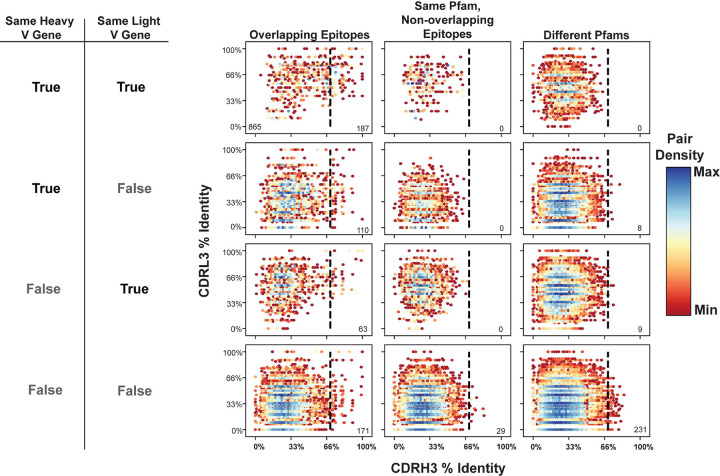
Computational epitope prediction remains an unmet need for therapeutic antibody development. We present three complementary approaches for predicting epitope relationships from antibody amino acid sequences. First, we analyze ~18 million antibody pairs targeting ~250 protein families and establish that a threshold of >70% CDRH3 sequence identity among antibodies sharing both heavy and light chain V-genes reliably predicts overlapping-epitope antibody pairs. Next, we develop a supervised contrastive fine-tuning framework for antibody large language models which results in embeddings that better correlate with epitope information than those from pretrained models. Applying this contrastive learning approach to SARS-CoV-2 receptor binding domain antibodies, we achieve 82.7% balanced accuracy in distinguishing same-epitope versus different-epitope antibody pairs and demonstrate the ability to predict relative levels of structural overlap from learning on functional epitope bins (Spearman ρ = 0.25). Finally, we create AbLang-PDB, a generalized model for predicting overlapping-epitope antibodies for a broad range of protein families. AbLang-PDB achieves five-fold improvement in average precision for predicting overlapping-epitope antibody pairs compared to sequence-based methods, and effectively predicts the amount of epitope overlap among overlapping-epitope pairs (ρ = 0.81). In an antibody discovery campaign searching for overlapping-epitope antibodies to the HIV-1 broadly neutralizing antibody 8ANC195, 70% of computationally selected candidates demonstrated HIV-1 specificity, with 50% showing competitive binding with 8ANC195. Together, the computational models presented here provide powerful tools for epitope-targeted antibody discovery, while demonstrating the efficacy of contrastive learning for improving epitope-representation.





 京公网安备 11010802042870号
京ICP备2023020795号-1
京公网安备 11010802042870号
京ICP备2023020795号-1

 分享
分享

 求助内容:
求助内容: 应助结果提醒方式:
 扫码关注我们
