Yui Tik Pang, Katie M Kuo, Lixinhao Yang, James C Gumbart
{"title":"DeepPath:利用基于物理的深度学习克服蛋白质转化途径预测的数据稀缺。","authors":"Yui Tik Pang, Katie M Kuo, Lixinhao Yang, James C Gumbart","doi":"10.1101/2025.02.27.640693","DOIUrl":null,"url":null,"abstract":"<p><p>The structural dynamics of proteins play a crucial role in their function, yet most experimental and deep learning methods produce only static models. While molecular dynamics (MD) simulations provide atomistic insight into conformational transitions, they remain computationally prohibitive, particularly for large-scale motions. Here, we introduce DeepPath, a deep-learning-based framework that rapidly generates physically realistic transition pathways between known protein states. Unlike conventional supervised learning approaches, DeepPath employs active learning to iteratively refine its predictions, leveraging molecular mechanical force fields as an oracle to guide pathway generation. We validated DeepPath on three biologically relevant test cases: SHP2 activation, CdiB H1 secretion, and the BAM complex lateral gate opening. DeepPath accurately predicted the transition pathways for all test cases, reproducing key intermediate structures and transient interactions observed in previous studies. Notably, DeepPath also predicted an intermediate between the BAM inward- and outward-open states that closely aligns with an experimentally observed hybrid-barrel structure (TMscore = 0.91). Across all cases, DeepPath achieved accurate pathway predictions within hours, showcasing an efficient alternative to MD simulations for exploring protein conformational transitions.</p>","PeriodicalId":519960,"journal":{"name":"bioRxiv : the preprint server for biology","volume":" ","pages":""},"PeriodicalIF":0.0000,"publicationDate":"2025-03-02","publicationTypes":"Journal Article","fieldsOfStudy":null,"isOpenAccess":false,"openAccessPdf":"https://www.ncbi.nlm.nih.gov/pmc/articles/PMC11888466/pdf/","citationCount":"0","resultStr":"{\"title\":\"DeepPath: Overcoming data scarcity for protein transition pathway prediction using physics-based deep learning.\",\"authors\":\"Yui Tik Pang, Katie M Kuo, Lixinhao Yang, James C Gumbart\",\"doi\":\"10.1101/2025.02.27.640693\",\"DOIUrl\":null,\"url\":null,\"abstract\":\"<p><p>The structural dynamics of proteins play a crucial role in their function, yet most experimental and deep learning methods produce only static models. While molecular dynamics (MD) simulations provide atomistic insight into conformational transitions, they remain computationally prohibitive, particularly for large-scale motions. Here, we introduce DeepPath, a deep-learning-based framework that rapidly generates physically realistic transition pathways between known protein states. Unlike conventional supervised learning approaches, DeepPath employs active learning to iteratively refine its predictions, leveraging molecular mechanical force fields as an oracle to guide pathway generation. We validated DeepPath on three biologically relevant test cases: SHP2 activation, CdiB H1 secretion, and the BAM complex lateral gate opening. DeepPath accurately predicted the transition pathways for all test cases, reproducing key intermediate structures and transient interactions observed in previous studies. Notably, DeepPath also predicted an intermediate between the BAM inward- and outward-open states that closely aligns with an experimentally observed hybrid-barrel structure (TMscore = 0.91). Across all cases, DeepPath achieved accurate pathway predictions within hours, showcasing an efficient alternative to MD simulations for exploring protein conformational transitions.</p>\",\"PeriodicalId\":519960,\"journal\":{\"name\":\"bioRxiv : the preprint server for biology\",\"volume\":\" \",\"pages\":\"\"},\"PeriodicalIF\":0.0000,\"publicationDate\":\"2025-03-02\",\"publicationTypes\":\"Journal Article\",\"fieldsOfStudy\":null,\"isOpenAccess\":false,\"openAccessPdf\":\"https://www.ncbi.nlm.nih.gov/pmc/articles/PMC11888466/pdf/\",\"citationCount\":\"0\",\"resultStr\":null,\"platform\":\"Semanticscholar\",\"paperid\":null,\"PeriodicalName\":\"bioRxiv : the preprint server for biology\",\"FirstCategoryId\":\"1085\",\"ListUrlMain\":\"https://doi.org/10.1101/2025.02.27.640693\",\"RegionNum\":0,\"RegionCategory\":null,\"ArticlePicture\":[],\"TitleCN\":null,\"AbstractTextCN\":null,\"PMCID\":null,\"EPubDate\":\"\",\"PubModel\":\"\",\"JCR\":\"\",\"JCRName\":\"\",\"Score\":null,\"Total\":0}","platform":"Semanticscholar","paperid":null,"PeriodicalName":"bioRxiv : the preprint server for biology","FirstCategoryId":"1085","ListUrlMain":"https://doi.org/10.1101/2025.02.27.640693","RegionNum":0,"RegionCategory":null,"ArticlePicture":[],"TitleCN":null,"AbstractTextCN":null,"PMCID":null,"EPubDate":"","PubModel":"","JCR":"","JCRName":"","Score":null,"Total":0}
DeepPath: Overcoming data scarcity for protein transition pathway prediction using physics-based deep learning.
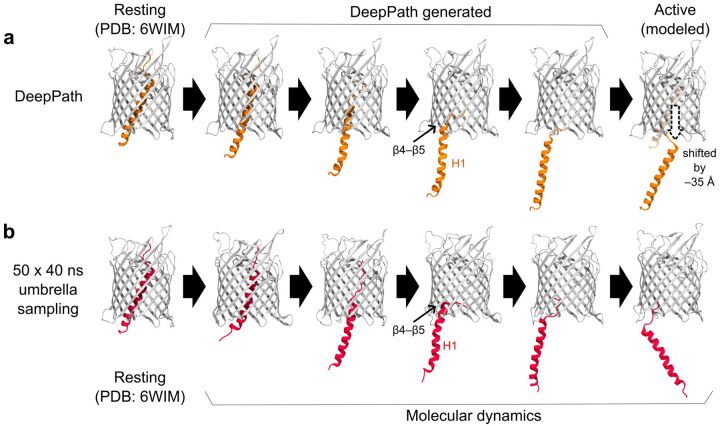
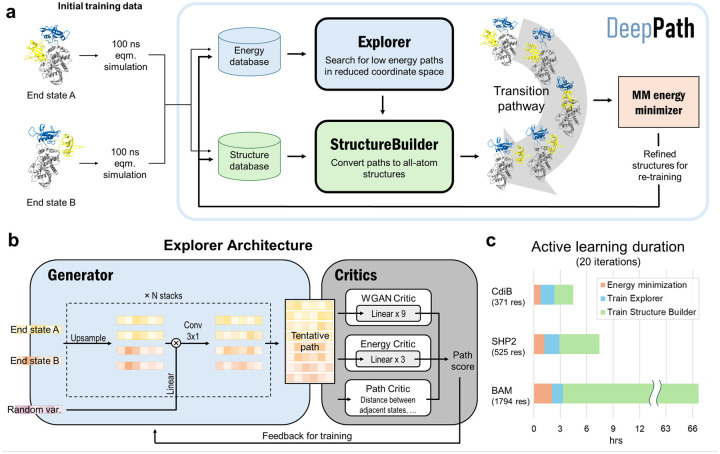
The structural dynamics of proteins play a crucial role in their function, yet most experimental and deep learning methods produce only static models. While molecular dynamics (MD) simulations provide atomistic insight into conformational transitions, they remain computationally prohibitive, particularly for large-scale motions. Here, we introduce DeepPath, a deep-learning-based framework that rapidly generates physically realistic transition pathways between known protein states. Unlike conventional supervised learning approaches, DeepPath employs active learning to iteratively refine its predictions, leveraging molecular mechanical force fields as an oracle to guide pathway generation. We validated DeepPath on three biologically relevant test cases: SHP2 activation, CdiB H1 secretion, and the BAM complex lateral gate opening. DeepPath accurately predicted the transition pathways for all test cases, reproducing key intermediate structures and transient interactions observed in previous studies. Notably, DeepPath also predicted an intermediate between the BAM inward- and outward-open states that closely aligns with an experimentally observed hybrid-barrel structure (TMscore = 0.91). Across all cases, DeepPath achieved accurate pathway predictions within hours, showcasing an efficient alternative to MD simulations for exploring protein conformational transitions.





 京公网安备 11010802042870号
京ICP备2023020795号-1
京公网安备 11010802042870号
京ICP备2023020795号-1

 分享
分享

 求助内容:
求助内容: 应助结果提醒方式:
 扫码关注我们
