Yan Ye, Guoshuo Tang, Xiangze Meng, Rui Yang, Baohua Guo, Xuming Xie
{"title":"生物可降解聚己二酸丁二酯/对苯二甲酸酯在各种气候条件下高效、精确的室外寿命预测方法","authors":"Yan Ye, Guoshuo Tang, Xiangze Meng, Rui Yang, Baohua Guo, Xuming Xie","doi":"10.1016/j.jclepro.2025.145276","DOIUrl":null,"url":null,"abstract":"<div><div>Outdoor lifetime prediction of a plastic gives the quantitative relationship between its service property and environmental factors, and is fundamental for efficient utilization and minimizing waste. However, it is still a major challenge after decades of great efforts. Poly (butylene adipate/terephthalate) (PBAT) has been widely used as biodegradable mulch films. Here we established a lifetime prediction method of PBAT under different climatic conditions. We established the quantitative correspondence of PBAT to environmental conditions by measuring CO<sub>2</sub> generation rates of PBAT under various combinations of temperature, solar irradiance, and humidity. A correlation between the CO<sub>2</sub> generation rate and the tensile strength of PBAT during outdoor aging is determined. Then, the lifetime prediction model of PBAT was built, showing the deterioration rates of tensile strength under various climate conditions. This model enables quantitative prediction of the space and time distribution of aging rates of PBAT in China, as well as quantitative comparison between any accelerated and natural aging. This work cut the time and money cost down greatly on lifetime prediction of PBAT, and facilitates the fine-tuning of PBAT stability based on the region of deployment. Moreover, this lifetime prediction method is a common strategy and can be used to other polymer materials for outdoor applications.</div></div>","PeriodicalId":349,"journal":{"name":"Journal of Cleaner Production","volume":"500 ","pages":"Article 145276"},"PeriodicalIF":10.0000,"publicationDate":"2025-04-01","publicationTypes":"Journal Article","fieldsOfStudy":null,"isOpenAccess":false,"openAccessPdf":"","citationCount":"0","resultStr":"{\"title\":\"Efficient and precise outdoor lifetime prediction method for biodegradable poly (butylene adipate/ terephthalate) under various climate conditions\",\"authors\":\"Yan Ye, Guoshuo Tang, Xiangze Meng, Rui Yang, Baohua Guo, Xuming Xie\",\"doi\":\"10.1016/j.jclepro.2025.145276\",\"DOIUrl\":null,\"url\":null,\"abstract\":\"<div><div>Outdoor lifetime prediction of a plastic gives the quantitative relationship between its service property and environmental factors, and is fundamental for efficient utilization and minimizing waste. However, it is still a major challenge after decades of great efforts. Poly (butylene adipate/terephthalate) (PBAT) has been widely used as biodegradable mulch films. Here we established a lifetime prediction method of PBAT under different climatic conditions. We established the quantitative correspondence of PBAT to environmental conditions by measuring CO<sub>2</sub> generation rates of PBAT under various combinations of temperature, solar irradiance, and humidity. A correlation between the CO<sub>2</sub> generation rate and the tensile strength of PBAT during outdoor aging is determined. Then, the lifetime prediction model of PBAT was built, showing the deterioration rates of tensile strength under various climate conditions. This model enables quantitative prediction of the space and time distribution of aging rates of PBAT in China, as well as quantitative comparison between any accelerated and natural aging. This work cut the time and money cost down greatly on lifetime prediction of PBAT, and facilitates the fine-tuning of PBAT stability based on the region of deployment. Moreover, this lifetime prediction method is a common strategy and can be used to other polymer materials for outdoor applications.</div></div>\",\"PeriodicalId\":349,\"journal\":{\"name\":\"Journal of Cleaner Production\",\"volume\":\"500 \",\"pages\":\"Article 145276\"},\"PeriodicalIF\":10.0000,\"publicationDate\":\"2025-04-01\",\"publicationTypes\":\"Journal Article\",\"fieldsOfStudy\":null,\"isOpenAccess\":false,\"openAccessPdf\":\"\",\"citationCount\":\"0\",\"resultStr\":null,\"platform\":\"Semanticscholar\",\"paperid\":null,\"PeriodicalName\":\"Journal of Cleaner Production\",\"FirstCategoryId\":\"93\",\"ListUrlMain\":\"https://www.sciencedirect.com/science/article/pii/S0959652625006262\",\"RegionNum\":1,\"RegionCategory\":\"环境科学与生态学\",\"ArticlePicture\":[],\"TitleCN\":null,\"AbstractTextCN\":null,\"PMCID\":null,\"EPubDate\":\"2025/3/10 0:00:00\",\"PubModel\":\"Epub\",\"JCR\":\"Q1\",\"JCRName\":\"ENGINEERING, ENVIRONMENTAL\",\"Score\":null,\"Total\":0}","platform":"Semanticscholar","paperid":null,"PeriodicalName":"Journal of Cleaner Production","FirstCategoryId":"93","ListUrlMain":"https://www.sciencedirect.com/science/article/pii/S0959652625006262","RegionNum":1,"RegionCategory":"环境科学与生态学","ArticlePicture":[],"TitleCN":null,"AbstractTextCN":null,"PMCID":null,"EPubDate":"2025/3/10 0:00:00","PubModel":"Epub","JCR":"Q1","JCRName":"ENGINEERING, ENVIRONMENTAL","Score":null,"Total":0}
Efficient and precise outdoor lifetime prediction method for biodegradable poly (butylene adipate/ terephthalate) under various climate conditions
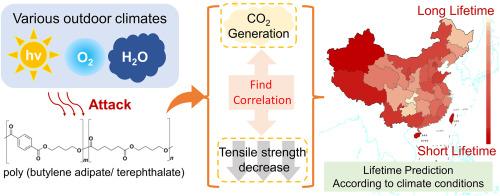
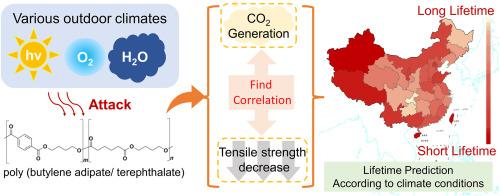
Outdoor lifetime prediction of a plastic gives the quantitative relationship between its service property and environmental factors, and is fundamental for efficient utilization and minimizing waste. However, it is still a major challenge after decades of great efforts. Poly (butylene adipate/terephthalate) (PBAT) has been widely used as biodegradable mulch films. Here we established a lifetime prediction method of PBAT under different climatic conditions. We established the quantitative correspondence of PBAT to environmental conditions by measuring CO2 generation rates of PBAT under various combinations of temperature, solar irradiance, and humidity. A correlation between the CO2 generation rate and the tensile strength of PBAT during outdoor aging is determined. Then, the lifetime prediction model of PBAT was built, showing the deterioration rates of tensile strength under various climate conditions. This model enables quantitative prediction of the space and time distribution of aging rates of PBAT in China, as well as quantitative comparison between any accelerated and natural aging. This work cut the time and money cost down greatly on lifetime prediction of PBAT, and facilitates the fine-tuning of PBAT stability based on the region of deployment. Moreover, this lifetime prediction method is a common strategy and can be used to other polymer materials for outdoor applications.
期刊介绍:
The Journal of Cleaner Production is an international, transdisciplinary journal that addresses and discusses theoretical and practical Cleaner Production, Environmental, and Sustainability issues. It aims to help societies become more sustainable by focusing on the concept of 'Cleaner Production', which aims at preventing waste production and increasing efficiencies in energy, water, resources, and human capital use. The journal serves as a platform for corporations, governments, education institutions, regions, and societies to engage in discussions and research related to Cleaner Production, environmental, and sustainability practices.




 京公网安备 11010802042870号
京ICP备2023020795号-1
京公网安备 11010802042870号
京ICP备2023020795号-1

 分享
分享
 求助内容:
求助内容: 应助结果提醒方式:
 扫码关注我们
