{"title":"利用机器学习模型加强城市下水道系统硫化氢控制:利用Boosting算法开发一种新的预测仿真方法","authors":"Duc Viet Nguyen , Miran Seo , Yue Chen , Di Wu","doi":"10.1016/j.jhazmat.2025.137906","DOIUrl":null,"url":null,"abstract":"<div><div>Sewer networks are important urban infrastructure for transporting sewage to treatment plants, yet the generation of hydrogen sulfide within these systems poses significant challenges. This acidic toxic gas not only emits foul odors but also causes corrosion, necessitating effective control measures. Recent studies have introduced a modelling approach to predict and control the formation of hydrogen sulfide in sewer system. However, the conventional and mathematical models have demonstrated limitations in simulating non-linear data. Meanwhile, advanced (boosting) machine learnings are proving to be effective tools for forecasting complex data, making them particularly suitable for simulating of sulfide concentrations. In this work, we aimed to develop a novel approach to predict hydrogen sulfide formation in sewer systems. This work employed 11 machine learning models (4 boosting algorithms and 7 traditional algorithms) for over 700 datasets to analysis the correlations between the key sewer operational parameters (including pH, dissolved oxygen (DO), temperature, weather conditions, sulfate concentration, and ammonia levels) and hydrogen sulfide production. The results showed that eXtreme Gradient Boosting (XGBoost) has the highest prediction efficiency (R=0.97, RMSE=0.177 mg/L), outperformed other boosting and traditional methods. The newly developed boosting-based model successfully predicted sulfide formation in various sewer networks, validated against literature data (R> 0.9, RMSE of 0.24 mg/L), confirming its effectiveness for simulating hydrogen sulfide in sewer tunnels. The optimal conditions for minimizing total sulfide generation were identified by the XGBoost model. These findings have the potential to improve the control and operation of sewer system in the future.</div></div>","PeriodicalId":361,"journal":{"name":"Journal of Hazardous Materials","volume":"491 ","pages":"Article 137906"},"PeriodicalIF":11.3000,"publicationDate":"2025-07-05","publicationTypes":"Journal Article","fieldsOfStudy":null,"isOpenAccess":false,"openAccessPdf":"","citationCount":"0","resultStr":"{\"title\":\"Enhancing hydrogen sulfide control in urban sewer systems using machine learning models: Development of a new predictive simulation approach by using boosting algorithm\",\"authors\":\"Duc Viet Nguyen , Miran Seo , Yue Chen , Di Wu\",\"doi\":\"10.1016/j.jhazmat.2025.137906\",\"DOIUrl\":null,\"url\":null,\"abstract\":\"<div><div>Sewer networks are important urban infrastructure for transporting sewage to treatment plants, yet the generation of hydrogen sulfide within these systems poses significant challenges. This acidic toxic gas not only emits foul odors but also causes corrosion, necessitating effective control measures. Recent studies have introduced a modelling approach to predict and control the formation of hydrogen sulfide in sewer system. However, the conventional and mathematical models have demonstrated limitations in simulating non-linear data. Meanwhile, advanced (boosting) machine learnings are proving to be effective tools for forecasting complex data, making them particularly suitable for simulating of sulfide concentrations. In this work, we aimed to develop a novel approach to predict hydrogen sulfide formation in sewer systems. This work employed 11 machine learning models (4 boosting algorithms and 7 traditional algorithms) for over 700 datasets to analysis the correlations between the key sewer operational parameters (including pH, dissolved oxygen (DO), temperature, weather conditions, sulfate concentration, and ammonia levels) and hydrogen sulfide production. The results showed that eXtreme Gradient Boosting (XGBoost) has the highest prediction efficiency (R=0.97, RMSE=0.177 mg/L), outperformed other boosting and traditional methods. The newly developed boosting-based model successfully predicted sulfide formation in various sewer networks, validated against literature data (R> 0.9, RMSE of 0.24 mg/L), confirming its effectiveness for simulating hydrogen sulfide in sewer tunnels. The optimal conditions for minimizing total sulfide generation were identified by the XGBoost model. These findings have the potential to improve the control and operation of sewer system in the future.</div></div>\",\"PeriodicalId\":361,\"journal\":{\"name\":\"Journal of Hazardous Materials\",\"volume\":\"491 \",\"pages\":\"Article 137906\"},\"PeriodicalIF\":11.3000,\"publicationDate\":\"2025-07-05\",\"publicationTypes\":\"Journal Article\",\"fieldsOfStudy\":null,\"isOpenAccess\":false,\"openAccessPdf\":\"\",\"citationCount\":\"0\",\"resultStr\":null,\"platform\":\"Semanticscholar\",\"paperid\":null,\"PeriodicalName\":\"Journal of Hazardous Materials\",\"FirstCategoryId\":\"93\",\"ListUrlMain\":\"https://www.sciencedirect.com/science/article/pii/S0304389425008209\",\"RegionNum\":1,\"RegionCategory\":\"环境科学与生态学\",\"ArticlePicture\":[],\"TitleCN\":null,\"AbstractTextCN\":null,\"PMCID\":null,\"EPubDate\":\"2025/3/11 0:00:00\",\"PubModel\":\"Epub\",\"JCR\":\"Q1\",\"JCRName\":\"ENGINEERING, ENVIRONMENTAL\",\"Score\":null,\"Total\":0}","platform":"Semanticscholar","paperid":null,"PeriodicalName":"Journal of Hazardous Materials","FirstCategoryId":"93","ListUrlMain":"https://www.sciencedirect.com/science/article/pii/S0304389425008209","RegionNum":1,"RegionCategory":"环境科学与生态学","ArticlePicture":[],"TitleCN":null,"AbstractTextCN":null,"PMCID":null,"EPubDate":"2025/3/11 0:00:00","PubModel":"Epub","JCR":"Q1","JCRName":"ENGINEERING, ENVIRONMENTAL","Score":null,"Total":0}
Enhancing hydrogen sulfide control in urban sewer systems using machine learning models: Development of a new predictive simulation approach by using boosting algorithm
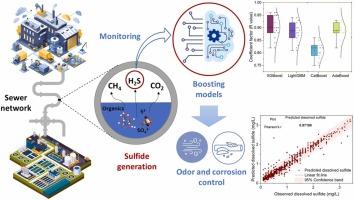
Sewer networks are important urban infrastructure for transporting sewage to treatment plants, yet the generation of hydrogen sulfide within these systems poses significant challenges. This acidic toxic gas not only emits foul odors but also causes corrosion, necessitating effective control measures. Recent studies have introduced a modelling approach to predict and control the formation of hydrogen sulfide in sewer system. However, the conventional and mathematical models have demonstrated limitations in simulating non-linear data. Meanwhile, advanced (boosting) machine learnings are proving to be effective tools for forecasting complex data, making them particularly suitable for simulating of sulfide concentrations. In this work, we aimed to develop a novel approach to predict hydrogen sulfide formation in sewer systems. This work employed 11 machine learning models (4 boosting algorithms and 7 traditional algorithms) for over 700 datasets to analysis the correlations between the key sewer operational parameters (including pH, dissolved oxygen (DO), temperature, weather conditions, sulfate concentration, and ammonia levels) and hydrogen sulfide production. The results showed that eXtreme Gradient Boosting (XGBoost) has the highest prediction efficiency (R=0.97, RMSE=0.177 mg/L), outperformed other boosting and traditional methods. The newly developed boosting-based model successfully predicted sulfide formation in various sewer networks, validated against literature data (R> 0.9, RMSE of 0.24 mg/L), confirming its effectiveness for simulating hydrogen sulfide in sewer tunnels. The optimal conditions for minimizing total sulfide generation were identified by the XGBoost model. These findings have the potential to improve the control and operation of sewer system in the future.
期刊介绍:
The Journal of Hazardous Materials serves as a global platform for promoting cutting-edge research in the field of Environmental Science and Engineering. Our publication features a wide range of articles, including full-length research papers, review articles, and perspectives, with the aim of enhancing our understanding of the dangers and risks associated with various materials concerning public health and the environment. It is important to note that the term "environmental contaminants" refers specifically to substances that pose hazardous effects through contamination, while excluding those that do not have such impacts on the environment or human health. Moreover, we emphasize the distinction between wastes and hazardous materials in order to provide further clarity on the scope of the journal. We have a keen interest in exploring specific compounds and microbial agents that have adverse effects on the environment.





 京公网安备 11010802042870号
京ICP备2023020795号-1
京公网安备 11010802042870号
京ICP备2023020795号-1

 分享
分享
 求助内容:
求助内容: 应助结果提醒方式:
 扫码关注我们
