Jiahuan Qiu, Qiuyue Sheng, Xinyuan Qian, Junxian Yao, Yujie Zhao, Xinyue Zhang, Chengcan Han, Ziliang Wu, Hui Ye, Boyu Peng, Guorong Shan, Qiang Zheng, Hanying Li, Miao Du
{"title":"基于固液界面掺杂的垂直相分离PSS薄膜用于柔性有机电化学晶体管","authors":"Jiahuan Qiu, Qiuyue Sheng, Xinyuan Qian, Junxian Yao, Yujie Zhao, Xinyue Zhang, Chengcan Han, Ziliang Wu, Hui Ye, Boyu Peng, Guorong Shan, Qiang Zheng, Hanying Li, Miao Du","doi":"10.1021/acsami.5c01311","DOIUrl":null,"url":null,"abstract":"Organic electrochemical transistors (OECTs) are seen as some of the most promising devices in organic bioelectronics. Recent interest in OECTs is sparked by the high performance of an organic semiconductor channel material, i.e., poly(3,4-ethylenedioxythiophene):poly(styrenesulfonate) (PEDOT:PSS). The capability of ion penetration and charge transport of the channel determines the performance of the OECTs. However, the uniform structure of the PEDOT:PSS channel always makes it difficult to achieve a well-balanced between the two functions. Here, we report a novel PEDOT:PSS film with a vertical phase separation structure (VPSS-P), where PSS accumulates at the surface, and PEDOT enriches at the bottom of the film. Such a unique structure improves the electrochemical stability and reduces the contact resistance, significantly enhancing OECT performance with high transconductance (70.5 mS), product of mobility (μ) and volumetric capacitance (<i>C</i>*) (μ<i>C</i>* ∼ 479 F cm<sup>–1</sup> V<sup>–1</sup> s<sup>–1</sup>), and ultralow contact resistance (∼0.79 Ω cm). Flexible OECT devices with VPSS-P show robust performance against deformation. Our findings highlight a new class of high-performance transistors and provide guidelines for designing state-of-the-art channel materials.","PeriodicalId":5,"journal":{"name":"ACS Applied Materials & Interfaces","volume":"21 1","pages":""},"PeriodicalIF":8.2000,"publicationDate":"2025-03-11","publicationTypes":"Journal Article","fieldsOfStudy":null,"isOpenAccess":false,"openAccessPdf":"","citationCount":"0","resultStr":"{\"title\":\"Vertically Phase-Separated PEDOT:PSS Film via Solid–Liquid Interface Doping for Flexible Organic Electrochemical Transistors\",\"authors\":\"Jiahuan Qiu, Qiuyue Sheng, Xinyuan Qian, Junxian Yao, Yujie Zhao, Xinyue Zhang, Chengcan Han, Ziliang Wu, Hui Ye, Boyu Peng, Guorong Shan, Qiang Zheng, Hanying Li, Miao Du\",\"doi\":\"10.1021/acsami.5c01311\",\"DOIUrl\":null,\"url\":null,\"abstract\":\"Organic electrochemical transistors (OECTs) are seen as some of the most promising devices in organic bioelectronics. Recent interest in OECTs is sparked by the high performance of an organic semiconductor channel material, i.e., poly(3,4-ethylenedioxythiophene):poly(styrenesulfonate) (PEDOT:PSS). The capability of ion penetration and charge transport of the channel determines the performance of the OECTs. However, the uniform structure of the PEDOT:PSS channel always makes it difficult to achieve a well-balanced between the two functions. Here, we report a novel PEDOT:PSS film with a vertical phase separation structure (VPSS-P), where PSS accumulates at the surface, and PEDOT enriches at the bottom of the film. Such a unique structure improves the electrochemical stability and reduces the contact resistance, significantly enhancing OECT performance with high transconductance (70.5 mS), product of mobility (μ) and volumetric capacitance (<i>C</i>*) (μ<i>C</i>* ∼ 479 F cm<sup>–1</sup> V<sup>–1</sup> s<sup>–1</sup>), and ultralow contact resistance (∼0.79 Ω cm). Flexible OECT devices with VPSS-P show robust performance against deformation. Our findings highlight a new class of high-performance transistors and provide guidelines for designing state-of-the-art channel materials.\",\"PeriodicalId\":5,\"journal\":{\"name\":\"ACS Applied Materials & Interfaces\",\"volume\":\"21 1\",\"pages\":\"\"},\"PeriodicalIF\":8.2000,\"publicationDate\":\"2025-03-11\",\"publicationTypes\":\"Journal Article\",\"fieldsOfStudy\":null,\"isOpenAccess\":false,\"openAccessPdf\":\"\",\"citationCount\":\"0\",\"resultStr\":null,\"platform\":\"Semanticscholar\",\"paperid\":null,\"PeriodicalName\":\"ACS Applied Materials & Interfaces\",\"FirstCategoryId\":\"88\",\"ListUrlMain\":\"https://doi.org/10.1021/acsami.5c01311\",\"RegionNum\":2,\"RegionCategory\":\"材料科学\",\"ArticlePicture\":[],\"TitleCN\":null,\"AbstractTextCN\":null,\"PMCID\":null,\"EPubDate\":\"\",\"PubModel\":\"\",\"JCR\":\"Q1\",\"JCRName\":\"MATERIALS SCIENCE, MULTIDISCIPLINARY\",\"Score\":null,\"Total\":0}","platform":"Semanticscholar","paperid":null,"PeriodicalName":"ACS Applied Materials & Interfaces","FirstCategoryId":"88","ListUrlMain":"https://doi.org/10.1021/acsami.5c01311","RegionNum":2,"RegionCategory":"材料科学","ArticlePicture":[],"TitleCN":null,"AbstractTextCN":null,"PMCID":null,"EPubDate":"","PubModel":"","JCR":"Q1","JCRName":"MATERIALS SCIENCE, MULTIDISCIPLINARY","Score":null,"Total":0}
引用次数: 0
摘要
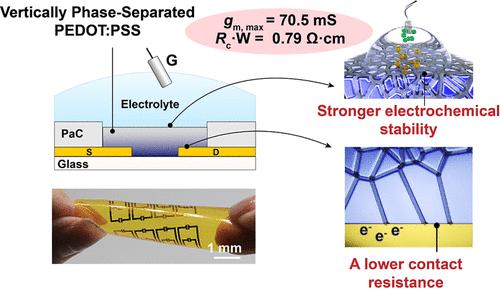
有机电化学晶体管(OECTs)是有机生物电子学中最有前途的器件之一。最近对oect的兴趣是由一种高性能的有机半导体通道材料引发的,即聚(3,4-乙烯二氧噻吩):聚(苯乙烯磺酸盐)(PEDOT:PSS)。离子穿透和电荷输运的能力决定了oect的性能。然而,由于PEDOT:PSS通道的统一结构,使得两者的功能很难很好地平衡。本文报道了一种具有垂直相分离结构(vps - p)的新型PEDOT:PSS薄膜,其中PSS积聚在薄膜表面,PEDOT富集在薄膜底部。这种独特的结构提高了电化学稳定性,降低了接触电阻,显著提高了OECT的性能,具有高跨导(70.5 mS)、迁移率(μ)和体积电容(C*) (μC* ~ 479 F cm - 1 V-1 s-1)和超低接触电阻(~ 0.79 Ω cm)。具有VPSS-P的柔性OECT设备具有抗变形的强大性能。我们的发现突出了一类新的高性能晶体管,并为设计最先进的沟道材料提供了指导方针。
Vertically Phase-Separated PEDOT:PSS Film via Solid–Liquid Interface Doping for Flexible Organic Electrochemical Transistors
Organic electrochemical transistors (OECTs) are seen as some of the most promising devices in organic bioelectronics. Recent interest in OECTs is sparked by the high performance of an organic semiconductor channel material, i.e., poly(3,4-ethylenedioxythiophene):poly(styrenesulfonate) (PEDOT:PSS). The capability of ion penetration and charge transport of the channel determines the performance of the OECTs. However, the uniform structure of the PEDOT:PSS channel always makes it difficult to achieve a well-balanced between the two functions. Here, we report a novel PEDOT:PSS film with a vertical phase separation structure (VPSS-P), where PSS accumulates at the surface, and PEDOT enriches at the bottom of the film. Such a unique structure improves the electrochemical stability and reduces the contact resistance, significantly enhancing OECT performance with high transconductance (70.5 mS), product of mobility (μ) and volumetric capacitance (C*) (μC* ∼ 479 F cm–1 V–1 s–1), and ultralow contact resistance (∼0.79 Ω cm). Flexible OECT devices with VPSS-P show robust performance against deformation. Our findings highlight a new class of high-performance transistors and provide guidelines for designing state-of-the-art channel materials.
期刊介绍:
ACS Applied Materials & Interfaces is a leading interdisciplinary journal that brings together chemists, engineers, physicists, and biologists to explore the development and utilization of newly-discovered materials and interfacial processes for specific applications. Our journal has experienced remarkable growth since its establishment in 2009, both in terms of the number of articles published and the impact of the research showcased. We are proud to foster a truly global community, with the majority of published articles originating from outside the United States, reflecting the rapid growth of applied research worldwide.




 京公网安备 11010802042870号
京ICP备2023020795号-1
京公网安备 11010802042870号
京ICP备2023020795号-1

 分享
分享
 求助内容:
求助内容: 应助结果提醒方式:
 扫码关注我们
