Bradley Nixon , William Hammond , Chris Zou , Lu Zhai
{"title":"更强的树木大小-死亡率与干旱和基底面积增加的关联:一项荟萃分析","authors":"Bradley Nixon , William Hammond , Chris Zou , Lu Zhai","doi":"10.1016/j.ecolind.2025.113326","DOIUrl":null,"url":null,"abstract":"<div><div>Given the escalating tree death rates with increasing drought disturbances, it’s imperative to enhance the mortality predictions for more informed management strategies to preserve forest resources. Tree size could serve as an indicator of tree mortality under drought, as theoretical studies have demonstrated that larger trees, due to their more susceptible hydraulic structures, are more likely to die during droughts. However, empirical studies have presented inconsistent findings regarding the relationship between tree size and mortality, challenging the importance of tree size in projecting drought-induced tree mortality. The variability in this relationship has not been thoroughly quantified, particularly under increasing drought impacts, such as greater drought magnitudes (including intensity and duration), warming temperature and larger stand basal area. We compiled 52 case studies at a global scale and conducted a <em>meta</em>-analysis to explore how the correlation between tree size and mortality fluctuates under drought. Our results showed that: (1) The correlation coefficients of tree size-mortality varied significantly across the studies analyzed, and ∼ 40 % of them reported a positive correlation, i.e., larger trees experienced higher mortality; (2) The correlation coefficients increased with drought intensity, drought duration, maximum temperature during drought, and stand basal area. Our results suggest a stronger association of tree size with tree mortality under intensified and prolonged droughts and greater basal areas. Thus, with the increasing droughts under climate change, tree size tends to play an increasing important role in projecting tree mortality. Moreover, management practices, e.g., thinning, could manipulate basal area to influence the tree size-mortality relationship.</div></div>","PeriodicalId":11459,"journal":{"name":"Ecological Indicators","volume":"172 ","pages":"Article 113326"},"PeriodicalIF":7.0000,"publicationDate":"2025-03-01","publicationTypes":"Journal Article","fieldsOfStudy":null,"isOpenAccess":false,"openAccessPdf":"","citationCount":"0","resultStr":"{\"title\":\"Stronger tree size-mortality association with increasing droughts and basal areas: A meta-analysis\",\"authors\":\"Bradley Nixon , William Hammond , Chris Zou , Lu Zhai\",\"doi\":\"10.1016/j.ecolind.2025.113326\",\"DOIUrl\":null,\"url\":null,\"abstract\":\"<div><div>Given the escalating tree death rates with increasing drought disturbances, it’s imperative to enhance the mortality predictions for more informed management strategies to preserve forest resources. Tree size could serve as an indicator of tree mortality under drought, as theoretical studies have demonstrated that larger trees, due to their more susceptible hydraulic structures, are more likely to die during droughts. However, empirical studies have presented inconsistent findings regarding the relationship between tree size and mortality, challenging the importance of tree size in projecting drought-induced tree mortality. The variability in this relationship has not been thoroughly quantified, particularly under increasing drought impacts, such as greater drought magnitudes (including intensity and duration), warming temperature and larger stand basal area. We compiled 52 case studies at a global scale and conducted a <em>meta</em>-analysis to explore how the correlation between tree size and mortality fluctuates under drought. Our results showed that: (1) The correlation coefficients of tree size-mortality varied significantly across the studies analyzed, and ∼ 40 % of them reported a positive correlation, i.e., larger trees experienced higher mortality; (2) The correlation coefficients increased with drought intensity, drought duration, maximum temperature during drought, and stand basal area. Our results suggest a stronger association of tree size with tree mortality under intensified and prolonged droughts and greater basal areas. Thus, with the increasing droughts under climate change, tree size tends to play an increasing important role in projecting tree mortality. Moreover, management practices, e.g., thinning, could manipulate basal area to influence the tree size-mortality relationship.</div></div>\",\"PeriodicalId\":11459,\"journal\":{\"name\":\"Ecological Indicators\",\"volume\":\"172 \",\"pages\":\"Article 113326\"},\"PeriodicalIF\":7.0000,\"publicationDate\":\"2025-03-01\",\"publicationTypes\":\"Journal Article\",\"fieldsOfStudy\":null,\"isOpenAccess\":false,\"openAccessPdf\":\"\",\"citationCount\":\"0\",\"resultStr\":null,\"platform\":\"Semanticscholar\",\"paperid\":null,\"PeriodicalName\":\"Ecological Indicators\",\"FirstCategoryId\":\"93\",\"ListUrlMain\":\"https://www.sciencedirect.com/science/article/pii/S1470160X25002572\",\"RegionNum\":2,\"RegionCategory\":\"环境科学与生态学\",\"ArticlePicture\":[],\"TitleCN\":null,\"AbstractTextCN\":null,\"PMCID\":null,\"EPubDate\":\"2025/3/11 0:00:00\",\"PubModel\":\"Epub\",\"JCR\":\"Q1\",\"JCRName\":\"ENVIRONMENTAL SCIENCES\",\"Score\":null,\"Total\":0}","platform":"Semanticscholar","paperid":null,"PeriodicalName":"Ecological Indicators","FirstCategoryId":"93","ListUrlMain":"https://www.sciencedirect.com/science/article/pii/S1470160X25002572","RegionNum":2,"RegionCategory":"环境科学与生态学","ArticlePicture":[],"TitleCN":null,"AbstractTextCN":null,"PMCID":null,"EPubDate":"2025/3/11 0:00:00","PubModel":"Epub","JCR":"Q1","JCRName":"ENVIRONMENTAL SCIENCES","Score":null,"Total":0}
Stronger tree size-mortality association with increasing droughts and basal areas: A meta-analysis
Given the escalating tree death rates with increasing drought disturbances, it’s imperative to enhance the mortality predictions for more informed management strategies to preserve forest resources. Tree size could serve as an indicator of tree mortality under drought, as theoretical studies have demonstrated that larger trees, due to their more susceptible hydraulic structures, are more likely to die during droughts. However, empirical studies have presented inconsistent findings regarding the relationship between tree size and mortality, challenging the importance of tree size in projecting drought-induced tree mortality. The variability in this relationship has not been thoroughly quantified, particularly under increasing drought impacts, such as greater drought magnitudes (including intensity and duration), warming temperature and larger stand basal area. We compiled 52 case studies at a global scale and conducted a meta-analysis to explore how the correlation between tree size and mortality fluctuates under drought. Our results showed that: (1) The correlation coefficients of tree size-mortality varied significantly across the studies analyzed, and ∼ 40 % of them reported a positive correlation, i.e., larger trees experienced higher mortality; (2) The correlation coefficients increased with drought intensity, drought duration, maximum temperature during drought, and stand basal area. Our results suggest a stronger association of tree size with tree mortality under intensified and prolonged droughts and greater basal areas. Thus, with the increasing droughts under climate change, tree size tends to play an increasing important role in projecting tree mortality. Moreover, management practices, e.g., thinning, could manipulate basal area to influence the tree size-mortality relationship.
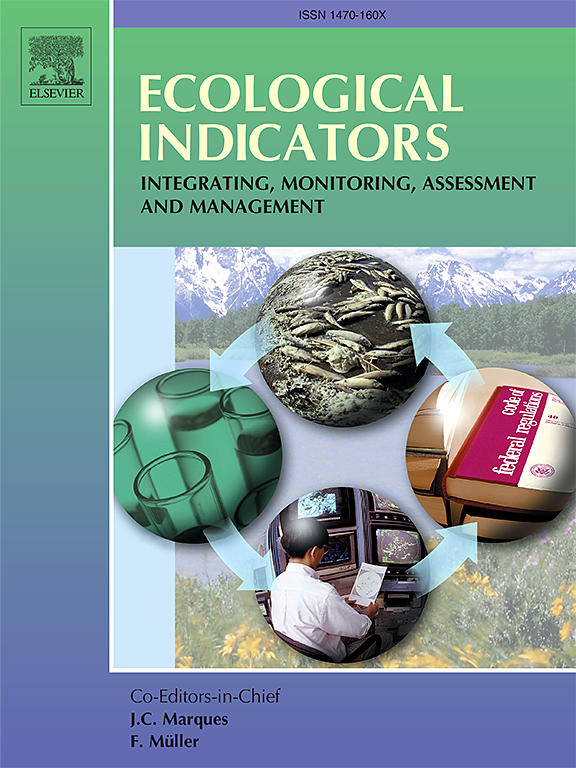
期刊介绍:
The ultimate aim of Ecological Indicators is to integrate the monitoring and assessment of ecological and environmental indicators with management practices. The journal provides a forum for the discussion of the applied scientific development and review of traditional indicator approaches as well as for theoretical, modelling and quantitative applications such as index development. Research into the following areas will be published.
• All aspects of ecological and environmental indicators and indices.
• New indicators, and new approaches and methods for indicator development, testing and use.
• Development and modelling of indices, e.g. application of indicator suites across multiple scales and resources.
• Analysis and research of resource, system- and scale-specific indicators.
• Methods for integration of social and other valuation metrics for the production of scientifically rigorous and politically-relevant assessments using indicator-based monitoring and assessment programs.
• How research indicators can be transformed into direct application for management purposes.
• Broader assessment objectives and methods, e.g. biodiversity, biological integrity, and sustainability, through the use of indicators.
• Resource-specific indicators such as landscape, agroecosystems, forests, wetlands, etc.




 京公网安备 11010802042870号
京ICP备2023020795号-1
京公网安备 11010802042870号
京ICP备2023020795号-1

 分享
分享
 求助内容:
求助内容: 应助结果提醒方式:
 扫码关注我们
