Gharam I. Mohammed , Sulafa Nassar , Thoraya A. Farghaly
{"title":"利用巯基氨基脲连接苯砜部分的化学传感器检测铅(II)离子的分光光度法","authors":"Gharam I. Mohammed , Sulafa Nassar , Thoraya A. Farghaly","doi":"10.1016/j.rechem.2025.102174","DOIUrl":null,"url":null,"abstract":"<div><div>For the spectrophotometric determination of lead, a novel, straightforward, and sensitive technique has been described. In an alkaline media (pH 12), lead)II (forms a yellow chelate with 2-(1-(4-methoxyphenyl)-2-(phenylsulfonyl)ethylidene)-hydrazine-1-carbothioamide. The complex's molar absorptivity at 257 nm (λ<sub>max</sub>) is 1.6 × 10<sup>3</sup> L mol<sup>−1</sup> cm<sup>−1</sup>, and its quantification and detection limits are 3.04 μg mL<sup>−1</sup> (15 μmol L<sup>−1</sup>) and 1.25 μg mL<sup>−1</sup> (6.03 μmol L<sup>−1</sup>), respectively. In the concentration range of (2.4–12) × 10<sup>−5</sup> mol L<sup>−1</sup>, Beer's law is followed. The technique has also been used for Pb recovery investigations in water samples. The molar ratio, which was 1:1 (L: Pb<sup>2+</sup>), guaranteed that a metal complex would form between the L and Pb ions. Simple, inexpensive, easy to use, rapid detection, and sensitivity are only a few advantages of the employed technique. The isolation and study of the solid complex (L-Pb) has provided more insight into the structure and stoichiometry of the complex that forms in solution between Pb(II) and L ligand. By using analytical methods such elemental analysis, spectral mass, UV–Vis spectra, and thermal analysis, the structure of the solid complex has been clarified.</div></div>","PeriodicalId":420,"journal":{"name":"Results in Chemistry","volume":"15 ","pages":"Article 102174"},"PeriodicalIF":4.2000,"publicationDate":"2025-05-01","publicationTypes":"Journal Article","fieldsOfStudy":null,"isOpenAccess":false,"openAccessPdf":"","citationCount":"0","resultStr":"{\"title\":\"Spectrophotometric method for detecting lead (II) ions using a chemosensor of the thiosemicarbazone-linked phenyl sulphone moiety\",\"authors\":\"Gharam I. Mohammed , Sulafa Nassar , Thoraya A. Farghaly\",\"doi\":\"10.1016/j.rechem.2025.102174\",\"DOIUrl\":null,\"url\":null,\"abstract\":\"<div><div>For the spectrophotometric determination of lead, a novel, straightforward, and sensitive technique has been described. In an alkaline media (pH 12), lead)II (forms a yellow chelate with 2-(1-(4-methoxyphenyl)-2-(phenylsulfonyl)ethylidene)-hydrazine-1-carbothioamide. The complex's molar absorptivity at 257 nm (λ<sub>max</sub>) is 1.6 × 10<sup>3</sup> L mol<sup>−1</sup> cm<sup>−1</sup>, and its quantification and detection limits are 3.04 μg mL<sup>−1</sup> (15 μmol L<sup>−1</sup>) and 1.25 μg mL<sup>−1</sup> (6.03 μmol L<sup>−1</sup>), respectively. In the concentration range of (2.4–12) × 10<sup>−5</sup> mol L<sup>−1</sup>, Beer's law is followed. The technique has also been used for Pb recovery investigations in water samples. The molar ratio, which was 1:1 (L: Pb<sup>2+</sup>), guaranteed that a metal complex would form between the L and Pb ions. Simple, inexpensive, easy to use, rapid detection, and sensitivity are only a few advantages of the employed technique. The isolation and study of the solid complex (L-Pb) has provided more insight into the structure and stoichiometry of the complex that forms in solution between Pb(II) and L ligand. By using analytical methods such elemental analysis, spectral mass, UV–Vis spectra, and thermal analysis, the structure of the solid complex has been clarified.</div></div>\",\"PeriodicalId\":420,\"journal\":{\"name\":\"Results in Chemistry\",\"volume\":\"15 \",\"pages\":\"Article 102174\"},\"PeriodicalIF\":4.2000,\"publicationDate\":\"2025-05-01\",\"publicationTypes\":\"Journal Article\",\"fieldsOfStudy\":null,\"isOpenAccess\":false,\"openAccessPdf\":\"\",\"citationCount\":\"0\",\"resultStr\":null,\"platform\":\"Semanticscholar\",\"paperid\":null,\"PeriodicalName\":\"Results in Chemistry\",\"FirstCategoryId\":\"1085\",\"ListUrlMain\":\"https://www.sciencedirect.com/science/article/pii/S2211715625001572\",\"RegionNum\":0,\"RegionCategory\":null,\"ArticlePicture\":[],\"TitleCN\":null,\"AbstractTextCN\":null,\"PMCID\":null,\"EPubDate\":\"2025/3/8 0:00:00\",\"PubModel\":\"Epub\",\"JCR\":\"Q2\",\"JCRName\":\"CHEMISTRY, MULTIDISCIPLINARY\",\"Score\":null,\"Total\":0}","platform":"Semanticscholar","paperid":null,"PeriodicalName":"Results in Chemistry","FirstCategoryId":"1085","ListUrlMain":"https://www.sciencedirect.com/science/article/pii/S2211715625001572","RegionNum":0,"RegionCategory":null,"ArticlePicture":[],"TitleCN":null,"AbstractTextCN":null,"PMCID":null,"EPubDate":"2025/3/8 0:00:00","PubModel":"Epub","JCR":"Q2","JCRName":"CHEMISTRY, MULTIDISCIPLINARY","Score":null,"Total":0}
Spectrophotometric method for detecting lead (II) ions using a chemosensor of the thiosemicarbazone-linked phenyl sulphone moiety
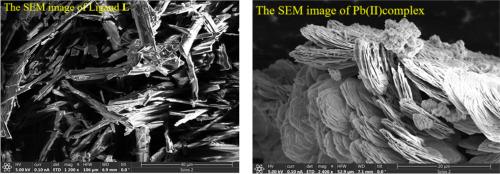
For the spectrophotometric determination of lead, a novel, straightforward, and sensitive technique has been described. In an alkaline media (pH 12), lead)II (forms a yellow chelate with 2-(1-(4-methoxyphenyl)-2-(phenylsulfonyl)ethylidene)-hydrazine-1-carbothioamide. The complex's molar absorptivity at 257 nm (λmax) is 1.6 × 10³ L mol−1 cm−1, and its quantification and detection limits are 3.04 μg mL−1 (15 μmol L−1) and 1.25 μg mL−1 (6.03 μmol L−1), respectively. In the concentration range of (2.4–12) × 10−5 mol L−1, Beer's law is followed. The technique has also been used for Pb recovery investigations in water samples. The molar ratio, which was 1:1 (L: Pb2+), guaranteed that a metal complex would form between the L and Pb ions. Simple, inexpensive, easy to use, rapid detection, and sensitivity are only a few advantages of the employed technique. The isolation and study of the solid complex (L-Pb) has provided more insight into the structure and stoichiometry of the complex that forms in solution between Pb(II) and L ligand. By using analytical methods such elemental analysis, spectral mass, UV–Vis spectra, and thermal analysis, the structure of the solid complex has been clarified.





 京公网安备 11010802042870号
京ICP备2023020795号-1
京公网安备 11010802042870号
京ICP备2023020795号-1

 分享
分享
 求助内容:
求助内容: 应助结果提醒方式:
 扫码关注我们
