{"title":"双交联水凝胶珠包封磷钨酸铵从高盐盐水中高效回收铷","authors":"Hui Yang, Baozhong Ma, Shuyang Shi, Jiancheng Yu, Yubo Liu, Zhihe Cao, Chengyan Wang, Yongqiang Chen","doi":"10.1016/j.desal.2025.118794","DOIUrl":null,"url":null,"abstract":"<div><div>Extracting rubidium from brine is critical for addressing the rubidium supply challenge. Ion exchange is an effective method for rubidium recovery, but practically, it faces the challenge that the adsorbent powder is too fine for column operation. Herein, hydrogel beads (AWP@AlG&PVA) were innovatively synthesized through dual crosslinking between sodium alginate and CaCl₂, as well as polyvinyl alcohol and boric acid, incorporating ammonium phosphotungstate (AWP) as the active component, and were employed as adsorbents for rubidium extraction from high-salinity brine. The mercury intrusion pore measurement confirmed that the prepared AWP@AlG&PVA is a porous material, with the majority of pores being large pores. Through systematic adsorption experiments, over 90 % of rubidium was adsorbed from the simulated solution under optimal conditions. The coexisting K<sup>+</sup> interfered with rubidium adsorption, while Na<sup>+</sup>, Ca<sup>2+</sup>, and Mg<sup>2+</sup> had no apparent influence. Adsorption kinetic study revealed that Rb adsorption adhered to the pseudo-first-order kinetic model. The adsorption isotherms of AWP@AlG&PVA on Rb<sup>+</sup> accord with the Freundlich model. XPS and SEM-EDS analyses indicated that the adsorption mechanism was ascribe to ion exchange between NH<sub>4</sub><sup>+</sup> and Rb<sup>+</sup>. Remarkably, the adsorbent exhibited excellent regeneration performance, retaining over 71.3 % of its adsorption ability after undergoing six sequential adsorption-desorption cycles in actual brine. This research suggested that the AWP@AlG&PVA beads address the challenges posed by fine powder and high solubility and are a feasible material for Rb adsorption from high-salinity brine.</div></div>","PeriodicalId":299,"journal":{"name":"Desalination","volume":"606 ","pages":"Article 118794"},"PeriodicalIF":9.8000,"publicationDate":"2025-07-01","publicationTypes":"Journal Article","fieldsOfStudy":null,"isOpenAccess":false,"openAccessPdf":"","citationCount":"0","resultStr":"{\"title\":\"Efficient recovery of rubidium from high-salinity brine using dual crosslinked hydrogel beads encapsulating ammonium phosphotungstate\",\"authors\":\"Hui Yang, Baozhong Ma, Shuyang Shi, Jiancheng Yu, Yubo Liu, Zhihe Cao, Chengyan Wang, Yongqiang Chen\",\"doi\":\"10.1016/j.desal.2025.118794\",\"DOIUrl\":null,\"url\":null,\"abstract\":\"<div><div>Extracting rubidium from brine is critical for addressing the rubidium supply challenge. Ion exchange is an effective method for rubidium recovery, but practically, it faces the challenge that the adsorbent powder is too fine for column operation. Herein, hydrogel beads (AWP@AlG&PVA) were innovatively synthesized through dual crosslinking between sodium alginate and CaCl₂, as well as polyvinyl alcohol and boric acid, incorporating ammonium phosphotungstate (AWP) as the active component, and were employed as adsorbents for rubidium extraction from high-salinity brine. The mercury intrusion pore measurement confirmed that the prepared AWP@AlG&PVA is a porous material, with the majority of pores being large pores. Through systematic adsorption experiments, over 90 % of rubidium was adsorbed from the simulated solution under optimal conditions. The coexisting K<sup>+</sup> interfered with rubidium adsorption, while Na<sup>+</sup>, Ca<sup>2+</sup>, and Mg<sup>2+</sup> had no apparent influence. Adsorption kinetic study revealed that Rb adsorption adhered to the pseudo-first-order kinetic model. The adsorption isotherms of AWP@AlG&PVA on Rb<sup>+</sup> accord with the Freundlich model. XPS and SEM-EDS analyses indicated that the adsorption mechanism was ascribe to ion exchange between NH<sub>4</sub><sup>+</sup> and Rb<sup>+</sup>. Remarkably, the adsorbent exhibited excellent regeneration performance, retaining over 71.3 % of its adsorption ability after undergoing six sequential adsorption-desorption cycles in actual brine. This research suggested that the AWP@AlG&PVA beads address the challenges posed by fine powder and high solubility and are a feasible material for Rb adsorption from high-salinity brine.</div></div>\",\"PeriodicalId\":299,\"journal\":{\"name\":\"Desalination\",\"volume\":\"606 \",\"pages\":\"Article 118794\"},\"PeriodicalIF\":9.8000,\"publicationDate\":\"2025-07-01\",\"publicationTypes\":\"Journal Article\",\"fieldsOfStudy\":null,\"isOpenAccess\":false,\"openAccessPdf\":\"\",\"citationCount\":\"0\",\"resultStr\":null,\"platform\":\"Semanticscholar\",\"paperid\":null,\"PeriodicalName\":\"Desalination\",\"FirstCategoryId\":\"5\",\"ListUrlMain\":\"https://www.sciencedirect.com/science/article/pii/S0011916425002693\",\"RegionNum\":1,\"RegionCategory\":\"工程技术\",\"ArticlePicture\":[],\"TitleCN\":null,\"AbstractTextCN\":null,\"PMCID\":null,\"EPubDate\":\"2025/3/8 0:00:00\",\"PubModel\":\"Epub\",\"JCR\":\"Q1\",\"JCRName\":\"ENGINEERING, CHEMICAL\",\"Score\":null,\"Total\":0}","platform":"Semanticscholar","paperid":null,"PeriodicalName":"Desalination","FirstCategoryId":"5","ListUrlMain":"https://www.sciencedirect.com/science/article/pii/S0011916425002693","RegionNum":1,"RegionCategory":"工程技术","ArticlePicture":[],"TitleCN":null,"AbstractTextCN":null,"PMCID":null,"EPubDate":"2025/3/8 0:00:00","PubModel":"Epub","JCR":"Q1","JCRName":"ENGINEERING, CHEMICAL","Score":null,"Total":0}
Efficient recovery of rubidium from high-salinity brine using dual crosslinked hydrogel beads encapsulating ammonium phosphotungstate
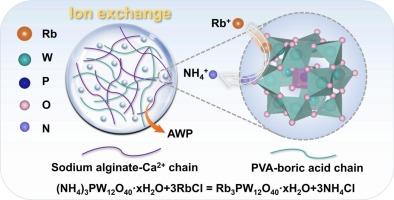
Extracting rubidium from brine is critical for addressing the rubidium supply challenge. Ion exchange is an effective method for rubidium recovery, but practically, it faces the challenge that the adsorbent powder is too fine for column operation. Herein, hydrogel beads (AWP@AlG&PVA) were innovatively synthesized through dual crosslinking between sodium alginate and CaCl₂, as well as polyvinyl alcohol and boric acid, incorporating ammonium phosphotungstate (AWP) as the active component, and were employed as adsorbents for rubidium extraction from high-salinity brine. The mercury intrusion pore measurement confirmed that the prepared AWP@AlG&PVA is a porous material, with the majority of pores being large pores. Through systematic adsorption experiments, over 90 % of rubidium was adsorbed from the simulated solution under optimal conditions. The coexisting K+ interfered with rubidium adsorption, while Na+, Ca2+, and Mg2+ had no apparent influence. Adsorption kinetic study revealed that Rb adsorption adhered to the pseudo-first-order kinetic model. The adsorption isotherms of AWP@AlG&PVA on Rb+ accord with the Freundlich model. XPS and SEM-EDS analyses indicated that the adsorption mechanism was ascribe to ion exchange between NH4+ and Rb+. Remarkably, the adsorbent exhibited excellent regeneration performance, retaining over 71.3 % of its adsorption ability after undergoing six sequential adsorption-desorption cycles in actual brine. This research suggested that the AWP@AlG&PVA beads address the challenges posed by fine powder and high solubility and are a feasible material for Rb adsorption from high-salinity brine.
期刊介绍:
Desalination is a scholarly journal that focuses on the field of desalination materials, processes, and associated technologies. It encompasses a wide range of disciplines and aims to publish exceptional papers in this area.
The journal invites submissions that explicitly revolve around water desalting and its applications to various sources such as seawater, groundwater, and wastewater. It particularly encourages research on diverse desalination methods including thermal, membrane, sorption, and hybrid processes.
By providing a platform for innovative studies, Desalination aims to advance the understanding and development of desalination technologies, promoting sustainable solutions for water scarcity challenges.




 京公网安备 11010802042870号
京ICP备2023020795号-1
京公网安备 11010802042870号
京ICP备2023020795号-1

 分享
分享
 求助内容:
求助内容: 应助结果提醒方式:
 扫码关注我们
