Zhaojing Jing , Xinxia Tian , Huibin Geng , Yangyang Wei , Jian Wang , Haitao Wang , Na Chang , Zhaokui Li
{"title":"金刚烷-1,3-二胺调节聚酰胺网络结构调节SWRO膜的选择性","authors":"Zhaojing Jing , Xinxia Tian , Huibin Geng , Yangyang Wei , Jian Wang , Haitao Wang , Na Chang , Zhaokui Li","doi":"10.1016/j.desal.2025.118792","DOIUrl":null,"url":null,"abstract":"<div><div>Seawater reverse osmosis (SWRO) membranes have served as the gold standard technology in seawater desalination over the past half-century. Despite their widespread application, the intrinsic separation mechanisms within the selective layer remain inadequately understood, highlighting the need for a new insight research. This study investigated the incorporation of adamantane-1,3-diamine (Ad), a secondary monomer characterized by its three-dimensional cage-like structure, into the aqueous phase to enhance its integration into the polyamide network. This affected the stacking morphology and spacing of the benzene rings as well as the folding and compaction structures. The fractal dimension of fully aromatic polyamide (APA) aggregates remained at about 1.70, indicating that Ad incorporation did not change the aggregation morphology, thus maintaining the consistent water permeability of the SWRO membrane. However, the rigid Ad molecules with obstructive effects increased the shoulder-to-shoulder packing spacing <em>d</em><sub><em>1</em></sub> of benzene rings in the polyamide network at high Ad concentrations. This change altered the twisting of polyamide chains, reducing their folding and colloidal particle compaction, thereby regulating the salt retention performance. As the composition, morphology, and thickness of APA layer remained largely unchanged, the packing spacing <em>d</em><sub><em>1</em></sub> is likely a key factor influencing the salt rejection performance of SWRO membranes.</div></div>","PeriodicalId":299,"journal":{"name":"Desalination","volume":"606 ","pages":"Article 118792"},"PeriodicalIF":9.9000,"publicationDate":"2025-07-01","publicationTypes":"Journal Article","fieldsOfStudy":null,"isOpenAccess":false,"openAccessPdf":"","citationCount":"0","resultStr":"{\"title\":\"Regulation of the polyamide network structure with adamantane-1,3-diamine to adjust the selectivity of SWRO membranes\",\"authors\":\"Zhaojing Jing , Xinxia Tian , Huibin Geng , Yangyang Wei , Jian Wang , Haitao Wang , Na Chang , Zhaokui Li\",\"doi\":\"10.1016/j.desal.2025.118792\",\"DOIUrl\":null,\"url\":null,\"abstract\":\"<div><div>Seawater reverse osmosis (SWRO) membranes have served as the gold standard technology in seawater desalination over the past half-century. Despite their widespread application, the intrinsic separation mechanisms within the selective layer remain inadequately understood, highlighting the need for a new insight research. This study investigated the incorporation of adamantane-1,3-diamine (Ad), a secondary monomer characterized by its three-dimensional cage-like structure, into the aqueous phase to enhance its integration into the polyamide network. This affected the stacking morphology and spacing of the benzene rings as well as the folding and compaction structures. The fractal dimension of fully aromatic polyamide (APA) aggregates remained at about 1.70, indicating that Ad incorporation did not change the aggregation morphology, thus maintaining the consistent water permeability of the SWRO membrane. However, the rigid Ad molecules with obstructive effects increased the shoulder-to-shoulder packing spacing <em>d</em><sub><em>1</em></sub> of benzene rings in the polyamide network at high Ad concentrations. This change altered the twisting of polyamide chains, reducing their folding and colloidal particle compaction, thereby regulating the salt retention performance. As the composition, morphology, and thickness of APA layer remained largely unchanged, the packing spacing <em>d</em><sub><em>1</em></sub> is likely a key factor influencing the salt rejection performance of SWRO membranes.</div></div>\",\"PeriodicalId\":299,\"journal\":{\"name\":\"Desalination\",\"volume\":\"606 \",\"pages\":\"Article 118792\"},\"PeriodicalIF\":9.9000,\"publicationDate\":\"2025-07-01\",\"publicationTypes\":\"Journal Article\",\"fieldsOfStudy\":null,\"isOpenAccess\":false,\"openAccessPdf\":\"\",\"citationCount\":\"0\",\"resultStr\":null,\"platform\":\"Semanticscholar\",\"paperid\":null,\"PeriodicalName\":\"Desalination\",\"FirstCategoryId\":\"5\",\"ListUrlMain\":\"https://www.sciencedirect.com/science/article/pii/S001191642500267X\",\"RegionNum\":1,\"RegionCategory\":\"工程技术\",\"ArticlePicture\":[],\"TitleCN\":null,\"AbstractTextCN\":null,\"PMCID\":null,\"EPubDate\":\"2025/3/8 0:00:00\",\"PubModel\":\"Epub\",\"JCR\":\"Q1\",\"JCRName\":\"ENGINEERING, CHEMICAL\",\"Score\":null,\"Total\":0}","platform":"Semanticscholar","paperid":null,"PeriodicalName":"Desalination","FirstCategoryId":"5","ListUrlMain":"https://www.sciencedirect.com/science/article/pii/S001191642500267X","RegionNum":1,"RegionCategory":"工程技术","ArticlePicture":[],"TitleCN":null,"AbstractTextCN":null,"PMCID":null,"EPubDate":"2025/3/8 0:00:00","PubModel":"Epub","JCR":"Q1","JCRName":"ENGINEERING, CHEMICAL","Score":null,"Total":0}
Regulation of the polyamide network structure with adamantane-1,3-diamine to adjust the selectivity of SWRO membranes
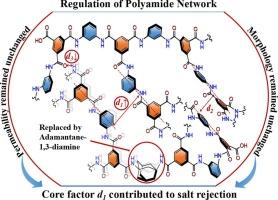
Seawater reverse osmosis (SWRO) membranes have served as the gold standard technology in seawater desalination over the past half-century. Despite their widespread application, the intrinsic separation mechanisms within the selective layer remain inadequately understood, highlighting the need for a new insight research. This study investigated the incorporation of adamantane-1,3-diamine (Ad), a secondary monomer characterized by its three-dimensional cage-like structure, into the aqueous phase to enhance its integration into the polyamide network. This affected the stacking morphology and spacing of the benzene rings as well as the folding and compaction structures. The fractal dimension of fully aromatic polyamide (APA) aggregates remained at about 1.70, indicating that Ad incorporation did not change the aggregation morphology, thus maintaining the consistent water permeability of the SWRO membrane. However, the rigid Ad molecules with obstructive effects increased the shoulder-to-shoulder packing spacing d1 of benzene rings in the polyamide network at high Ad concentrations. This change altered the twisting of polyamide chains, reducing their folding and colloidal particle compaction, thereby regulating the salt retention performance. As the composition, morphology, and thickness of APA layer remained largely unchanged, the packing spacing d1 is likely a key factor influencing the salt rejection performance of SWRO membranes.
期刊介绍:
Desalination is a scholarly journal that focuses on the field of desalination materials, processes, and associated technologies. It encompasses a wide range of disciplines and aims to publish exceptional papers in this area.
The journal invites submissions that explicitly revolve around water desalting and its applications to various sources such as seawater, groundwater, and wastewater. It particularly encourages research on diverse desalination methods including thermal, membrane, sorption, and hybrid processes.
By providing a platform for innovative studies, Desalination aims to advance the understanding and development of desalination technologies, promoting sustainable solutions for water scarcity challenges.




 京公网安备 11010802042870号
京ICP备2023020795号-1
京公网安备 11010802042870号
京ICP备2023020795号-1

 分享
分享
 求助内容:
求助内容: 应助结果提醒方式:
 扫码关注我们
