Sathish Thanikodi, Solairaju Jothi Arunachalam, Rathinasamy Saravanan, Jayant Giri, Muzhda Azizi, Ahmad O. Hourani, Faouzi Nasri
{"title":"不同纳米填料改性黄麻/红麻/玻璃纤维/环氧树脂杂化纳米复合材料的力学、形态和动态力学性能表征","authors":"Sathish Thanikodi, Solairaju Jothi Arunachalam, Rathinasamy Saravanan, Jayant Giri, Muzhda Azizi, Ahmad O. Hourani, Faouzi Nasri","doi":"10.1002/eng2.70026","DOIUrl":null,"url":null,"abstract":"<p>The study investigates the physical properties, strength, and flexibility of the jute/kenaf/glass reinforced composite. The composite is infused with equal quantities of silicon dioxide (SiO<sub>2</sub>), nanographene, and multi-walled carbon nanotubes (MWCNTs) at a concentration of 5 wt%, as specified by ASTM standards. The composite was created using a manual lay-up approach followed by compression molding, using a unique 10-layer fiber structure. The S4 (5%) composite specimen increased its tensile strength (TS) from 91 to 101 MPa, tensile modulus (TM) from 7.286 GPa to 10.286 GPa, interlaminar shear strength (ILSS) from 9.39 to 19.71 MPa, and glass-transition temperature (Tg) from 70°C to 85°C. The results show that the 5 wt% MWCNTs have significantly higher TS, TM, ILSS, and Tg than the unfilled composite and SiO<sub>2</sub>, nanographene, with increases of 5%, 2%, and 10%, respectively. Incorporating MWCNT nanofillers into composites significantly enhances their mechanical and dynamic characteristics when compared to composites without fillers. The study's findings show that adding MWCNTs to the matrix significantly improves performance when compared to the composite without any fillers. Scanning electron microscopy images reveal the underlying reasons of failure in composites, such as layer separation, material fissures, fiber extraction, and fiber breakage. The incorporation of 5 wt% MWCNTs into the jute/kenaf/glass hybrid composite matrix significantly enhances mechanical and dynamic properties compared to composites without fillers.</p>","PeriodicalId":72922,"journal":{"name":"Engineering reports : open access","volume":"7 3","pages":""},"PeriodicalIF":2.0000,"publicationDate":"2025-03-11","publicationTypes":"Journal Article","fieldsOfStudy":null,"isOpenAccess":false,"openAccessPdf":"https://onlinelibrary.wiley.com/doi/epdf/10.1002/eng2.70026","citationCount":"0","resultStr":"{\"title\":\"Characterization of Mechanical, Morphological, and Dynamic Mechanical Properties of Jute/Kenaf/Glass Fiber/Epoxy Modified With Various Nanofiller Hybridized Nanocomposites\",\"authors\":\"Sathish Thanikodi, Solairaju Jothi Arunachalam, Rathinasamy Saravanan, Jayant Giri, Muzhda Azizi, Ahmad O. Hourani, Faouzi Nasri\",\"doi\":\"10.1002/eng2.70026\",\"DOIUrl\":null,\"url\":null,\"abstract\":\"<p>The study investigates the physical properties, strength, and flexibility of the jute/kenaf/glass reinforced composite. The composite is infused with equal quantities of silicon dioxide (SiO<sub>2</sub>), nanographene, and multi-walled carbon nanotubes (MWCNTs) at a concentration of 5 wt%, as specified by ASTM standards. The composite was created using a manual lay-up approach followed by compression molding, using a unique 10-layer fiber structure. The S4 (5%) composite specimen increased its tensile strength (TS) from 91 to 101 MPa, tensile modulus (TM) from 7.286 GPa to 10.286 GPa, interlaminar shear strength (ILSS) from 9.39 to 19.71 MPa, and glass-transition temperature (Tg) from 70°C to 85°C. The results show that the 5 wt% MWCNTs have significantly higher TS, TM, ILSS, and Tg than the unfilled composite and SiO<sub>2</sub>, nanographene, with increases of 5%, 2%, and 10%, respectively. Incorporating MWCNT nanofillers into composites significantly enhances their mechanical and dynamic characteristics when compared to composites without fillers. The study's findings show that adding MWCNTs to the matrix significantly improves performance when compared to the composite without any fillers. Scanning electron microscopy images reveal the underlying reasons of failure in composites, such as layer separation, material fissures, fiber extraction, and fiber breakage. The incorporation of 5 wt% MWCNTs into the jute/kenaf/glass hybrid composite matrix significantly enhances mechanical and dynamic properties compared to composites without fillers.</p>\",\"PeriodicalId\":72922,\"journal\":{\"name\":\"Engineering reports : open access\",\"volume\":\"7 3\",\"pages\":\"\"},\"PeriodicalIF\":2.0000,\"publicationDate\":\"2025-03-11\",\"publicationTypes\":\"Journal Article\",\"fieldsOfStudy\":null,\"isOpenAccess\":false,\"openAccessPdf\":\"https://onlinelibrary.wiley.com/doi/epdf/10.1002/eng2.70026\",\"citationCount\":\"0\",\"resultStr\":null,\"platform\":\"Semanticscholar\",\"paperid\":null,\"PeriodicalName\":\"Engineering reports : open access\",\"FirstCategoryId\":\"1085\",\"ListUrlMain\":\"https://onlinelibrary.wiley.com/doi/10.1002/eng2.70026\",\"RegionNum\":0,\"RegionCategory\":null,\"ArticlePicture\":[],\"TitleCN\":null,\"AbstractTextCN\":null,\"PMCID\":null,\"EPubDate\":\"\",\"PubModel\":\"\",\"JCR\":\"Q3\",\"JCRName\":\"COMPUTER SCIENCE, INTERDISCIPLINARY APPLICATIONS\",\"Score\":null,\"Total\":0}","platform":"Semanticscholar","paperid":null,"PeriodicalName":"Engineering reports : open access","FirstCategoryId":"1085","ListUrlMain":"https://onlinelibrary.wiley.com/doi/10.1002/eng2.70026","RegionNum":0,"RegionCategory":null,"ArticlePicture":[],"TitleCN":null,"AbstractTextCN":null,"PMCID":null,"EPubDate":"","PubModel":"","JCR":"Q3","JCRName":"COMPUTER SCIENCE, INTERDISCIPLINARY APPLICATIONS","Score":null,"Total":0}
Characterization of Mechanical, Morphological, and Dynamic Mechanical Properties of Jute/Kenaf/Glass Fiber/Epoxy Modified With Various Nanofiller Hybridized Nanocomposites
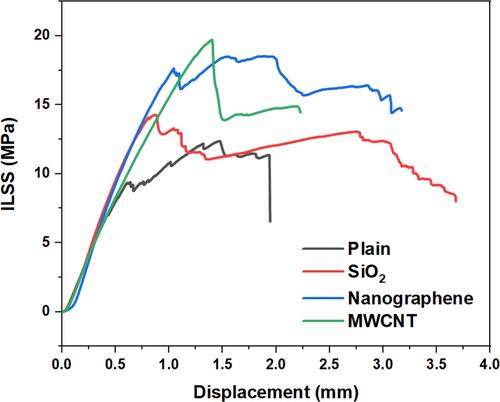
The study investigates the physical properties, strength, and flexibility of the jute/kenaf/glass reinforced composite. The composite is infused with equal quantities of silicon dioxide (SiO2), nanographene, and multi-walled carbon nanotubes (MWCNTs) at a concentration of 5 wt%, as specified by ASTM standards. The composite was created using a manual lay-up approach followed by compression molding, using a unique 10-layer fiber structure. The S4 (5%) composite specimen increased its tensile strength (TS) from 91 to 101 MPa, tensile modulus (TM) from 7.286 GPa to 10.286 GPa, interlaminar shear strength (ILSS) from 9.39 to 19.71 MPa, and glass-transition temperature (Tg) from 70°C to 85°C. The results show that the 5 wt% MWCNTs have significantly higher TS, TM, ILSS, and Tg than the unfilled composite and SiO2, nanographene, with increases of 5%, 2%, and 10%, respectively. Incorporating MWCNT nanofillers into composites significantly enhances their mechanical and dynamic characteristics when compared to composites without fillers. The study's findings show that adding MWCNTs to the matrix significantly improves performance when compared to the composite without any fillers. Scanning electron microscopy images reveal the underlying reasons of failure in composites, such as layer separation, material fissures, fiber extraction, and fiber breakage. The incorporation of 5 wt% MWCNTs into the jute/kenaf/glass hybrid composite matrix significantly enhances mechanical and dynamic properties compared to composites without fillers.




 京公网安备 11010802042870号
京ICP备2023020795号-1
京公网安备 11010802042870号
京ICP备2023020795号-1

 分享
分享

 求助内容:
求助内容: 应助结果提醒方式:
 扫码关注我们
