Marlene A. Velazco-Medel, Kacie Taylor Mariko Niimoto, Matthew D. Green
{"title":"探索磷基阴离子交换聚合物用于变湿直接空气捕获二氧化碳。","authors":"Marlene A. Velazco-Medel, Kacie Taylor Mariko Niimoto, Matthew D. Green","doi":"10.1002/marc.202401073","DOIUrl":null,"url":null,"abstract":"<p>This study explores the performance and stability of ammonium and phosphonium-based polymeric ionic liquids (PILs) with methyl and butyl substituents in moisture-swing direct air capture of CO<sub>2</sub>. The polymers are synthesized with chloride counterions, followed by ion exchange to the bicarbonate ion, and tests for CO<sub>2</sub> capture capacity and stability under cyclic wet–dry conditions. The phosphonium polymer with methyl substituents [PVBT-MeP] demonstrates the highest CO<sub>2</sub> capture capacity at ≈510 µmol g⁻¹, attributed to minimal steric hindrance and stronger ion pairing with bicarbonate. However, oxidative degradation is detected by <sup>31</sup>P NMR spectroscopy after the moisture swing experiment, with the appearance of a phosphine oxide peak at 61.28 ppm, which indicates phosphorus oxidation as the primary degradation pathway. In contrast, the ammonium polymer with butyl substituents [PVBT-BuN] exhibits the highest stability, showing no degradation over five moisture swing cycles. Additional stability experiments in 0.5 <span>m</span> KHCO<sub>3</sub> solutions reveal no degradation for any PIL, suggesting that oxidative degradation is driven by dynamic acid-base reactions during the moisture swing cycles in the air. These findings reveal the potential of phosphonium-based PILs for moisture-swing direct air capture, achieving high capacity while highlighting the need for optimized stability through counterion and structural design.</p>","PeriodicalId":205,"journal":{"name":"Macromolecular Rapid Communications","volume":"46 12","pages":""},"PeriodicalIF":4.1000,"publicationDate":"2025-03-10","publicationTypes":"Journal Article","fieldsOfStudy":null,"isOpenAccess":false,"openAccessPdf":"","citationCount":"0","resultStr":"{\"title\":\"Exploring Phosphonium-Based Anion Exchange Polymers for Moisture Swing Direct Air Capture of Carbon Dioxide\",\"authors\":\"Marlene A. Velazco-Medel, Kacie Taylor Mariko Niimoto, Matthew D. Green\",\"doi\":\"10.1002/marc.202401073\",\"DOIUrl\":null,\"url\":null,\"abstract\":\"<p>This study explores the performance and stability of ammonium and phosphonium-based polymeric ionic liquids (PILs) with methyl and butyl substituents in moisture-swing direct air capture of CO<sub>2</sub>. The polymers are synthesized with chloride counterions, followed by ion exchange to the bicarbonate ion, and tests for CO<sub>2</sub> capture capacity and stability under cyclic wet–dry conditions. The phosphonium polymer with methyl substituents [PVBT-MeP] demonstrates the highest CO<sub>2</sub> capture capacity at ≈510 µmol g⁻¹, attributed to minimal steric hindrance and stronger ion pairing with bicarbonate. However, oxidative degradation is detected by <sup>31</sup>P NMR spectroscopy after the moisture swing experiment, with the appearance of a phosphine oxide peak at 61.28 ppm, which indicates phosphorus oxidation as the primary degradation pathway. In contrast, the ammonium polymer with butyl substituents [PVBT-BuN] exhibits the highest stability, showing no degradation over five moisture swing cycles. Additional stability experiments in 0.5 <span>m</span> KHCO<sub>3</sub> solutions reveal no degradation for any PIL, suggesting that oxidative degradation is driven by dynamic acid-base reactions during the moisture swing cycles in the air. These findings reveal the potential of phosphonium-based PILs for moisture-swing direct air capture, achieving high capacity while highlighting the need for optimized stability through counterion and structural design.</p>\",\"PeriodicalId\":205,\"journal\":{\"name\":\"Macromolecular Rapid Communications\",\"volume\":\"46 12\",\"pages\":\"\"},\"PeriodicalIF\":4.1000,\"publicationDate\":\"2025-03-10\",\"publicationTypes\":\"Journal Article\",\"fieldsOfStudy\":null,\"isOpenAccess\":false,\"openAccessPdf\":\"\",\"citationCount\":\"0\",\"resultStr\":null,\"platform\":\"Semanticscholar\",\"paperid\":null,\"PeriodicalName\":\"Macromolecular Rapid Communications\",\"FirstCategoryId\":\"92\",\"ListUrlMain\":\"https://onlinelibrary.wiley.com/doi/10.1002/marc.202401073\",\"RegionNum\":3,\"RegionCategory\":\"化学\",\"ArticlePicture\":[],\"TitleCN\":null,\"AbstractTextCN\":null,\"PMCID\":null,\"EPubDate\":\"\",\"PubModel\":\"\",\"JCR\":\"Q2\",\"JCRName\":\"POLYMER SCIENCE\",\"Score\":null,\"Total\":0}","platform":"Semanticscholar","paperid":null,"PeriodicalName":"Macromolecular Rapid Communications","FirstCategoryId":"92","ListUrlMain":"https://onlinelibrary.wiley.com/doi/10.1002/marc.202401073","RegionNum":3,"RegionCategory":"化学","ArticlePicture":[],"TitleCN":null,"AbstractTextCN":null,"PMCID":null,"EPubDate":"","PubModel":"","JCR":"Q2","JCRName":"POLYMER SCIENCE","Score":null,"Total":0}
引用次数: 0
摘要
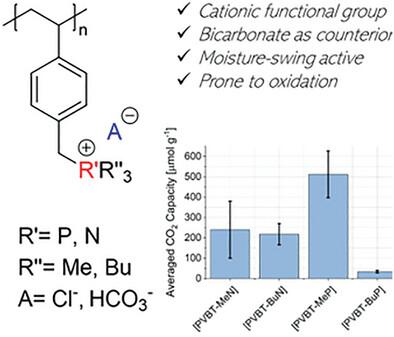
本研究探讨了甲基和丁基取代基铵基和磷基聚合物离子液体(PILs)在变湿直接空气捕集CO2中的性能和稳定性。这些聚合物是用氯离子合成的,然后离子交换成碳酸氢盐离子,并在干湿循环条件下测试二氧化碳捕获能力和稳定性。具有甲基取代基的磷酸聚合物[PVBT-MeP]表现出最高的CO2捕获能力(≈510µmol g⁻¹),归因于最小的空间位阻和与碳酸氢盐更强的离子配对。而在摇湿实验后,通过31P NMR检测到氧化降解,在61.28 ppm处出现了一个氧化磷峰,表明磷氧化是主要的降解途径。相比之下,具有丁基取代基的铵聚合物[PVBT-BuN]表现出最高的稳定性,在5个水分摇摆循环中没有降解。在0.5 m KHCO3溶液中进行的稳定性实验表明,任何PIL都没有降解,这表明氧化降解是由空气中水分摇摆循环中的动态酸碱反应驱动的。这些发现揭示了磷基pil在变湿直接空气捕获方面的潜力,实现了高容量,同时强调了通过对抗和结构设计优化稳定性的必要性。
Exploring Phosphonium-Based Anion Exchange Polymers for Moisture Swing Direct Air Capture of Carbon Dioxide
This study explores the performance and stability of ammonium and phosphonium-based polymeric ionic liquids (PILs) with methyl and butyl substituents in moisture-swing direct air capture of CO2. The polymers are synthesized with chloride counterions, followed by ion exchange to the bicarbonate ion, and tests for CO2 capture capacity and stability under cyclic wet–dry conditions. The phosphonium polymer with methyl substituents [PVBT-MeP] demonstrates the highest CO2 capture capacity at ≈510 µmol g⁻¹, attributed to minimal steric hindrance and stronger ion pairing with bicarbonate. However, oxidative degradation is detected by 31P NMR spectroscopy after the moisture swing experiment, with the appearance of a phosphine oxide peak at 61.28 ppm, which indicates phosphorus oxidation as the primary degradation pathway. In contrast, the ammonium polymer with butyl substituents [PVBT-BuN] exhibits the highest stability, showing no degradation over five moisture swing cycles. Additional stability experiments in 0.5 m KHCO3 solutions reveal no degradation for any PIL, suggesting that oxidative degradation is driven by dynamic acid-base reactions during the moisture swing cycles in the air. These findings reveal the potential of phosphonium-based PILs for moisture-swing direct air capture, achieving high capacity while highlighting the need for optimized stability through counterion and structural design.
期刊介绍:
Macromolecular Rapid Communications publishes original research in polymer science, ranging from chemistry and physics of polymers to polymers in materials science and life sciences.




 京公网安备 11010802042870号
京ICP备2023020795号-1
京公网安备 11010802042870号
京ICP备2023020795号-1

 分享
分享
 求助内容:
求助内容: 应助结果提醒方式:
 扫码关注我们
