Yuanyuan Xu , Shiqi Tian , Susu Jiang , Jun Ma , Gang Wen
{"title":"活性锰种类和电子传递途径氧化效率和环境影响的比较研究:高锰酸钾哪种活化途径最优?","authors":"Yuanyuan Xu , Shiqi Tian , Susu Jiang , Jun Ma , Gang Wen","doi":"10.1016/j.watres.2025.123490","DOIUrl":null,"url":null,"abstract":"<div><div>Various methods have been explored to activate potassium permanganate (Mn(VII)) for the elimination of organic compounds, typically by generating highly-reactive manganese species (RMnS) or mediated by electron transfer process (ETP). However, the oxidation selectivity, transformation pathways, toxicity byproduct potential, and efficacy in complicated water matrices associated with RMnS and ETP have not been comprehensively evaluated and compared, which is important for selecting a fit-of-purpose mechanism for water remediation. This study selected Mn(VII)/graphite process and ultraviolet (UV)/Mn(VII) process as the model ETP-dominated system and RMnS-dominated system, respectively. RMnS demonstrated significantly higher degradation efficiency for bromophenols, with oxidation rate constants 2.69–6.28 times higher than ETP. The oxidation efficiency of RMnS could be enhance under alkaline condition, whereas the degradation efficiency of ETP is dependent on the combined effects of solution pH and p<em>K</em>a of compounds. Furthermore, RMnS exhibited a stronger dehalogenation capacity, enabling the almost complete release of bromide ions from bromophenols with the formation of non-brominated organic product. Correspondingly, the RMnS process obviously reduced the brominated disinfection byproducts formation potential (DBPFPs). Mass spectrometry results revealed that the ETP process tended to form more polymeric brominated dimer products during the oxidation of bromophenol, leading to more DBPFPs production. ETP process showed superior degradation efficiency in real water backgrounds due to robustness against complicated water matrices, and displayed lower energy and oxidant consumption. Findings of this study elucidated the efficiency and mechanistic differences between RMnS and ETP, providing guidance for selecting activation methods to enhance KMnO<sub>4</sub>-based water treatment process.</div></div>","PeriodicalId":443,"journal":{"name":"Water Research","volume":"280 ","pages":"Article 123490"},"PeriodicalIF":12.8000,"publicationDate":"2025-07-15","publicationTypes":"Journal Article","fieldsOfStudy":null,"isOpenAccess":false,"openAccessPdf":"","citationCount":"0","resultStr":"{\"title\":\"A comparative study of reactive manganese species and electron transfer pathway in oxidation efficiency and environmental impact: Which activation route for potassium permanganate is optimal?\",\"authors\":\"Yuanyuan Xu , Shiqi Tian , Susu Jiang , Jun Ma , Gang Wen\",\"doi\":\"10.1016/j.watres.2025.123490\",\"DOIUrl\":null,\"url\":null,\"abstract\":\"<div><div>Various methods have been explored to activate potassium permanganate (Mn(VII)) for the elimination of organic compounds, typically by generating highly-reactive manganese species (RMnS) or mediated by electron transfer process (ETP). However, the oxidation selectivity, transformation pathways, toxicity byproduct potential, and efficacy in complicated water matrices associated with RMnS and ETP have not been comprehensively evaluated and compared, which is important for selecting a fit-of-purpose mechanism for water remediation. This study selected Mn(VII)/graphite process and ultraviolet (UV)/Mn(VII) process as the model ETP-dominated system and RMnS-dominated system, respectively. RMnS demonstrated significantly higher degradation efficiency for bromophenols, with oxidation rate constants 2.69–6.28 times higher than ETP. The oxidation efficiency of RMnS could be enhance under alkaline condition, whereas the degradation efficiency of ETP is dependent on the combined effects of solution pH and p<em>K</em>a of compounds. Furthermore, RMnS exhibited a stronger dehalogenation capacity, enabling the almost complete release of bromide ions from bromophenols with the formation of non-brominated organic product. Correspondingly, the RMnS process obviously reduced the brominated disinfection byproducts formation potential (DBPFPs). Mass spectrometry results revealed that the ETP process tended to form more polymeric brominated dimer products during the oxidation of bromophenol, leading to more DBPFPs production. ETP process showed superior degradation efficiency in real water backgrounds due to robustness against complicated water matrices, and displayed lower energy and oxidant consumption. Findings of this study elucidated the efficiency and mechanistic differences between RMnS and ETP, providing guidance for selecting activation methods to enhance KMnO<sub>4</sub>-based water treatment process.</div></div>\",\"PeriodicalId\":443,\"journal\":{\"name\":\"Water Research\",\"volume\":\"280 \",\"pages\":\"Article 123490\"},\"PeriodicalIF\":12.8000,\"publicationDate\":\"2025-07-15\",\"publicationTypes\":\"Journal Article\",\"fieldsOfStudy\":null,\"isOpenAccess\":false,\"openAccessPdf\":\"\",\"citationCount\":\"0\",\"resultStr\":null,\"platform\":\"Semanticscholar\",\"paperid\":null,\"PeriodicalName\":\"Water Research\",\"FirstCategoryId\":\"93\",\"ListUrlMain\":\"https://www.sciencedirect.com/science/article/pii/S0043135425004038\",\"RegionNum\":1,\"RegionCategory\":\"环境科学与生态学\",\"ArticlePicture\":[],\"TitleCN\":null,\"AbstractTextCN\":null,\"PMCID\":null,\"EPubDate\":\"2025/3/12 0:00:00\",\"PubModel\":\"Epub\",\"JCR\":\"Q1\",\"JCRName\":\"ENGINEERING, ENVIRONMENTAL\",\"Score\":null,\"Total\":0}","platform":"Semanticscholar","paperid":null,"PeriodicalName":"Water Research","FirstCategoryId":"93","ListUrlMain":"https://www.sciencedirect.com/science/article/pii/S0043135425004038","RegionNum":1,"RegionCategory":"环境科学与生态学","ArticlePicture":[],"TitleCN":null,"AbstractTextCN":null,"PMCID":null,"EPubDate":"2025/3/12 0:00:00","PubModel":"Epub","JCR":"Q1","JCRName":"ENGINEERING, ENVIRONMENTAL","Score":null,"Total":0}
A comparative study of reactive manganese species and electron transfer pathway in oxidation efficiency and environmental impact: Which activation route for potassium permanganate is optimal?
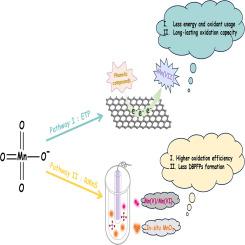
Various methods have been explored to activate potassium permanganate (Mn(VII)) for the elimination of organic compounds, typically by generating highly-reactive manganese species (RMnS) or mediated by electron transfer process (ETP). However, the oxidation selectivity, transformation pathways, toxicity byproduct potential, and efficacy in complicated water matrices associated with RMnS and ETP have not been comprehensively evaluated and compared, which is important for selecting a fit-of-purpose mechanism for water remediation. This study selected Mn(VII)/graphite process and ultraviolet (UV)/Mn(VII) process as the model ETP-dominated system and RMnS-dominated system, respectively. RMnS demonstrated significantly higher degradation efficiency for bromophenols, with oxidation rate constants 2.69–6.28 times higher than ETP. The oxidation efficiency of RMnS could be enhance under alkaline condition, whereas the degradation efficiency of ETP is dependent on the combined effects of solution pH and pKa of compounds. Furthermore, RMnS exhibited a stronger dehalogenation capacity, enabling the almost complete release of bromide ions from bromophenols with the formation of non-brominated organic product. Correspondingly, the RMnS process obviously reduced the brominated disinfection byproducts formation potential (DBPFPs). Mass spectrometry results revealed that the ETP process tended to form more polymeric brominated dimer products during the oxidation of bromophenol, leading to more DBPFPs production. ETP process showed superior degradation efficiency in real water backgrounds due to robustness against complicated water matrices, and displayed lower energy and oxidant consumption. Findings of this study elucidated the efficiency and mechanistic differences between RMnS and ETP, providing guidance for selecting activation methods to enhance KMnO4-based water treatment process.
期刊介绍:
Water Research, along with its open access companion journal Water Research X, serves as a platform for publishing original research papers covering various aspects of the science and technology related to the anthropogenic water cycle, water quality, and its management worldwide. The audience targeted by the journal comprises biologists, chemical engineers, chemists, civil engineers, environmental engineers, limnologists, and microbiologists. The scope of the journal include:
•Treatment processes for water and wastewaters (municipal, agricultural, industrial, and on-site treatment), including resource recovery and residuals management;
•Urban hydrology including sewer systems, stormwater management, and green infrastructure;
•Drinking water treatment and distribution;
•Potable and non-potable water reuse;
•Sanitation, public health, and risk assessment;
•Anaerobic digestion, solid and hazardous waste management, including source characterization and the effects and control of leachates and gaseous emissions;
•Contaminants (chemical, microbial, anthropogenic particles such as nanoparticles or microplastics) and related water quality sensing, monitoring, fate, and assessment;
•Anthropogenic impacts on inland, tidal, coastal and urban waters, focusing on surface and ground waters, and point and non-point sources of pollution;
•Environmental restoration, linked to surface water, groundwater and groundwater remediation;
•Analysis of the interfaces between sediments and water, and between water and atmosphere, focusing specifically on anthropogenic impacts;
•Mathematical modelling, systems analysis, machine learning, and beneficial use of big data related to the anthropogenic water cycle;
•Socio-economic, policy, and regulations studies.





 京公网安备 11010802042870号
京ICP备2023020795号-1
京公网安备 11010802042870号
京ICP备2023020795号-1

 分享
分享
 求助内容:
求助内容: 应助结果提醒方式:
 扫码关注我们
