Magdalena M. Mrokowska , Karolina Dzień , Anna Krztoń-Maziopa
{"title":"藻华期间流变分层海水对微塑料沉降动力学的影响","authors":"Magdalena M. Mrokowska , Karolina Dzień , Anna Krztoń-Maziopa","doi":"10.1016/j.watres.2025.123487","DOIUrl":null,"url":null,"abstract":"<div><div>The settling behaviour of microplastics (MPs) governs their residence time and bioavailability in the water column. Despite significant research efforts on the hydrodynamics of MPs in various aquatic environments, little attention has been given to MPs sinking in seawater enriched with mucus formed by exopolymers (EPSs) excessively secreted by microorganisms during algal blooms. These blooms often develop in density-stratified seawater and can rheologically modify the system by introducing a non-Newtonian EPS-rich layer to the Newtonian seawater column with a typical content of EPSs. In this study, we investigated the previously unaddressed role of rheological stratification that forms at the periphery of the algal bloom region in MPs sinking process. Our laboratory experiments revealed that variations in viscosity and viscoelasticity between Newtonian and non-Newtonian layers significantly impact MPs sinking velocity and orientation, often outweighing the effects of density stratification. Results demonstrated that the sinking velocity of MPs decreased in the non-Newtonian layer leading to residence times up to five times longer than in the Newtonian layer, showing a clear dependence on the viscosity difference between the two layers. Meanwhile, we identified the orientation instabilities of MPs enhanced with increasing EPS content. This study revealed previously unaddressed hydrodynamic effects in rheologically stratified seawater that may intensify MPs accumulation and their interactions with the ecosystem. This could help explain MPs fate in algal bloom-afflicted regions.</div></div>","PeriodicalId":443,"journal":{"name":"Water Research","volume":"280 ","pages":"Article 123487"},"PeriodicalIF":12.4000,"publicationDate":"2025-07-15","publicationTypes":"Journal Article","fieldsOfStudy":null,"isOpenAccess":false,"openAccessPdf":"","citationCount":"0","resultStr":"{\"title\":\"Effects of rheologically stratified seawater during algal bloom on sinking dynamics of microplastics\",\"authors\":\"Magdalena M. Mrokowska , Karolina Dzień , Anna Krztoń-Maziopa\",\"doi\":\"10.1016/j.watres.2025.123487\",\"DOIUrl\":null,\"url\":null,\"abstract\":\"<div><div>The settling behaviour of microplastics (MPs) governs their residence time and bioavailability in the water column. Despite significant research efforts on the hydrodynamics of MPs in various aquatic environments, little attention has been given to MPs sinking in seawater enriched with mucus formed by exopolymers (EPSs) excessively secreted by microorganisms during algal blooms. These blooms often develop in density-stratified seawater and can rheologically modify the system by introducing a non-Newtonian EPS-rich layer to the Newtonian seawater column with a typical content of EPSs. In this study, we investigated the previously unaddressed role of rheological stratification that forms at the periphery of the algal bloom region in MPs sinking process. Our laboratory experiments revealed that variations in viscosity and viscoelasticity between Newtonian and non-Newtonian layers significantly impact MPs sinking velocity and orientation, often outweighing the effects of density stratification. Results demonstrated that the sinking velocity of MPs decreased in the non-Newtonian layer leading to residence times up to five times longer than in the Newtonian layer, showing a clear dependence on the viscosity difference between the two layers. Meanwhile, we identified the orientation instabilities of MPs enhanced with increasing EPS content. This study revealed previously unaddressed hydrodynamic effects in rheologically stratified seawater that may intensify MPs accumulation and their interactions with the ecosystem. This could help explain MPs fate in algal bloom-afflicted regions.</div></div>\",\"PeriodicalId\":443,\"journal\":{\"name\":\"Water Research\",\"volume\":\"280 \",\"pages\":\"Article 123487\"},\"PeriodicalIF\":12.4000,\"publicationDate\":\"2025-07-15\",\"publicationTypes\":\"Journal Article\",\"fieldsOfStudy\":null,\"isOpenAccess\":false,\"openAccessPdf\":\"\",\"citationCount\":\"0\",\"resultStr\":null,\"platform\":\"Semanticscholar\",\"paperid\":null,\"PeriodicalName\":\"Water Research\",\"FirstCategoryId\":\"93\",\"ListUrlMain\":\"https://www.sciencedirect.com/science/article/pii/S0043135425004002\",\"RegionNum\":1,\"RegionCategory\":\"环境科学与生态学\",\"ArticlePicture\":[],\"TitleCN\":null,\"AbstractTextCN\":null,\"PMCID\":null,\"EPubDate\":\"2025/3/12 0:00:00\",\"PubModel\":\"Epub\",\"JCR\":\"Q1\",\"JCRName\":\"ENGINEERING, ENVIRONMENTAL\",\"Score\":null,\"Total\":0}","platform":"Semanticscholar","paperid":null,"PeriodicalName":"Water Research","FirstCategoryId":"93","ListUrlMain":"https://www.sciencedirect.com/science/article/pii/S0043135425004002","RegionNum":1,"RegionCategory":"环境科学与生态学","ArticlePicture":[],"TitleCN":null,"AbstractTextCN":null,"PMCID":null,"EPubDate":"2025/3/12 0:00:00","PubModel":"Epub","JCR":"Q1","JCRName":"ENGINEERING, ENVIRONMENTAL","Score":null,"Total":0}
Effects of rheologically stratified seawater during algal bloom on sinking dynamics of microplastics
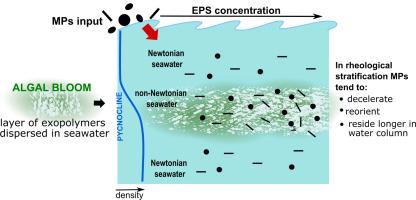
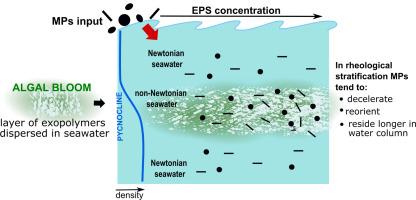
The settling behaviour of microplastics (MPs) governs their residence time and bioavailability in the water column. Despite significant research efforts on the hydrodynamics of MPs in various aquatic environments, little attention has been given to MPs sinking in seawater enriched with mucus formed by exopolymers (EPSs) excessively secreted by microorganisms during algal blooms. These blooms often develop in density-stratified seawater and can rheologically modify the system by introducing a non-Newtonian EPS-rich layer to the Newtonian seawater column with a typical content of EPSs. In this study, we investigated the previously unaddressed role of rheological stratification that forms at the periphery of the algal bloom region in MPs sinking process. Our laboratory experiments revealed that variations in viscosity and viscoelasticity between Newtonian and non-Newtonian layers significantly impact MPs sinking velocity and orientation, often outweighing the effects of density stratification. Results demonstrated that the sinking velocity of MPs decreased in the non-Newtonian layer leading to residence times up to five times longer than in the Newtonian layer, showing a clear dependence on the viscosity difference between the two layers. Meanwhile, we identified the orientation instabilities of MPs enhanced with increasing EPS content. This study revealed previously unaddressed hydrodynamic effects in rheologically stratified seawater that may intensify MPs accumulation and their interactions with the ecosystem. This could help explain MPs fate in algal bloom-afflicted regions.
期刊介绍:
Water Research, along with its open access companion journal Water Research X, serves as a platform for publishing original research papers covering various aspects of the science and technology related to the anthropogenic water cycle, water quality, and its management worldwide. The audience targeted by the journal comprises biologists, chemical engineers, chemists, civil engineers, environmental engineers, limnologists, and microbiologists. The scope of the journal include:
•Treatment processes for water and wastewaters (municipal, agricultural, industrial, and on-site treatment), including resource recovery and residuals management;
•Urban hydrology including sewer systems, stormwater management, and green infrastructure;
•Drinking water treatment and distribution;
•Potable and non-potable water reuse;
•Sanitation, public health, and risk assessment;
•Anaerobic digestion, solid and hazardous waste management, including source characterization and the effects and control of leachates and gaseous emissions;
•Contaminants (chemical, microbial, anthropogenic particles such as nanoparticles or microplastics) and related water quality sensing, monitoring, fate, and assessment;
•Anthropogenic impacts on inland, tidal, coastal and urban waters, focusing on surface and ground waters, and point and non-point sources of pollution;
•Environmental restoration, linked to surface water, groundwater and groundwater remediation;
•Analysis of the interfaces between sediments and water, and between water and atmosphere, focusing specifically on anthropogenic impacts;
•Mathematical modelling, systems analysis, machine learning, and beneficial use of big data related to the anthropogenic water cycle;
•Socio-economic, policy, and regulations studies.




 京公网安备 11010802042870号
京ICP备2023020795号-1
京公网安备 11010802042870号
京ICP备2023020795号-1

 分享
分享
 求助内容:
求助内容: 应助结果提醒方式:
 扫码关注我们
