Lin Ma , Xiaoyu Shi , Jingyi Liu , ShiShuai Gao , Daihui Zhang , Zenghui Cheng , Chenhuan Lai , Yuzhi Xu
{"title":"响应面法优化超声辅助木质素解聚制备低甲醛木材胶粘剂","authors":"Lin Ma , Xiaoyu Shi , Jingyi Liu , ShiShuai Gao , Daihui Zhang , Zenghui Cheng , Chenhuan Lai , Yuzhi Xu","doi":"10.1016/j.indcrop.2025.120760","DOIUrl":null,"url":null,"abstract":"<div><div>The heterogeneity, high molecular weight, and low content of functional groups have limited the high-value utilization of lignin to prepare high-performance resins. To overcome this obstacle, ultrasound-assisted lignin depolymerization was investigated as a gentle, efficient, and inexpensive method to improve the functionality and homogeneity of lignin. The response surface methodology combined with the Box–Behnken design was employed to optimize the yield and molecular weight of oligomeric lignin by varying three parameters: sonication time, lignin mass fraction, and solvent ratio. The predicted optimal yield (33 %) and molecular weight (<em>M</em><sub>n</sub> = 700) under optimal conditions (3 h, 14.3 % lignin, and MeOH/H<sub>2</sub>O = 3:1) were almost the same as those obtained experimentally (<em>M</em><sub>n</sub> = 710), yield of 33.8 %, proving the validity of the model. The depolymerized lignin (DL) was directly substituted for phenol to prepare depolymerized lignin phenol-formaldehyde resins (DLPF). The rheological and adhesive properties of these resins were compared with pure PF resin and lignin phenol-formaldehyde (LPF) resins. An enhanced bonding strength, but lower curing temperature and formaldehyde emission, were observed. This study presents a cost-effective and efficient method to prepare depolymerized lignin as the precursors of high-performance resins.</div></div>","PeriodicalId":13581,"journal":{"name":"Industrial Crops and Products","volume":"227 ","pages":"Article 120760"},"PeriodicalIF":6.4000,"publicationDate":"2025-05-01","publicationTypes":"Journal Article","fieldsOfStudy":null,"isOpenAccess":false,"openAccessPdf":"","citationCount":"0","resultStr":"{\"title\":\"Optimization of ultrasound-assisted lignin depolymerization using response surface methodology for low-formaldehyde emission wood adhesives\",\"authors\":\"Lin Ma , Xiaoyu Shi , Jingyi Liu , ShiShuai Gao , Daihui Zhang , Zenghui Cheng , Chenhuan Lai , Yuzhi Xu\",\"doi\":\"10.1016/j.indcrop.2025.120760\",\"DOIUrl\":null,\"url\":null,\"abstract\":\"<div><div>The heterogeneity, high molecular weight, and low content of functional groups have limited the high-value utilization of lignin to prepare high-performance resins. To overcome this obstacle, ultrasound-assisted lignin depolymerization was investigated as a gentle, efficient, and inexpensive method to improve the functionality and homogeneity of lignin. The response surface methodology combined with the Box–Behnken design was employed to optimize the yield and molecular weight of oligomeric lignin by varying three parameters: sonication time, lignin mass fraction, and solvent ratio. The predicted optimal yield (33 %) and molecular weight (<em>M</em><sub>n</sub> = 700) under optimal conditions (3 h, 14.3 % lignin, and MeOH/H<sub>2</sub>O = 3:1) were almost the same as those obtained experimentally (<em>M</em><sub>n</sub> = 710), yield of 33.8 %, proving the validity of the model. The depolymerized lignin (DL) was directly substituted for phenol to prepare depolymerized lignin phenol-formaldehyde resins (DLPF). The rheological and adhesive properties of these resins were compared with pure PF resin and lignin phenol-formaldehyde (LPF) resins. An enhanced bonding strength, but lower curing temperature and formaldehyde emission, were observed. This study presents a cost-effective and efficient method to prepare depolymerized lignin as the precursors of high-performance resins.</div></div>\",\"PeriodicalId\":13581,\"journal\":{\"name\":\"Industrial Crops and Products\",\"volume\":\"227 \",\"pages\":\"Article 120760\"},\"PeriodicalIF\":6.4000,\"publicationDate\":\"2025-05-01\",\"publicationTypes\":\"Journal Article\",\"fieldsOfStudy\":null,\"isOpenAccess\":false,\"openAccessPdf\":\"\",\"citationCount\":\"0\",\"resultStr\":null,\"platform\":\"Semanticscholar\",\"paperid\":null,\"PeriodicalName\":\"Industrial Crops and Products\",\"FirstCategoryId\":\"97\",\"ListUrlMain\":\"https://www.sciencedirect.com/science/article/pii/S0926669025003061\",\"RegionNum\":1,\"RegionCategory\":\"农林科学\",\"ArticlePicture\":[],\"TitleCN\":null,\"AbstractTextCN\":null,\"PMCID\":null,\"EPubDate\":\"2025/3/12 0:00:00\",\"PubModel\":\"Epub\",\"JCR\":\"Q1\",\"JCRName\":\"AGRICULTURAL ENGINEERING\",\"Score\":null,\"Total\":0}","platform":"Semanticscholar","paperid":null,"PeriodicalName":"Industrial Crops and Products","FirstCategoryId":"97","ListUrlMain":"https://www.sciencedirect.com/science/article/pii/S0926669025003061","RegionNum":1,"RegionCategory":"农林科学","ArticlePicture":[],"TitleCN":null,"AbstractTextCN":null,"PMCID":null,"EPubDate":"2025/3/12 0:00:00","PubModel":"Epub","JCR":"Q1","JCRName":"AGRICULTURAL ENGINEERING","Score":null,"Total":0}
Optimization of ultrasound-assisted lignin depolymerization using response surface methodology for low-formaldehyde emission wood adhesives
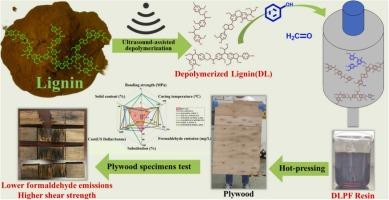
The heterogeneity, high molecular weight, and low content of functional groups have limited the high-value utilization of lignin to prepare high-performance resins. To overcome this obstacle, ultrasound-assisted lignin depolymerization was investigated as a gentle, efficient, and inexpensive method to improve the functionality and homogeneity of lignin. The response surface methodology combined with the Box–Behnken design was employed to optimize the yield and molecular weight of oligomeric lignin by varying three parameters: sonication time, lignin mass fraction, and solvent ratio. The predicted optimal yield (33 %) and molecular weight (Mn = 700) under optimal conditions (3 h, 14.3 % lignin, and MeOH/H2O = 3:1) were almost the same as those obtained experimentally (Mn = 710), yield of 33.8 %, proving the validity of the model. The depolymerized lignin (DL) was directly substituted for phenol to prepare depolymerized lignin phenol-formaldehyde resins (DLPF). The rheological and adhesive properties of these resins were compared with pure PF resin and lignin phenol-formaldehyde (LPF) resins. An enhanced bonding strength, but lower curing temperature and formaldehyde emission, were observed. This study presents a cost-effective and efficient method to prepare depolymerized lignin as the precursors of high-performance resins.
期刊介绍:
Industrial Crops and Products is an International Journal publishing academic and industrial research on industrial (defined as non-food/non-feed) crops and products. Papers concern both crop-oriented and bio-based materials from crops-oriented research, and should be of interest to an international audience, hypothesis driven, and where comparisons are made statistics performed.




 京公网安备 11010802042870号
京ICP备2023020795号-1
京公网安备 11010802042870号
京ICP备2023020795号-1

 分享
分享
 求助内容:
求助内容: 应助结果提醒方式:
 扫码关注我们
