Jun-Ho Hong , Jeon Kim , Ejin Han , Seon-Mo Yang , Hee-Soo Kim , Jihwan Kim , Chong Seung Yoon
{"title":"利用氧化亚铁硫杆菌对废锂离子电池正极材料进行磁场辅助生物浸出","authors":"Jun-Ho Hong , Jeon Kim , Ejin Han , Seon-Mo Yang , Hee-Soo Kim , Jihwan Kim , Chong Seung Yoon","doi":"10.1016/j.chemosphere.2025.144303","DOIUrl":null,"url":null,"abstract":"<div><div>A relatively weak static magnetic field with field strength is externally applied during the growth of using <em>Acidithiobacillus ferrooxidans</em> and subsequent bioleaching of spent Li-ion batteries (LIBs) to recover Li, Ni, Co, and Mn. 5 mT is the optimal field strength which allows 100 % Li to be recovered from a commercial black mass containing Li[Ni<sub>0.6</sub>Co<sub>0.2</sub>Mn<sub>0.2</sub>]O<sub>2</sub> after 3 days of leaching. 85 % Ni, 95 % Co, and 100 % Mn are also recovered as dissolved in biogenic H<sub>2</sub>SO<sub>4</sub> after 3 days. Without the external magnetic field, the leaching efficiency is limited to 20–40 % after the same leaching period. It is shown that the magnetic state of the substrate largely influences bioleaching efficiency since the magnetic enhancement is observed only from paramagnetic and ferromagnetic materials through improved cell attachment and not from antiferromagnetic materials. The proposed magnetic field-assisted bioleaching of spent LIBs using <em>A. ferrooxidans</em> can help the recycling of raw materials back into the circular economy for LIBs.</div></div>","PeriodicalId":276,"journal":{"name":"Chemosphere","volume":"376 ","pages":"Article 144303"},"PeriodicalIF":8.1000,"publicationDate":"2025-05-01","publicationTypes":"Journal Article","fieldsOfStudy":null,"isOpenAccess":false,"openAccessPdf":"","citationCount":"0","resultStr":"{\"title\":\"Magnetic field-assisted bioleaching of cathode materials from spent Li-ion batteries using Acidithiobacillus ferrooxidans\",\"authors\":\"Jun-Ho Hong , Jeon Kim , Ejin Han , Seon-Mo Yang , Hee-Soo Kim , Jihwan Kim , Chong Seung Yoon\",\"doi\":\"10.1016/j.chemosphere.2025.144303\",\"DOIUrl\":null,\"url\":null,\"abstract\":\"<div><div>A relatively weak static magnetic field with field strength is externally applied during the growth of using <em>Acidithiobacillus ferrooxidans</em> and subsequent bioleaching of spent Li-ion batteries (LIBs) to recover Li, Ni, Co, and Mn. 5 mT is the optimal field strength which allows 100 % Li to be recovered from a commercial black mass containing Li[Ni<sub>0.6</sub>Co<sub>0.2</sub>Mn<sub>0.2</sub>]O<sub>2</sub> after 3 days of leaching. 85 % Ni, 95 % Co, and 100 % Mn are also recovered as dissolved in biogenic H<sub>2</sub>SO<sub>4</sub> after 3 days. Without the external magnetic field, the leaching efficiency is limited to 20–40 % after the same leaching period. It is shown that the magnetic state of the substrate largely influences bioleaching efficiency since the magnetic enhancement is observed only from paramagnetic and ferromagnetic materials through improved cell attachment and not from antiferromagnetic materials. The proposed magnetic field-assisted bioleaching of spent LIBs using <em>A. ferrooxidans</em> can help the recycling of raw materials back into the circular economy for LIBs.</div></div>\",\"PeriodicalId\":276,\"journal\":{\"name\":\"Chemosphere\",\"volume\":\"376 \",\"pages\":\"Article 144303\"},\"PeriodicalIF\":8.1000,\"publicationDate\":\"2025-05-01\",\"publicationTypes\":\"Journal Article\",\"fieldsOfStudy\":null,\"isOpenAccess\":false,\"openAccessPdf\":\"\",\"citationCount\":\"0\",\"resultStr\":null,\"platform\":\"Semanticscholar\",\"paperid\":null,\"PeriodicalName\":\"Chemosphere\",\"FirstCategoryId\":\"93\",\"ListUrlMain\":\"https://www.sciencedirect.com/science/article/pii/S0045653525002450\",\"RegionNum\":2,\"RegionCategory\":\"环境科学与生态学\",\"ArticlePicture\":[],\"TitleCN\":null,\"AbstractTextCN\":null,\"PMCID\":null,\"EPubDate\":\"2025/3/12 0:00:00\",\"PubModel\":\"Epub\",\"JCR\":\"Q1\",\"JCRName\":\"ENVIRONMENTAL SCIENCES\",\"Score\":null,\"Total\":0}","platform":"Semanticscholar","paperid":null,"PeriodicalName":"Chemosphere","FirstCategoryId":"93","ListUrlMain":"https://www.sciencedirect.com/science/article/pii/S0045653525002450","RegionNum":2,"RegionCategory":"环境科学与生态学","ArticlePicture":[],"TitleCN":null,"AbstractTextCN":null,"PMCID":null,"EPubDate":"2025/3/12 0:00:00","PubModel":"Epub","JCR":"Q1","JCRName":"ENVIRONMENTAL SCIENCES","Score":null,"Total":0}
Magnetic field-assisted bioleaching of cathode materials from spent Li-ion batteries using Acidithiobacillus ferrooxidans
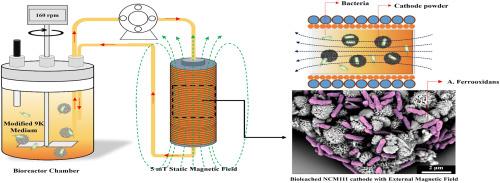
A relatively weak static magnetic field with field strength is externally applied during the growth of using Acidithiobacillus ferrooxidans and subsequent bioleaching of spent Li-ion batteries (LIBs) to recover Li, Ni, Co, and Mn. 5 mT is the optimal field strength which allows 100 % Li to be recovered from a commercial black mass containing Li[Ni0.6Co0.2Mn0.2]O2 after 3 days of leaching. 85 % Ni, 95 % Co, and 100 % Mn are also recovered as dissolved in biogenic H2SO4 after 3 days. Without the external magnetic field, the leaching efficiency is limited to 20–40 % after the same leaching period. It is shown that the magnetic state of the substrate largely influences bioleaching efficiency since the magnetic enhancement is observed only from paramagnetic and ferromagnetic materials through improved cell attachment and not from antiferromagnetic materials. The proposed magnetic field-assisted bioleaching of spent LIBs using A. ferrooxidans can help the recycling of raw materials back into the circular economy for LIBs.
期刊介绍:
Chemosphere, being an international multidisciplinary journal, is dedicated to publishing original communications and review articles on chemicals in the environment. The scope covers a wide range of topics, including the identification, quantification, behavior, fate, toxicology, treatment, and remediation of chemicals in the bio-, hydro-, litho-, and atmosphere, ensuring the broad dissemination of research in this field.




 京公网安备 11010802042870号
京ICP备2023020795号-1
京公网安备 11010802042870号
京ICP备2023020795号-1

 分享
分享
 求助内容:
求助内容: 应助结果提醒方式:
 扫码关注我们
