Y.Q. Lin , X. Bai , F.B. Xiong , Z.K. Hu , M.M. Li , Q.Q. Zhuang , Z.J. Cheng
{"title":"用于白光LED和室内植物生长的新型Na3KMg7(PO4)6: RE3+ (RE = Eu, Dy, Tb)荧光粉的合成及多色发光性能","authors":"Y.Q. Lin , X. Bai , F.B. Xiong , Z.K. Hu , M.M. Li , Q.Q. Zhuang , Z.J. Cheng","doi":"10.1016/j.optmat.2025.116887","DOIUrl":null,"url":null,"abstract":"<div><div>Novel phosphors Na<sub>3</sub>KMg<sub>7</sub>(PO<sub>4</sub>)<sub>6</sub>: RE<sup>3+</sup> (RE = Eu, Dy, Tb) were successfully synthesized via a high temperature solid-state reaction method. The X-ray diffraction (XRD), scanning electron microscopy (SEM), photoluminescence (PL) excitation and emission spectra, decay lifetimes and temperature-dependent PL emission spectra were utilized to characterize these as-synthesized samples. Under UV light excitation, Na<sub>3</sub>KMg<sub>7</sub>(PO<sub>4</sub>)<sub>6</sub>: Eu<sup>3+</sup>, Na<sub>3</sub>KMg<sub>7</sub>(PO<sub>4</sub>)<sub>6</sub>: Dy<sup>3+</sup>, and Na<sub>3</sub>KMg<sub>7</sub>(PO<sub>4</sub>)<sub>6</sub>: Tb<sup>3+</sup> exhibited the characteristic emission of Eu<sup>3+</sup> at 696 nm (the <sup>5</sup>D<sub>0</sub>→<sup>7</sup>F<sub>4</sub> transition), Dy<sup>3+</sup> at 478 nm (the <sup>4</sup>F<sub>9/2</sub> → <sup>6</sup>H<sub>15/2</sub> transition) and 572 nm (the <sup>4</sup>F<sub>9/2</sub> → <sup>6</sup>H<sub>13/2</sub> transition), and Tb<sup>3+</sup> at 540 nm (the <sup>5</sup>D<sub>4</sub>→<sup>7</sup>F<sub>5</sub> transition), respectively. The emission bands of Na<sub>3</sub>KMg<sub>7</sub>(PO<sub>4</sub>)<sub>6</sub>: Eu<sup>3+</sup> matched well with the photosensitive pigments phytochrome P<sub>R</sub> and P<sub>FR</sub>. The concentration quenching of Na<sub>3</sub>KMg<sub>7</sub>(PO<sub>4</sub>)<sub>6</sub>: RE<sup>3+</sup> (RE = Eu, Dy, Tb) were attributed to be the dipole-quadrupole, dipole-dipole and dipole-dipole electric multipole interactions, respectively. These phosphors exhibited good thermal stability and maintained above 85 % of their room-temperature emission intensities at 453 <em>K</em>. These results demonstrated that Na<sub>3</sub>KMg<sub>7</sub>(PO<sub>4</sub>)<sub>6</sub>: RE<sup>3+</sup> (RE = Eu, Dy, Tb) as novel multi-color emitting phosphors have a great potential application in white LED and indoor plant growth.</div></div>","PeriodicalId":19564,"journal":{"name":"Optical Materials","volume":"162 ","pages":"Article 116887"},"PeriodicalIF":4.2000,"publicationDate":"2025-05-01","publicationTypes":"Journal Article","fieldsOfStudy":null,"isOpenAccess":false,"openAccessPdf":"","citationCount":"0","resultStr":"{\"title\":\"Synthesis and multi-color emission properties of novel Na3KMg7(PO4)6: RE3+ (RE = Eu, Dy, Tb) phosphor for white LED and indoor plant growth\",\"authors\":\"Y.Q. Lin , X. Bai , F.B. Xiong , Z.K. Hu , M.M. Li , Q.Q. Zhuang , Z.J. Cheng\",\"doi\":\"10.1016/j.optmat.2025.116887\",\"DOIUrl\":null,\"url\":null,\"abstract\":\"<div><div>Novel phosphors Na<sub>3</sub>KMg<sub>7</sub>(PO<sub>4</sub>)<sub>6</sub>: RE<sup>3+</sup> (RE = Eu, Dy, Tb) were successfully synthesized via a high temperature solid-state reaction method. The X-ray diffraction (XRD), scanning electron microscopy (SEM), photoluminescence (PL) excitation and emission spectra, decay lifetimes and temperature-dependent PL emission spectra were utilized to characterize these as-synthesized samples. Under UV light excitation, Na<sub>3</sub>KMg<sub>7</sub>(PO<sub>4</sub>)<sub>6</sub>: Eu<sup>3+</sup>, Na<sub>3</sub>KMg<sub>7</sub>(PO<sub>4</sub>)<sub>6</sub>: Dy<sup>3+</sup>, and Na<sub>3</sub>KMg<sub>7</sub>(PO<sub>4</sub>)<sub>6</sub>: Tb<sup>3+</sup> exhibited the characteristic emission of Eu<sup>3+</sup> at 696 nm (the <sup>5</sup>D<sub>0</sub>→<sup>7</sup>F<sub>4</sub> transition), Dy<sup>3+</sup> at 478 nm (the <sup>4</sup>F<sub>9/2</sub> → <sup>6</sup>H<sub>15/2</sub> transition) and 572 nm (the <sup>4</sup>F<sub>9/2</sub> → <sup>6</sup>H<sub>13/2</sub> transition), and Tb<sup>3+</sup> at 540 nm (the <sup>5</sup>D<sub>4</sub>→<sup>7</sup>F<sub>5</sub> transition), respectively. The emission bands of Na<sub>3</sub>KMg<sub>7</sub>(PO<sub>4</sub>)<sub>6</sub>: Eu<sup>3+</sup> matched well with the photosensitive pigments phytochrome P<sub>R</sub> and P<sub>FR</sub>. The concentration quenching of Na<sub>3</sub>KMg<sub>7</sub>(PO<sub>4</sub>)<sub>6</sub>: RE<sup>3+</sup> (RE = Eu, Dy, Tb) were attributed to be the dipole-quadrupole, dipole-dipole and dipole-dipole electric multipole interactions, respectively. These phosphors exhibited good thermal stability and maintained above 85 % of their room-temperature emission intensities at 453 <em>K</em>. These results demonstrated that Na<sub>3</sub>KMg<sub>7</sub>(PO<sub>4</sub>)<sub>6</sub>: RE<sup>3+</sup> (RE = Eu, Dy, Tb) as novel multi-color emitting phosphors have a great potential application in white LED and indoor plant growth.</div></div>\",\"PeriodicalId\":19564,\"journal\":{\"name\":\"Optical Materials\",\"volume\":\"162 \",\"pages\":\"Article 116887\"},\"PeriodicalIF\":4.2000,\"publicationDate\":\"2025-05-01\",\"publicationTypes\":\"Journal Article\",\"fieldsOfStudy\":null,\"isOpenAccess\":false,\"openAccessPdf\":\"\",\"citationCount\":\"0\",\"resultStr\":null,\"platform\":\"Semanticscholar\",\"paperid\":null,\"PeriodicalName\":\"Optical Materials\",\"FirstCategoryId\":\"88\",\"ListUrlMain\":\"https://www.sciencedirect.com/science/article/pii/S0925346725002472\",\"RegionNum\":3,\"RegionCategory\":\"材料科学\",\"ArticlePicture\":[],\"TitleCN\":null,\"AbstractTextCN\":null,\"PMCID\":null,\"EPubDate\":\"2025/3/6 0:00:00\",\"PubModel\":\"Epub\",\"JCR\":\"Q2\",\"JCRName\":\"MATERIALS SCIENCE, MULTIDISCIPLINARY\",\"Score\":null,\"Total\":0}","platform":"Semanticscholar","paperid":null,"PeriodicalName":"Optical Materials","FirstCategoryId":"88","ListUrlMain":"https://www.sciencedirect.com/science/article/pii/S0925346725002472","RegionNum":3,"RegionCategory":"材料科学","ArticlePicture":[],"TitleCN":null,"AbstractTextCN":null,"PMCID":null,"EPubDate":"2025/3/6 0:00:00","PubModel":"Epub","JCR":"Q2","JCRName":"MATERIALS SCIENCE, MULTIDISCIPLINARY","Score":null,"Total":0}
Synthesis and multi-color emission properties of novel Na3KMg7(PO4)6: RE3+ (RE = Eu, Dy, Tb) phosphor for white LED and indoor plant growth
Novel phosphors Na3KMg7(PO4)6: RE3+ (RE = Eu, Dy, Tb) were successfully synthesized via a high temperature solid-state reaction method. The X-ray diffraction (XRD), scanning electron microscopy (SEM), photoluminescence (PL) excitation and emission spectra, decay lifetimes and temperature-dependent PL emission spectra were utilized to characterize these as-synthesized samples. Under UV light excitation, Na3KMg7(PO4)6: Eu3+, Na3KMg7(PO4)6: Dy3+, and Na3KMg7(PO4)6: Tb3+ exhibited the characteristic emission of Eu3+ at 696 nm (the 5D0→7F4 transition), Dy3+ at 478 nm (the 4F9/2 → 6H15/2 transition) and 572 nm (the 4F9/2 → 6H13/2 transition), and Tb3+ at 540 nm (the 5D4→7F5 transition), respectively. The emission bands of Na3KMg7(PO4)6: Eu3+ matched well with the photosensitive pigments phytochrome PR and PFR. The concentration quenching of Na3KMg7(PO4)6: RE3+ (RE = Eu, Dy, Tb) were attributed to be the dipole-quadrupole, dipole-dipole and dipole-dipole electric multipole interactions, respectively. These phosphors exhibited good thermal stability and maintained above 85 % of their room-temperature emission intensities at 453 K. These results demonstrated that Na3KMg7(PO4)6: RE3+ (RE = Eu, Dy, Tb) as novel multi-color emitting phosphors have a great potential application in white LED and indoor plant growth.
期刊介绍:
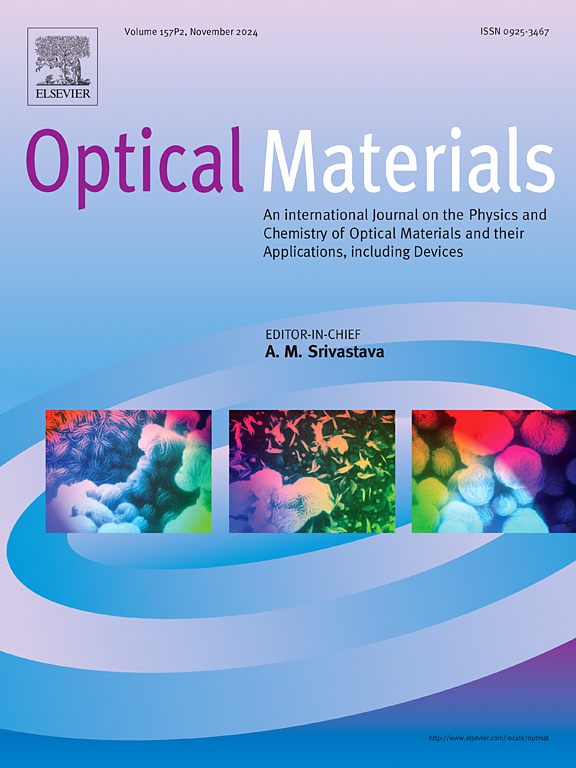
Optical Materials has an open access mirror journal Optical Materials: X, sharing the same aims and scope, editorial team, submission system and rigorous peer review.
The purpose of Optical Materials is to provide a means of communication and technology transfer between researchers who are interested in materials for potential device applications. The journal publishes original papers and review articles on the design, synthesis, characterisation and applications of optical materials.
OPTICAL MATERIALS focuses on:
• Optical Properties of Material Systems;
• The Materials Aspects of Optical Phenomena;
• The Materials Aspects of Devices and Applications.
Authors can submit separate research elements describing their data to Data in Brief and methods to Methods X.




 京公网安备 11010802042870号
京ICP备2023020795号-1
京公网安备 11010802042870号
京ICP备2023020795号-1

 分享
分享
 求助内容:
求助内容: 应助结果提醒方式:
 扫码关注我们
