Amanda R. Chappel , William F. Kenney , Matthew N. Waters , Caroline Buchanan Fisher , João H.F. Amaral , Edward J. Phlips , Elise S. Morrison
{"title":"沿海沉积物记录了美国佛罗里达州坦帕湾数十年的文化富营养化","authors":"Amanda R. Chappel , William F. Kenney , Matthew N. Waters , Caroline Buchanan Fisher , João H.F. Amaral , Edward J. Phlips , Elise S. Morrison","doi":"10.1016/j.ecolind.2025.113329","DOIUrl":null,"url":null,"abstract":"<div><div>Phosphorus (P) sustainability is a complex problem – it is a limited resource critical for agricultural productivity, but fertilizer production generates extensive phosphogypsum waste and can impair downstream water quality. Industrial, urban, and agricultural activities contribute to cultural eutrophication, thereby degrading both coastal and inland ecosystems and storing legacy nutrients in sediments. This study investigated the long-term effects of phosphogypsum wastewater discharges on legacy nutrient accumulation, an unintended impact of the fertilizer industry that is often overlooked and understudied. Sediment cores were collected to reconstruct the depositional history of two sites in Tampa Bay, Florida, USA that experienced past wastewater releases; the most recent in 2021. Sediments had high concentrations of stored or legacy nutrients (total P: 0.11 – 15.01 mg g<sup>−1</sup>; total nitrogen: 0.04 – 0.37 %) particularly during discharge timeframes, as assessed by short-lived radioisotopes, and were predominantly in bioavailable forms, as assessed by bulk pools and <sup>31</sup>P nuclear magnetic resonance spectroscopy. These values are comparable to hypereutrophic lakes impacted by agriculture and urbanization. Sediment accumulation rates were elevated relative to other Florida estuaries (Bishop Harbor: 13,092 – 46,706 g m<sup>−2</sup> yr<sup>−1</sup>; Piney Point Creek: 3,064 – 23,990 g m<sup>−2</sup> yr<sup>−1</sup>), which can alter biogeochemical cycling and the fate of nutrient loading. Phosphorus accumulation rates and other proxies had downcore peaks corresponding to discharge events from 2001 to 2004, 2011, and 2021 with P accumulation rates ranging from 0.5 – 559 g m<sup>−2</sup> yr<sup>−1</sup>. These findings indicate that estuarine nutrient budgets need to incorporate stored sedimentary nutrient pools and internal benthic fluxes and highlight the need for a more sustainable P supply chain.</div></div>","PeriodicalId":11459,"journal":{"name":"Ecological Indicators","volume":"172 ","pages":"Article 113329"},"PeriodicalIF":7.0000,"publicationDate":"2025-03-01","publicationTypes":"Journal Article","fieldsOfStudy":null,"isOpenAccess":false,"openAccessPdf":"","citationCount":"0","resultStr":"{\"title\":\"Coastal sediments record decades of cultural eutrophication in Tampa Bay, Florida, USA\",\"authors\":\"Amanda R. Chappel , William F. Kenney , Matthew N. Waters , Caroline Buchanan Fisher , João H.F. Amaral , Edward J. Phlips , Elise S. Morrison\",\"doi\":\"10.1016/j.ecolind.2025.113329\",\"DOIUrl\":null,\"url\":null,\"abstract\":\"<div><div>Phosphorus (P) sustainability is a complex problem – it is a limited resource critical for agricultural productivity, but fertilizer production generates extensive phosphogypsum waste and can impair downstream water quality. Industrial, urban, and agricultural activities contribute to cultural eutrophication, thereby degrading both coastal and inland ecosystems and storing legacy nutrients in sediments. This study investigated the long-term effects of phosphogypsum wastewater discharges on legacy nutrient accumulation, an unintended impact of the fertilizer industry that is often overlooked and understudied. Sediment cores were collected to reconstruct the depositional history of two sites in Tampa Bay, Florida, USA that experienced past wastewater releases; the most recent in 2021. Sediments had high concentrations of stored or legacy nutrients (total P: 0.11 – 15.01 mg g<sup>−1</sup>; total nitrogen: 0.04 – 0.37 %) particularly during discharge timeframes, as assessed by short-lived radioisotopes, and were predominantly in bioavailable forms, as assessed by bulk pools and <sup>31</sup>P nuclear magnetic resonance spectroscopy. These values are comparable to hypereutrophic lakes impacted by agriculture and urbanization. Sediment accumulation rates were elevated relative to other Florida estuaries (Bishop Harbor: 13,092 – 46,706 g m<sup>−2</sup> yr<sup>−1</sup>; Piney Point Creek: 3,064 – 23,990 g m<sup>−2</sup> yr<sup>−1</sup>), which can alter biogeochemical cycling and the fate of nutrient loading. Phosphorus accumulation rates and other proxies had downcore peaks corresponding to discharge events from 2001 to 2004, 2011, and 2021 with P accumulation rates ranging from 0.5 – 559 g m<sup>−2</sup> yr<sup>−1</sup>. These findings indicate that estuarine nutrient budgets need to incorporate stored sedimentary nutrient pools and internal benthic fluxes and highlight the need for a more sustainable P supply chain.</div></div>\",\"PeriodicalId\":11459,\"journal\":{\"name\":\"Ecological Indicators\",\"volume\":\"172 \",\"pages\":\"Article 113329\"},\"PeriodicalIF\":7.0000,\"publicationDate\":\"2025-03-01\",\"publicationTypes\":\"Journal Article\",\"fieldsOfStudy\":null,\"isOpenAccess\":false,\"openAccessPdf\":\"\",\"citationCount\":\"0\",\"resultStr\":null,\"platform\":\"Semanticscholar\",\"paperid\":null,\"PeriodicalName\":\"Ecological Indicators\",\"FirstCategoryId\":\"93\",\"ListUrlMain\":\"https://www.sciencedirect.com/science/article/pii/S1470160X25002602\",\"RegionNum\":2,\"RegionCategory\":\"环境科学与生态学\",\"ArticlePicture\":[],\"TitleCN\":null,\"AbstractTextCN\":null,\"PMCID\":null,\"EPubDate\":\"2025/3/12 0:00:00\",\"PubModel\":\"Epub\",\"JCR\":\"Q1\",\"JCRName\":\"ENVIRONMENTAL SCIENCES\",\"Score\":null,\"Total\":0}","platform":"Semanticscholar","paperid":null,"PeriodicalName":"Ecological Indicators","FirstCategoryId":"93","ListUrlMain":"https://www.sciencedirect.com/science/article/pii/S1470160X25002602","RegionNum":2,"RegionCategory":"环境科学与生态学","ArticlePicture":[],"TitleCN":null,"AbstractTextCN":null,"PMCID":null,"EPubDate":"2025/3/12 0:00:00","PubModel":"Epub","JCR":"Q1","JCRName":"ENVIRONMENTAL SCIENCES","Score":null,"Total":0}
引用次数: 0
摘要
磷(P)的可持续性是一个复杂的问题——它是一种对农业生产力至关重要的有限资源,但肥料生产会产生大量的磷石膏废物,并可能损害下游水质。工业、城市和农业活动助长了文化富营养化,从而使沿海和内陆生态系统退化,并将遗留的营养物质储存在沉积物中。本研究调查了磷石膏废水排放对遗留养分积累的长期影响,这是化肥行业经常被忽视和研究不足的意外影响。收集了沉积物岩心,重建了美国佛罗里达州坦帕湾两个经历过废水排放的地点的沉积历史;最近一次是在2021年。沉积物具有高浓度的储存或遗留养分(总P: 0.11 - 15.01 mg g - 1;总氮:0.04 - 0.37%),特别是在放电期间(通过短寿命放射性同位素评估),并且主要以生物可利用形式存在(通过体积池和31P核磁共振波谱评估)。这些值与受农业和城市化影响的富营养化湖泊相当。与佛罗里达其他河口相比,泥沙堆积率有所上升(Bishop Harbor: 13,092 - 46,706 g m−2 yr−1;Piney Point Creek: 3,064 - 23,990 g m−2 yr−1),这可以改变生物地球化学循环和营养负荷的命运。磷积累速率和其他指标在2001 - 2004年、2011年和2021年的排放事件对应的下核峰值,P积累速率在0.5 - 559 g m−2 yr−1之间。这些发现表明,河口营养收支需要包括储存的沉积营养池和内部底栖生物通量,并强调需要一个更可持续的P供应链。
Coastal sediments record decades of cultural eutrophication in Tampa Bay, Florida, USA
Phosphorus (P) sustainability is a complex problem – it is a limited resource critical for agricultural productivity, but fertilizer production generates extensive phosphogypsum waste and can impair downstream water quality. Industrial, urban, and agricultural activities contribute to cultural eutrophication, thereby degrading both coastal and inland ecosystems and storing legacy nutrients in sediments. This study investigated the long-term effects of phosphogypsum wastewater discharges on legacy nutrient accumulation, an unintended impact of the fertilizer industry that is often overlooked and understudied. Sediment cores were collected to reconstruct the depositional history of two sites in Tampa Bay, Florida, USA that experienced past wastewater releases; the most recent in 2021. Sediments had high concentrations of stored or legacy nutrients (total P: 0.11 – 15.01 mg g−1; total nitrogen: 0.04 – 0.37 %) particularly during discharge timeframes, as assessed by short-lived radioisotopes, and were predominantly in bioavailable forms, as assessed by bulk pools and 31P nuclear magnetic resonance spectroscopy. These values are comparable to hypereutrophic lakes impacted by agriculture and urbanization. Sediment accumulation rates were elevated relative to other Florida estuaries (Bishop Harbor: 13,092 – 46,706 g m−2 yr−1; Piney Point Creek: 3,064 – 23,990 g m−2 yr−1), which can alter biogeochemical cycling and the fate of nutrient loading. Phosphorus accumulation rates and other proxies had downcore peaks corresponding to discharge events from 2001 to 2004, 2011, and 2021 with P accumulation rates ranging from 0.5 – 559 g m−2 yr−1. These findings indicate that estuarine nutrient budgets need to incorporate stored sedimentary nutrient pools and internal benthic fluxes and highlight the need for a more sustainable P supply chain.
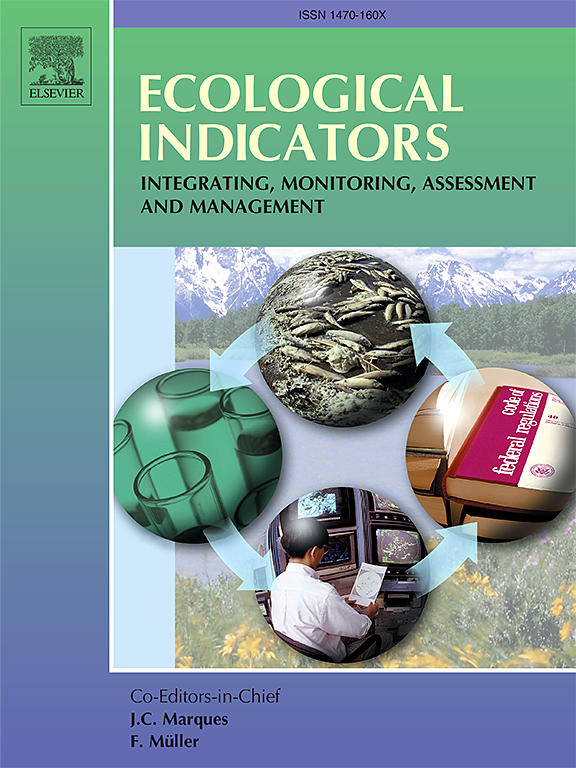
期刊介绍:
The ultimate aim of Ecological Indicators is to integrate the monitoring and assessment of ecological and environmental indicators with management practices. The journal provides a forum for the discussion of the applied scientific development and review of traditional indicator approaches as well as for theoretical, modelling and quantitative applications such as index development. Research into the following areas will be published.
• All aspects of ecological and environmental indicators and indices.
• New indicators, and new approaches and methods for indicator development, testing and use.
• Development and modelling of indices, e.g. application of indicator suites across multiple scales and resources.
• Analysis and research of resource, system- and scale-specific indicators.
• Methods for integration of social and other valuation metrics for the production of scientifically rigorous and politically-relevant assessments using indicator-based monitoring and assessment programs.
• How research indicators can be transformed into direct application for management purposes.
• Broader assessment objectives and methods, e.g. biodiversity, biological integrity, and sustainability, through the use of indicators.
• Resource-specific indicators such as landscape, agroecosystems, forests, wetlands, etc.





 京公网安备 11010802042870号
京ICP备2023020795号-1
京公网安备 11010802042870号
京ICP备2023020795号-1

 分享
分享
 求助内容:
求助内容: 应助结果提醒方式:
 扫码关注我们
