Daoyuan Zu , Jianbo Liu , Heting Wei , Kui Yang , Hailin Tian , Jinxing Ma , Zhifeng Yang
{"title":"Fenton-like系统的比较生命周期评估:还原剂驱动策略的环境效益见解","authors":"Daoyuan Zu , Jianbo Liu , Heting Wei , Kui Yang , Hailin Tian , Jinxing Ma , Zhifeng Yang","doi":"10.1016/j.watres.2025.123489","DOIUrl":null,"url":null,"abstract":"<div><div>Reductant-driven Fenton-like advanced oxidation processes (AOPs) offer the potential to reduce transition metal and oxidant consumption, but the environmental implications of introducing reductants remain unclear. This study employs life cycle assessment (LCA) to evaluate the environmental impacts of reductant-driven Fenton-like systems as an alternative to conventional AOP. Five distinct Fenton-like systems were investigated, and their corresponding life cycle inventories compiled following systematic optimization of operating parameters. Results demonstrate that introducing reductant shifts environmental hotspots from oxidants to the added reductants. Commodity chemical reductants (hydroxylamine and ascorbic acid) significantly reduce energy consumption and environmental damage due to economies of scale. Their per unit Cumulative Energy Demand (CED) and environmental damage value are two orders of magnitude lower than those of specialty chemical reductants (10.31 and 8.93 MJ g<sup>−1</sup> MXene and MoS<sub>2</sub>). Thus, novel catalysts, potentially associated with high energy consumption and toxic byproducts, require careful evaluation of their catalytic efficiency and unit environmental impact to determine overall environmental benefits. Scaling up chemical production, adopting regeneration strategy and transitioning to renewable energy sources represent key strategies for further environmental improvement. This study provides a quantitative framework for assessing the environmental performance of alternative Fenton-like systems, informing the design of more environmentally sustainable water purification technologies.</div></div>","PeriodicalId":443,"journal":{"name":"Water Research","volume":"279 ","pages":"Article 123489"},"PeriodicalIF":12.4000,"publicationDate":"2025-07-01","publicationTypes":"Journal Article","fieldsOfStudy":null,"isOpenAccess":false,"openAccessPdf":"","citationCount":"0","resultStr":"{\"title\":\"Comparative life cycle assessment of Fenton-like systems: Insights into the environmental benefits of reductant-driven strategies\",\"authors\":\"Daoyuan Zu , Jianbo Liu , Heting Wei , Kui Yang , Hailin Tian , Jinxing Ma , Zhifeng Yang\",\"doi\":\"10.1016/j.watres.2025.123489\",\"DOIUrl\":null,\"url\":null,\"abstract\":\"<div><div>Reductant-driven Fenton-like advanced oxidation processes (AOPs) offer the potential to reduce transition metal and oxidant consumption, but the environmental implications of introducing reductants remain unclear. This study employs life cycle assessment (LCA) to evaluate the environmental impacts of reductant-driven Fenton-like systems as an alternative to conventional AOP. Five distinct Fenton-like systems were investigated, and their corresponding life cycle inventories compiled following systematic optimization of operating parameters. Results demonstrate that introducing reductant shifts environmental hotspots from oxidants to the added reductants. Commodity chemical reductants (hydroxylamine and ascorbic acid) significantly reduce energy consumption and environmental damage due to economies of scale. Their per unit Cumulative Energy Demand (CED) and environmental damage value are two orders of magnitude lower than those of specialty chemical reductants (10.31 and 8.93 MJ g<sup>−1</sup> MXene and MoS<sub>2</sub>). Thus, novel catalysts, potentially associated with high energy consumption and toxic byproducts, require careful evaluation of their catalytic efficiency and unit environmental impact to determine overall environmental benefits. Scaling up chemical production, adopting regeneration strategy and transitioning to renewable energy sources represent key strategies for further environmental improvement. This study provides a quantitative framework for assessing the environmental performance of alternative Fenton-like systems, informing the design of more environmentally sustainable water purification technologies.</div></div>\",\"PeriodicalId\":443,\"journal\":{\"name\":\"Water Research\",\"volume\":\"279 \",\"pages\":\"Article 123489\"},\"PeriodicalIF\":12.4000,\"publicationDate\":\"2025-07-01\",\"publicationTypes\":\"Journal Article\",\"fieldsOfStudy\":null,\"isOpenAccess\":false,\"openAccessPdf\":\"\",\"citationCount\":\"0\",\"resultStr\":null,\"platform\":\"Semanticscholar\",\"paperid\":null,\"PeriodicalName\":\"Water Research\",\"FirstCategoryId\":\"93\",\"ListUrlMain\":\"https://www.sciencedirect.com/science/article/pii/S0043135425004026\",\"RegionNum\":1,\"RegionCategory\":\"环境科学与生态学\",\"ArticlePicture\":[],\"TitleCN\":null,\"AbstractTextCN\":null,\"PMCID\":null,\"EPubDate\":\"2025/3/13 0:00:00\",\"PubModel\":\"Epub\",\"JCR\":\"Q1\",\"JCRName\":\"ENGINEERING, ENVIRONMENTAL\",\"Score\":null,\"Total\":0}","platform":"Semanticscholar","paperid":null,"PeriodicalName":"Water Research","FirstCategoryId":"93","ListUrlMain":"https://www.sciencedirect.com/science/article/pii/S0043135425004026","RegionNum":1,"RegionCategory":"环境科学与生态学","ArticlePicture":[],"TitleCN":null,"AbstractTextCN":null,"PMCID":null,"EPubDate":"2025/3/13 0:00:00","PubModel":"Epub","JCR":"Q1","JCRName":"ENGINEERING, ENVIRONMENTAL","Score":null,"Total":0}
Comparative life cycle assessment of Fenton-like systems: Insights into the environmental benefits of reductant-driven strategies
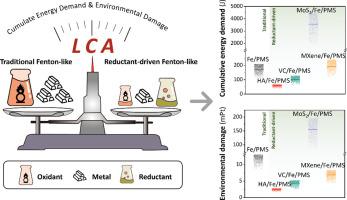
Reductant-driven Fenton-like advanced oxidation processes (AOPs) offer the potential to reduce transition metal and oxidant consumption, but the environmental implications of introducing reductants remain unclear. This study employs life cycle assessment (LCA) to evaluate the environmental impacts of reductant-driven Fenton-like systems as an alternative to conventional AOP. Five distinct Fenton-like systems were investigated, and their corresponding life cycle inventories compiled following systematic optimization of operating parameters. Results demonstrate that introducing reductant shifts environmental hotspots from oxidants to the added reductants. Commodity chemical reductants (hydroxylamine and ascorbic acid) significantly reduce energy consumption and environmental damage due to economies of scale. Their per unit Cumulative Energy Demand (CED) and environmental damage value are two orders of magnitude lower than those of specialty chemical reductants (10.31 and 8.93 MJ g−1 MXene and MoS2). Thus, novel catalysts, potentially associated with high energy consumption and toxic byproducts, require careful evaluation of their catalytic efficiency and unit environmental impact to determine overall environmental benefits. Scaling up chemical production, adopting regeneration strategy and transitioning to renewable energy sources represent key strategies for further environmental improvement. This study provides a quantitative framework for assessing the environmental performance of alternative Fenton-like systems, informing the design of more environmentally sustainable water purification technologies.
期刊介绍:
Water Research, along with its open access companion journal Water Research X, serves as a platform for publishing original research papers covering various aspects of the science and technology related to the anthropogenic water cycle, water quality, and its management worldwide. The audience targeted by the journal comprises biologists, chemical engineers, chemists, civil engineers, environmental engineers, limnologists, and microbiologists. The scope of the journal include:
•Treatment processes for water and wastewaters (municipal, agricultural, industrial, and on-site treatment), including resource recovery and residuals management;
•Urban hydrology including sewer systems, stormwater management, and green infrastructure;
•Drinking water treatment and distribution;
•Potable and non-potable water reuse;
•Sanitation, public health, and risk assessment;
•Anaerobic digestion, solid and hazardous waste management, including source characterization and the effects and control of leachates and gaseous emissions;
•Contaminants (chemical, microbial, anthropogenic particles such as nanoparticles or microplastics) and related water quality sensing, monitoring, fate, and assessment;
•Anthropogenic impacts on inland, tidal, coastal and urban waters, focusing on surface and ground waters, and point and non-point sources of pollution;
•Environmental restoration, linked to surface water, groundwater and groundwater remediation;
•Analysis of the interfaces between sediments and water, and between water and atmosphere, focusing specifically on anthropogenic impacts;
•Mathematical modelling, systems analysis, machine learning, and beneficial use of big data related to the anthropogenic water cycle;
•Socio-economic, policy, and regulations studies.





 京公网安备 11010802042870号
京ICP备2023020795号-1
京公网安备 11010802042870号
京ICP备2023020795号-1

 分享
分享
 求助内容:
求助内容: 应助结果提醒方式:
 扫码关注我们
