Thomas Swift, Edward Dyson, Natalia Koniuch, Richard Telford, Stephen Rimmer
{"title":"克服“扩散限制”-通过扩散有序核磁共振测量高摩尔质量聚合物所需的原理","authors":"Thomas Swift, Edward Dyson, Natalia Koniuch, Richard Telford, Stephen Rimmer","doi":"10.1016/j.aca.2025.343937","DOIUrl":null,"url":null,"abstract":"<div><h3>Question</h3><div>This paper studies the importance of resolving ‘in-solution’ viscosity to determine an accurate hydrodynamic radii for high molar mass or high dispersity macromolecules via DOSY NMR. Analysis of polymer size via diffusion NMR has become increasingly more common, however as in-solution viscosity increases NMR output becomes more complex and requires dedicated methodologies (both in the instrumentation and data treatment) that can sufficiently resolve slowly diffusing analytes.</div></div><div><h3>Results</h3><div>Diffusion measurements were used to determine hydrodynamic radii of dissolved polymer chains of materials across a broad molar mass range in multiple solvents. Studied systems included poly(ethylene glycol), poly(ethylene oxide), poly(styrene), poly(methyl methacrylate) and poly(<em>N</em>-isopropylacrylamide) and all are shown to match known literature values for dissolved polymer coils with a high degree of accuracy. However, it is shown that it is essential to use the “in-solution viscosity”, which can be obtained by applying a viscosity correction factor to the pure solvent viscosity. It was found that % error in outputs correlates to the viscosity of the solvent, with low viscosity solvents contributing to a higher variability in output data. We have also shown how the experimental range of the technique can be expanded to high molar mass (in excess of 1 million g mol<sup>−1</sup>), or high viscosity, and demonstrated the advantages of a diffusion optimised NMR probe (Bruker DiffBB) to target slowly diffusing chemical species.</div></div><div><h3>Significance</h3><div>The presence of even small quantities of large molar mass polymer analytes (2 mg mL<sup>−1</sup>) has an impact on in-solution viscosity, and thus provides a systematic offset in output diffusion values that are commonly used to interpret polymer sample size. DOSY NMR data include the diffusion of the solvent in-solution. Therefore, DOSY NMR measurements alone, with no internal or external standard besides the solvent itself, can be used to correct for this, allowing for prediction of an accurate hydrodynamic radius (and thus molar mass) of large, slowly diffusing, materials.</div></div>","PeriodicalId":240,"journal":{"name":"Analytica Chimica Acta","volume":"1352 ","pages":"Article 343937"},"PeriodicalIF":6.0000,"publicationDate":"2025-05-22","publicationTypes":"Journal Article","fieldsOfStudy":null,"isOpenAccess":false,"openAccessPdf":"","citationCount":"0","resultStr":"{\"title\":\"Overcoming ‘Diffusion Limits’ – Principles required to measure high molar mass polymers by diffusion ordered NMR\",\"authors\":\"Thomas Swift, Edward Dyson, Natalia Koniuch, Richard Telford, Stephen Rimmer\",\"doi\":\"10.1016/j.aca.2025.343937\",\"DOIUrl\":null,\"url\":null,\"abstract\":\"<div><h3>Question</h3><div>This paper studies the importance of resolving ‘in-solution’ viscosity to determine an accurate hydrodynamic radii for high molar mass or high dispersity macromolecules via DOSY NMR. Analysis of polymer size via diffusion NMR has become increasingly more common, however as in-solution viscosity increases NMR output becomes more complex and requires dedicated methodologies (both in the instrumentation and data treatment) that can sufficiently resolve slowly diffusing analytes.</div></div><div><h3>Results</h3><div>Diffusion measurements were used to determine hydrodynamic radii of dissolved polymer chains of materials across a broad molar mass range in multiple solvents. Studied systems included poly(ethylene glycol), poly(ethylene oxide), poly(styrene), poly(methyl methacrylate) and poly(<em>N</em>-isopropylacrylamide) and all are shown to match known literature values for dissolved polymer coils with a high degree of accuracy. However, it is shown that it is essential to use the “in-solution viscosity”, which can be obtained by applying a viscosity correction factor to the pure solvent viscosity. It was found that % error in outputs correlates to the viscosity of the solvent, with low viscosity solvents contributing to a higher variability in output data. We have also shown how the experimental range of the technique can be expanded to high molar mass (in excess of 1 million g mol<sup>−1</sup>), or high viscosity, and demonstrated the advantages of a diffusion optimised NMR probe (Bruker DiffBB) to target slowly diffusing chemical species.</div></div><div><h3>Significance</h3><div>The presence of even small quantities of large molar mass polymer analytes (2 mg mL<sup>−1</sup>) has an impact on in-solution viscosity, and thus provides a systematic offset in output diffusion values that are commonly used to interpret polymer sample size. DOSY NMR data include the diffusion of the solvent in-solution. Therefore, DOSY NMR measurements alone, with no internal or external standard besides the solvent itself, can be used to correct for this, allowing for prediction of an accurate hydrodynamic radius (and thus molar mass) of large, slowly diffusing, materials.</div></div>\",\"PeriodicalId\":240,\"journal\":{\"name\":\"Analytica Chimica Acta\",\"volume\":\"1352 \",\"pages\":\"Article 343937\"},\"PeriodicalIF\":6.0000,\"publicationDate\":\"2025-05-22\",\"publicationTypes\":\"Journal Article\",\"fieldsOfStudy\":null,\"isOpenAccess\":false,\"openAccessPdf\":\"\",\"citationCount\":\"0\",\"resultStr\":null,\"platform\":\"Semanticscholar\",\"paperid\":null,\"PeriodicalName\":\"Analytica Chimica Acta\",\"FirstCategoryId\":\"92\",\"ListUrlMain\":\"https://www.sciencedirect.com/science/article/pii/S0003267025003319\",\"RegionNum\":2,\"RegionCategory\":\"化学\",\"ArticlePicture\":[],\"TitleCN\":null,\"AbstractTextCN\":null,\"PMCID\":null,\"EPubDate\":\"2025/3/13 0:00:00\",\"PubModel\":\"Epub\",\"JCR\":\"Q1\",\"JCRName\":\"CHEMISTRY, ANALYTICAL\",\"Score\":null,\"Total\":0}","platform":"Semanticscholar","paperid":null,"PeriodicalName":"Analytica Chimica Acta","FirstCategoryId":"92","ListUrlMain":"https://www.sciencedirect.com/science/article/pii/S0003267025003319","RegionNum":2,"RegionCategory":"化学","ArticlePicture":[],"TitleCN":null,"AbstractTextCN":null,"PMCID":null,"EPubDate":"2025/3/13 0:00:00","PubModel":"Epub","JCR":"Q1","JCRName":"CHEMISTRY, ANALYTICAL","Score":null,"Total":0}
Overcoming ‘Diffusion Limits’ – Principles required to measure high molar mass polymers by diffusion ordered NMR
Question
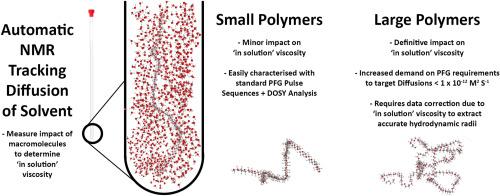
This paper studies the importance of resolving ‘in-solution’ viscosity to determine an accurate hydrodynamic radii for high molar mass or high dispersity macromolecules via DOSY NMR. Analysis of polymer size via diffusion NMR has become increasingly more common, however as in-solution viscosity increases NMR output becomes more complex and requires dedicated methodologies (both in the instrumentation and data treatment) that can sufficiently resolve slowly diffusing analytes.
Results
Diffusion measurements were used to determine hydrodynamic radii of dissolved polymer chains of materials across a broad molar mass range in multiple solvents. Studied systems included poly(ethylene glycol), poly(ethylene oxide), poly(styrene), poly(methyl methacrylate) and poly(N-isopropylacrylamide) and all are shown to match known literature values for dissolved polymer coils with a high degree of accuracy. However, it is shown that it is essential to use the “in-solution viscosity”, which can be obtained by applying a viscosity correction factor to the pure solvent viscosity. It was found that % error in outputs correlates to the viscosity of the solvent, with low viscosity solvents contributing to a higher variability in output data. We have also shown how the experimental range of the technique can be expanded to high molar mass (in excess of 1 million g mol−1), or high viscosity, and demonstrated the advantages of a diffusion optimised NMR probe (Bruker DiffBB) to target slowly diffusing chemical species.
Significance
The presence of even small quantities of large molar mass polymer analytes (2 mg mL−1) has an impact on in-solution viscosity, and thus provides a systematic offset in output diffusion values that are commonly used to interpret polymer sample size. DOSY NMR data include the diffusion of the solvent in-solution. Therefore, DOSY NMR measurements alone, with no internal or external standard besides the solvent itself, can be used to correct for this, allowing for prediction of an accurate hydrodynamic radius (and thus molar mass) of large, slowly diffusing, materials.
期刊介绍:
Analytica Chimica Acta has an open access mirror journal Analytica Chimica Acta: X, sharing the same aims and scope, editorial team, submission system and rigorous peer review.
Analytica Chimica Acta provides a forum for the rapid publication of original research, and critical, comprehensive reviews dealing with all aspects of fundamental and applied modern analytical chemistry. The journal welcomes the submission of research papers which report studies concerning the development of new and significant analytical methodologies. In determining the suitability of submitted articles for publication, particular scrutiny will be placed on the degree of novelty and impact of the research and the extent to which it adds to the existing body of knowledge in analytical chemistry.




 京公网安备 11010802042870号
京ICP备2023020795号-1
京公网安备 11010802042870号
京ICP备2023020795号-1

 分享
分享
 求助内容:
求助内容: 应助结果提醒方式:
 扫码关注我们
