{"title":"多材料3D打印连续碳纤维增强热固性复合材料,具有定制的纤维路径和定制的符合热塑性塑料模具","authors":"Haoqi Zhang , Aonan Li , Jiang Wu , Dongmin Yang","doi":"10.1016/j.compositesb.2025.112373","DOIUrl":null,"url":null,"abstract":"<div><div>This paper proposes a novel additive manufacturing approach for rapid, integrated fabrication of complex structures made from 3D-printed composites with low porosity and a high continuous fibre content. Continuous carbon fibre reinforced epoxy composites with >50 % fibre volume fraction were printed in parallel with short carbon fibre reinforced polyamide-6 (PA6) conforming moulds which have a melt temperature higher than the curing temperature of epoxy. The research further optimized the continuous fibre paths through experiments and as-manufactured finite element simulations, using 3D-printed truss structures under three-points bending as a case study. Additionally, the incorporation of polylactic acid (PLA) with a lower melting temperature, enhanced compatibility and bonding between the epoxy and PA6. The approach was applied and demonstrated for a lightweight composite wing box using tailored material interface and customised reinforcement alongside varying infill densities. This approach also opens up possibilities for assembling lightweight, large-scale composite structures using 3D-printed high-performance continuous carbon fibre units.</div></div>","PeriodicalId":10660,"journal":{"name":"Composites Part B: Engineering","volume":"298 ","pages":"Article 112373"},"PeriodicalIF":14.2000,"publicationDate":"2025-06-01","publicationTypes":"Journal Article","fieldsOfStudy":null,"isOpenAccess":false,"openAccessPdf":"","citationCount":"0","resultStr":"{\"title\":\"Multi-material 3D printing of continuous carbon fibre reinforced thermoset composites with tailored fibre paths and bespoke conforming thermoplastic moulds\",\"authors\":\"Haoqi Zhang , Aonan Li , Jiang Wu , Dongmin Yang\",\"doi\":\"10.1016/j.compositesb.2025.112373\",\"DOIUrl\":null,\"url\":null,\"abstract\":\"<div><div>This paper proposes a novel additive manufacturing approach for rapid, integrated fabrication of complex structures made from 3D-printed composites with low porosity and a high continuous fibre content. Continuous carbon fibre reinforced epoxy composites with >50 % fibre volume fraction were printed in parallel with short carbon fibre reinforced polyamide-6 (PA6) conforming moulds which have a melt temperature higher than the curing temperature of epoxy. The research further optimized the continuous fibre paths through experiments and as-manufactured finite element simulations, using 3D-printed truss structures under three-points bending as a case study. Additionally, the incorporation of polylactic acid (PLA) with a lower melting temperature, enhanced compatibility and bonding between the epoxy and PA6. The approach was applied and demonstrated for a lightweight composite wing box using tailored material interface and customised reinforcement alongside varying infill densities. This approach also opens up possibilities for assembling lightweight, large-scale composite structures using 3D-printed high-performance continuous carbon fibre units.</div></div>\",\"PeriodicalId\":10660,\"journal\":{\"name\":\"Composites Part B: Engineering\",\"volume\":\"298 \",\"pages\":\"Article 112373\"},\"PeriodicalIF\":14.2000,\"publicationDate\":\"2025-06-01\",\"publicationTypes\":\"Journal Article\",\"fieldsOfStudy\":null,\"isOpenAccess\":false,\"openAccessPdf\":\"\",\"citationCount\":\"0\",\"resultStr\":null,\"platform\":\"Semanticscholar\",\"paperid\":null,\"PeriodicalName\":\"Composites Part B: Engineering\",\"FirstCategoryId\":\"5\",\"ListUrlMain\":\"https://www.sciencedirect.com/science/article/pii/S1359836825002653\",\"RegionNum\":1,\"RegionCategory\":\"材料科学\",\"ArticlePicture\":[],\"TitleCN\":null,\"AbstractTextCN\":null,\"PMCID\":null,\"EPubDate\":\"2025/3/10 0:00:00\",\"PubModel\":\"Epub\",\"JCR\":\"Q1\",\"JCRName\":\"ENGINEERING, MULTIDISCIPLINARY\",\"Score\":null,\"Total\":0}","platform":"Semanticscholar","paperid":null,"PeriodicalName":"Composites Part B: Engineering","FirstCategoryId":"5","ListUrlMain":"https://www.sciencedirect.com/science/article/pii/S1359836825002653","RegionNum":1,"RegionCategory":"材料科学","ArticlePicture":[],"TitleCN":null,"AbstractTextCN":null,"PMCID":null,"EPubDate":"2025/3/10 0:00:00","PubModel":"Epub","JCR":"Q1","JCRName":"ENGINEERING, MULTIDISCIPLINARY","Score":null,"Total":0}
Multi-material 3D printing of continuous carbon fibre reinforced thermoset composites with tailored fibre paths and bespoke conforming thermoplastic moulds
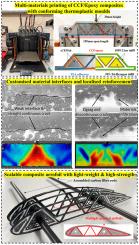
This paper proposes a novel additive manufacturing approach for rapid, integrated fabrication of complex structures made from 3D-printed composites with low porosity and a high continuous fibre content. Continuous carbon fibre reinforced epoxy composites with >50 % fibre volume fraction were printed in parallel with short carbon fibre reinforced polyamide-6 (PA6) conforming moulds which have a melt temperature higher than the curing temperature of epoxy. The research further optimized the continuous fibre paths through experiments and as-manufactured finite element simulations, using 3D-printed truss structures under three-points bending as a case study. Additionally, the incorporation of polylactic acid (PLA) with a lower melting temperature, enhanced compatibility and bonding between the epoxy and PA6. The approach was applied and demonstrated for a lightweight composite wing box using tailored material interface and customised reinforcement alongside varying infill densities. This approach also opens up possibilities for assembling lightweight, large-scale composite structures using 3D-printed high-performance continuous carbon fibre units.
期刊介绍:
Composites Part B: Engineering is a journal that publishes impactful research of high quality on composite materials. This research is supported by fundamental mechanics and materials science and engineering approaches. The targeted research can cover a wide range of length scales, ranging from nano to micro and meso, and even to the full product and structure level. The journal specifically focuses on engineering applications that involve high performance composites. These applications can range from low volume and high cost to high volume and low cost composite development.
The main goal of the journal is to provide a platform for the prompt publication of original and high quality research. The emphasis is on design, development, modeling, validation, and manufacturing of engineering details and concepts. The journal welcomes both basic research papers and proposals for review articles. Authors are encouraged to address challenges across various application areas. These areas include, but are not limited to, aerospace, automotive, and other surface transportation. The journal also covers energy-related applications, with a focus on renewable energy. Other application areas include infrastructure, off-shore and maritime projects, health care technology, and recreational products.




 京公网安备 11010802042870号
京ICP备2023020795号-1
京公网安备 11010802042870号
京ICP备2023020795号-1

 分享
分享
 求助内容:
求助内容: 应助结果提醒方式:
 扫码关注我们
