Huabing Huang, Zhiwen Tao, Jiayin Zhan, Changpeng Wang
{"title":"对比或多样性:城市洪水易感性模型中的非洪水采样","authors":"Huabing Huang, Zhiwen Tao, Jiayin Zhan, Changpeng Wang","doi":"10.1016/j.jhydrol.2025.133053","DOIUrl":null,"url":null,"abstract":"<div><div>Flood susceptibility modeling is a typical imbalanced problem in which the amount of flood data is much smaller than that of non-flood data. To ensure balanced learning, only a small fraction of non-flood data is selected for machine learning. Traditional sampling methods, such as Random Sampling (RS) and Stratified Sampling (SS), neglect abundant information within non-flood data and its relationship with flood data. This neglect leads to insufficient binary classification performance and biased susceptibility estimation, both of which are influenced by sample contrast and diversity, respectively. Unfortunately, these two objectives cannot be achieved simultaneously due to the trade-off between sample contrast and diversity. This dual-objective optimization requires a trade-off between contrast and diversity in sample quality. This study proposed a Distance-Based Sampling (DBS) framework that connects non-flood samples to flood data using Euclidean distance. Ten DBS scenarios with varying contrast and diversity levels (from 0.0 to 1.0 to 0.9–1.0) were designed for systematic evaluation. The best DBS scenario was further compared with RS, SS, and Inverse-Occurrence Sampling (IOS). To derive robust results, four machine learning techniques—Artificial Neural Network (ANN), Random Forest (RF), Support Vector Machine (SVM), and eXtreme Gradient Boosting (XGBoost)—were employed in two heterogeneous urban districts in Guangzhou, China, along with multiple indices, i.e. Area Under the Curve (AUC), mean susceptibility, standard deviation of susceptibility, and flood density order. The main findings of this study were as follows: (1) High sample contrast led to excellent binary classification performance but resulted in an overestimation of flood susceptibility. (2) High sample diversity resulted in insufficient binary classification performance and an underestimation of flood susceptibility. (3) Under the DBS framework, the performance curve of the dual-objective problem is unimodal. The best performance was achieved at a trade-off between contrast and diversity, specifically in the DBS scenario 0.3–1.0. (4) The DBS scenario 0.3–1.0 outperformed RS, SS, and IOS. Finally, this study underscores the critical role of non-flood sample quality and the balance between sample contrast and diversity in flood susceptibility modeling. The proposed DBS framework is objective and flexible, and can be applied to negative sampling in susceptibility modeling for other hazards, such as landslides and wildfires.</div></div>","PeriodicalId":362,"journal":{"name":"Journal of Hydrology","volume":"656 ","pages":"Article 133053"},"PeriodicalIF":7.3000,"publicationDate":"2025-08-01","publicationTypes":"Journal Article","fieldsOfStudy":null,"isOpenAccess":false,"openAccessPdf":"","citationCount":"0","resultStr":"{\"title\":\"Contrast or Diversity: Non-Flood sampling in urban flood susceptibility modelling\",\"authors\":\"Huabing Huang, Zhiwen Tao, Jiayin Zhan, Changpeng Wang\",\"doi\":\"10.1016/j.jhydrol.2025.133053\",\"DOIUrl\":null,\"url\":null,\"abstract\":\"<div><div>Flood susceptibility modeling is a typical imbalanced problem in which the amount of flood data is much smaller than that of non-flood data. To ensure balanced learning, only a small fraction of non-flood data is selected for machine learning. Traditional sampling methods, such as Random Sampling (RS) and Stratified Sampling (SS), neglect abundant information within non-flood data and its relationship with flood data. This neglect leads to insufficient binary classification performance and biased susceptibility estimation, both of which are influenced by sample contrast and diversity, respectively. Unfortunately, these two objectives cannot be achieved simultaneously due to the trade-off between sample contrast and diversity. This dual-objective optimization requires a trade-off between contrast and diversity in sample quality. This study proposed a Distance-Based Sampling (DBS) framework that connects non-flood samples to flood data using Euclidean distance. Ten DBS scenarios with varying contrast and diversity levels (from 0.0 to 1.0 to 0.9–1.0) were designed for systematic evaluation. The best DBS scenario was further compared with RS, SS, and Inverse-Occurrence Sampling (IOS). To derive robust results, four machine learning techniques—Artificial Neural Network (ANN), Random Forest (RF), Support Vector Machine (SVM), and eXtreme Gradient Boosting (XGBoost)—were employed in two heterogeneous urban districts in Guangzhou, China, along with multiple indices, i.e. Area Under the Curve (AUC), mean susceptibility, standard deviation of susceptibility, and flood density order. The main findings of this study were as follows: (1) High sample contrast led to excellent binary classification performance but resulted in an overestimation of flood susceptibility. (2) High sample diversity resulted in insufficient binary classification performance and an underestimation of flood susceptibility. (3) Under the DBS framework, the performance curve of the dual-objective problem is unimodal. The best performance was achieved at a trade-off between contrast and diversity, specifically in the DBS scenario 0.3–1.0. (4) The DBS scenario 0.3–1.0 outperformed RS, SS, and IOS. Finally, this study underscores the critical role of non-flood sample quality and the balance between sample contrast and diversity in flood susceptibility modeling. The proposed DBS framework is objective and flexible, and can be applied to negative sampling in susceptibility modeling for other hazards, such as landslides and wildfires.</div></div>\",\"PeriodicalId\":362,\"journal\":{\"name\":\"Journal of Hydrology\",\"volume\":\"656 \",\"pages\":\"Article 133053\"},\"PeriodicalIF\":7.3000,\"publicationDate\":\"2025-08-01\",\"publicationTypes\":\"Journal Article\",\"fieldsOfStudy\":null,\"isOpenAccess\":false,\"openAccessPdf\":\"\",\"citationCount\":\"0\",\"resultStr\":null,\"platform\":\"Semanticscholar\",\"paperid\":null,\"PeriodicalName\":\"Journal of Hydrology\",\"FirstCategoryId\":\"89\",\"ListUrlMain\":\"https://www.sciencedirect.com/science/article/pii/S0022169425003919\",\"RegionNum\":1,\"RegionCategory\":\"地球科学\",\"ArticlePicture\":[],\"TitleCN\":null,\"AbstractTextCN\":null,\"PMCID\":null,\"EPubDate\":\"2025/3/10 0:00:00\",\"PubModel\":\"Epub\",\"JCR\":\"Q1\",\"JCRName\":\"ENGINEERING, CIVIL\",\"Score\":null,\"Total\":0}","platform":"Semanticscholar","paperid":null,"PeriodicalName":"Journal of Hydrology","FirstCategoryId":"89","ListUrlMain":"https://www.sciencedirect.com/science/article/pii/S0022169425003919","RegionNum":1,"RegionCategory":"地球科学","ArticlePicture":[],"TitleCN":null,"AbstractTextCN":null,"PMCID":null,"EPubDate":"2025/3/10 0:00:00","PubModel":"Epub","JCR":"Q1","JCRName":"ENGINEERING, CIVIL","Score":null,"Total":0}
Contrast or Diversity: Non-Flood sampling in urban flood susceptibility modelling
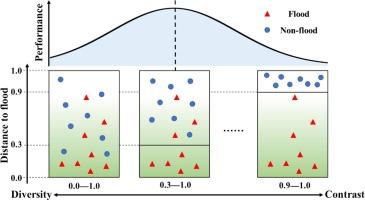
Flood susceptibility modeling is a typical imbalanced problem in which the amount of flood data is much smaller than that of non-flood data. To ensure balanced learning, only a small fraction of non-flood data is selected for machine learning. Traditional sampling methods, such as Random Sampling (RS) and Stratified Sampling (SS), neglect abundant information within non-flood data and its relationship with flood data. This neglect leads to insufficient binary classification performance and biased susceptibility estimation, both of which are influenced by sample contrast and diversity, respectively. Unfortunately, these two objectives cannot be achieved simultaneously due to the trade-off between sample contrast and diversity. This dual-objective optimization requires a trade-off between contrast and diversity in sample quality. This study proposed a Distance-Based Sampling (DBS) framework that connects non-flood samples to flood data using Euclidean distance. Ten DBS scenarios with varying contrast and diversity levels (from 0.0 to 1.0 to 0.9–1.0) were designed for systematic evaluation. The best DBS scenario was further compared with RS, SS, and Inverse-Occurrence Sampling (IOS). To derive robust results, four machine learning techniques—Artificial Neural Network (ANN), Random Forest (RF), Support Vector Machine (SVM), and eXtreme Gradient Boosting (XGBoost)—were employed in two heterogeneous urban districts in Guangzhou, China, along with multiple indices, i.e. Area Under the Curve (AUC), mean susceptibility, standard deviation of susceptibility, and flood density order. The main findings of this study were as follows: (1) High sample contrast led to excellent binary classification performance but resulted in an overestimation of flood susceptibility. (2) High sample diversity resulted in insufficient binary classification performance and an underestimation of flood susceptibility. (3) Under the DBS framework, the performance curve of the dual-objective problem is unimodal. The best performance was achieved at a trade-off between contrast and diversity, specifically in the DBS scenario 0.3–1.0. (4) The DBS scenario 0.3–1.0 outperformed RS, SS, and IOS. Finally, this study underscores the critical role of non-flood sample quality and the balance between sample contrast and diversity in flood susceptibility modeling. The proposed DBS framework is objective and flexible, and can be applied to negative sampling in susceptibility modeling for other hazards, such as landslides and wildfires.
期刊介绍:
The Journal of Hydrology publishes original research papers and comprehensive reviews in all the subfields of the hydrological sciences including water based management and policy issues that impact on economics and society. These comprise, but are not limited to the physical, chemical, biogeochemical, stochastic and systems aspects of surface and groundwater hydrology, hydrometeorology and hydrogeology. Relevant topics incorporating the insights and methodologies of disciplines such as climatology, water resource systems, hydraulics, agrohydrology, geomorphology, soil science, instrumentation and remote sensing, civil and environmental engineering are included. Social science perspectives on hydrological problems such as resource and ecological economics, environmental sociology, psychology and behavioural science, management and policy analysis are also invited. Multi-and interdisciplinary analyses of hydrological problems are within scope. The science published in the Journal of Hydrology is relevant to catchment scales rather than exclusively to a local scale or site.




 京公网安备 11010802042870号
京ICP备2023020795号-1
京公网安备 11010802042870号
京ICP备2023020795号-1

 分享
分享
 求助内容:
求助内容: 应助结果提醒方式:
 扫码关注我们
