Guogang Xu , Joseph Schell , Songhua Quan , Yucheng Gao , Sung-Jen Wei , Meixia Pan , Xianlin Han , Guiming Li , Daohong Zhou , Haiyan Jiang , Felix F. Dong , Erin Munkácsy , Nobuo Horikoshi , David Gius
{"title":"线粒体ACSS1-K635乙酰化敲入小鼠在生酮饮食中表现出肝脏脂质代谢的改变。","authors":"Guogang Xu , Joseph Schell , Songhua Quan , Yucheng Gao , Sung-Jen Wei , Meixia Pan , Xianlin Han , Guiming Li , Daohong Zhou , Haiyan Jiang , Felix F. Dong , Erin Munkácsy , Nobuo Horikoshi , David Gius","doi":"10.1016/j.freeradbiomed.2025.03.009","DOIUrl":null,"url":null,"abstract":"<div><div>Acetyl-CoA Synthetase Short Chain Family Member-1 (ACSS1) catalyzes the ligation of acetate and coenzyme A to generate acetyl-CoA in the mitochondria to produce ATP through the tricarboxylic acid (TCA) cycle. We recently generated an ACSS1-acetylation (Ac) mimic knock-in mouse, where lysine 635 was mutated to glutamine (K635Q), which structurally and biochemically mimics an acetylated lysine. ACSS1 enzymatic activity is regulated, at least in part, through the acetylation of lysine 635 in mice (lysine 642 in humans), a Sirtuin 3 deacetylation target. We challenged our <em>Acss1</em><sup><em>K635Q</em></sup> knock-in mice with a three-week ketogenic diet. While both wild-type and <em>Acss1</em><sup><em>K635Q</em></sup> knock-in mice were in ketosis with similar blood glucose levels, the <em>Acss1</em><sup><em>K635Q</em></sup> mice exhibited elevated blood acetate and liver acetyl-CoA. In addition, and importantly, compared to wild-type mice, the liver in the <em>Acss1</em><sup><em>K635Q</em></sup> mice displayed a much more predominant liver steatosis morphology and accumulation of lipid drops, as measured by H&E and Oil Red O staining. RNAseq analysis identified that genes related to mitochondrial respiratory chain complexes and oxidative stress were significantly overexpressed in the <em>Acss1</em><sup><em>K635Q</em></sup> mice on a KD. Finally, lipidomics analysis revealed very different lipid profiles for these groups, including a dramatic increase in triacylglycerides (TAGs), phosphatidylcholines (PCs), phosphatidylethanolamines (PEs), and cardiolipins in the <em>Acss1</em><sup><em>K635Q</em></sup> liver.</div></div>","PeriodicalId":12407,"journal":{"name":"Free Radical Biology and Medicine","volume":"232 ","pages":"Pages 260-268"},"PeriodicalIF":8.2000,"publicationDate":"2025-05-01","publicationTypes":"Journal Article","fieldsOfStudy":null,"isOpenAccess":false,"openAccessPdf":"","citationCount":"0","resultStr":"{\"title\":\"Mitochondrial ACSS1-K635 acetylation knock-in mice exhibit altered liver lipid metabolism on a ketogenic diet\",\"authors\":\"Guogang Xu , Joseph Schell , Songhua Quan , Yucheng Gao , Sung-Jen Wei , Meixia Pan , Xianlin Han , Guiming Li , Daohong Zhou , Haiyan Jiang , Felix F. Dong , Erin Munkácsy , Nobuo Horikoshi , David Gius\",\"doi\":\"10.1016/j.freeradbiomed.2025.03.009\",\"DOIUrl\":null,\"url\":null,\"abstract\":\"<div><div>Acetyl-CoA Synthetase Short Chain Family Member-1 (ACSS1) catalyzes the ligation of acetate and coenzyme A to generate acetyl-CoA in the mitochondria to produce ATP through the tricarboxylic acid (TCA) cycle. We recently generated an ACSS1-acetylation (Ac) mimic knock-in mouse, where lysine 635 was mutated to glutamine (K635Q), which structurally and biochemically mimics an acetylated lysine. ACSS1 enzymatic activity is regulated, at least in part, through the acetylation of lysine 635 in mice (lysine 642 in humans), a Sirtuin 3 deacetylation target. We challenged our <em>Acss1</em><sup><em>K635Q</em></sup> knock-in mice with a three-week ketogenic diet. While both wild-type and <em>Acss1</em><sup><em>K635Q</em></sup> knock-in mice were in ketosis with similar blood glucose levels, the <em>Acss1</em><sup><em>K635Q</em></sup> mice exhibited elevated blood acetate and liver acetyl-CoA. In addition, and importantly, compared to wild-type mice, the liver in the <em>Acss1</em><sup><em>K635Q</em></sup> mice displayed a much more predominant liver steatosis morphology and accumulation of lipid drops, as measured by H&E and Oil Red O staining. RNAseq analysis identified that genes related to mitochondrial respiratory chain complexes and oxidative stress were significantly overexpressed in the <em>Acss1</em><sup><em>K635Q</em></sup> mice on a KD. Finally, lipidomics analysis revealed very different lipid profiles for these groups, including a dramatic increase in triacylglycerides (TAGs), phosphatidylcholines (PCs), phosphatidylethanolamines (PEs), and cardiolipins in the <em>Acss1</em><sup><em>K635Q</em></sup> liver.</div></div>\",\"PeriodicalId\":12407,\"journal\":{\"name\":\"Free Radical Biology and Medicine\",\"volume\":\"232 \",\"pages\":\"Pages 260-268\"},\"PeriodicalIF\":8.2000,\"publicationDate\":\"2025-05-01\",\"publicationTypes\":\"Journal Article\",\"fieldsOfStudy\":null,\"isOpenAccess\":false,\"openAccessPdf\":\"\",\"citationCount\":\"0\",\"resultStr\":null,\"platform\":\"Semanticscholar\",\"paperid\":null,\"PeriodicalName\":\"Free Radical Biology and Medicine\",\"FirstCategoryId\":\"3\",\"ListUrlMain\":\"https://www.sciencedirect.com/science/article/pii/S0891584925001595\",\"RegionNum\":2,\"RegionCategory\":\"生物学\",\"ArticlePicture\":[],\"TitleCN\":null,\"AbstractTextCN\":null,\"PMCID\":null,\"EPubDate\":\"2025/3/10 0:00:00\",\"PubModel\":\"Epub\",\"JCR\":\"Q1\",\"JCRName\":\"BIOCHEMISTRY & MOLECULAR BIOLOGY\",\"Score\":null,\"Total\":0}","platform":"Semanticscholar","paperid":null,"PeriodicalName":"Free Radical Biology and Medicine","FirstCategoryId":"3","ListUrlMain":"https://www.sciencedirect.com/science/article/pii/S0891584925001595","RegionNum":2,"RegionCategory":"生物学","ArticlePicture":[],"TitleCN":null,"AbstractTextCN":null,"PMCID":null,"EPubDate":"2025/3/10 0:00:00","PubModel":"Epub","JCR":"Q1","JCRName":"BIOCHEMISTRY & MOLECULAR BIOLOGY","Score":null,"Total":0}
引用次数: 0
摘要
乙酰辅酶A合成酶短链家族成员-1 (ACSS1)在线粒体内通过三羧酸(TCA)循环催化醋酸与辅酶A的连接生成乙酰辅酶A,产生ATP。我们最近建立了一个acss1乙酰化(Ac)模拟敲入小鼠,其中赖氨酸635突变为谷氨酰胺(K635Q),其结构和生化模拟乙酰化赖氨酸。ACSS1酶活性至少在一定程度上是通过小鼠赖氨酸635(人类赖氨酸642)的乙酰化来调节的,而赖氨酸635是Sirtuin 3去乙酰化的靶点。我们用三周的生酮饮食挑战了我们的Acss1K635Q敲入小鼠。虽然野生型和Acss1K635Q敲入小鼠都处于酮症状态,血糖水平相似,但Acss1K635Q敲入小鼠表现出血醋酸盐和肝脏乙酰辅酶a升高。此外,重要的是,通过H&E和Oil Red O染色,与野生型小鼠相比,Acss1K635Q小鼠的肝脏显示出更明显的肝脏脂肪变性形态和脂滴积累。RNAseq分析发现,与线粒体呼吸链复合物和氧化应激相关的基因在Acss1K635Q小鼠的KD上显著过表达。最后,脂质组学分析揭示了这些组的脂质谱非常不同,包括Acss1K635Q肝脏中甘油三酯(TAGs)、磷脂酰胆碱(PCs)、磷脂酰乙醇胺(PEs)和心磷脂的显著增加。
Mitochondrial ACSS1-K635 acetylation knock-in mice exhibit altered liver lipid metabolism on a ketogenic diet
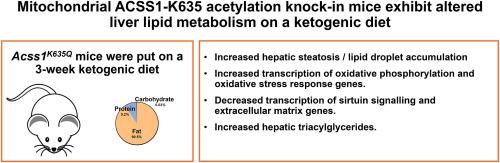
Acetyl-CoA Synthetase Short Chain Family Member-1 (ACSS1) catalyzes the ligation of acetate and coenzyme A to generate acetyl-CoA in the mitochondria to produce ATP through the tricarboxylic acid (TCA) cycle. We recently generated an ACSS1-acetylation (Ac) mimic knock-in mouse, where lysine 635 was mutated to glutamine (K635Q), which structurally and biochemically mimics an acetylated lysine. ACSS1 enzymatic activity is regulated, at least in part, through the acetylation of lysine 635 in mice (lysine 642 in humans), a Sirtuin 3 deacetylation target. We challenged our Acss1K635Q knock-in mice with a three-week ketogenic diet. While both wild-type and Acss1K635Q knock-in mice were in ketosis with similar blood glucose levels, the Acss1K635Q mice exhibited elevated blood acetate and liver acetyl-CoA. In addition, and importantly, compared to wild-type mice, the liver in the Acss1K635Q mice displayed a much more predominant liver steatosis morphology and accumulation of lipid drops, as measured by H&E and Oil Red O staining. RNAseq analysis identified that genes related to mitochondrial respiratory chain complexes and oxidative stress were significantly overexpressed in the Acss1K635Q mice on a KD. Finally, lipidomics analysis revealed very different lipid profiles for these groups, including a dramatic increase in triacylglycerides (TAGs), phosphatidylcholines (PCs), phosphatidylethanolamines (PEs), and cardiolipins in the Acss1K635Q liver.
期刊介绍:
Free Radical Biology and Medicine is a leading journal in the field of redox biology, which is the study of the role of reactive oxygen species (ROS) and other oxidizing agents in biological systems. The journal serves as a premier forum for publishing innovative and groundbreaking research that explores the redox biology of health and disease, covering a wide range of topics and disciplines. Free Radical Biology and Medicine also commissions Special Issues that highlight recent advances in both basic and clinical research, with a particular emphasis on the mechanisms underlying altered metabolism and redox signaling. These Special Issues aim to provide a focused platform for the latest research in the field, fostering collaboration and knowledge exchange among researchers and clinicians.




 京公网安备 11010802042870号
京ICP备2023020795号-1
京公网安备 11010802042870号
京ICP备2023020795号-1

 分享
分享
 求助内容:
求助内容: 应助结果提醒方式:
 扫码关注我们
