{"title":"中老年人血浆动脉粥样硬化指数与认知功能障碍的关系:CHARLS结果","authors":"Juan Zhou, Han Han, Weimin Bai","doi":"10.3389/fnagi.2025.1506973","DOIUrl":null,"url":null,"abstract":"<p><strong>Background: </strong>The atherogenic index of plasma (AIP) has been proposed as a novel biomarker predictor for dyslipidemia and has been linked to various diseases. In this study, we explored the relationship between AIP levels and cognitive impairment in a middle-aged and older population.</p><p><strong>Methods: </strong>This study utilized data from the China Health and Retirement Longitudinal Study (CHARLS) for 7,918 individuals aged 45 and older. The AIP was calculated as the logarithmic ratio of triglycerides to high-density lipoprotein cholesterol. To assess the relationship between the AIP and cognitive impairment, logistic regression models were employed, while restricted cubic spline analysis was conducted to explore potential non-linear associations between AIP levels and cognitive impairment.</p><p><strong>Results: </strong>The study participants had a mean age of 58.4 ± 8.8 years, and 49.1% were female. From 2011 to 2018, 2,911 participants (36.8%) developed cognitive impairment. After adjusting for potential confounders, the AIP was found to be significantly associated with cognitive impairment. In particular, participants in the higher AIP quartiles (Q2: odds ratio [OR]: 1.45, 95% confidence interval [CI]: 1.24-1.69, <i>P</i> < 0.001, Q3: OR: 1.63, 95% CI: 1.40-1.91, <i>P</i> < 0.001, and Q4: OR: 1.68, 95% CI: 1.43-1.98, <i>P</i> < 0.001) showed an increased risk of cognitive impairment compared to those in the lowest quartile (Q1). Additionally, a non-linear relationship was observed between AIP levels and cognitive impairment risk (P for nonlinear < 0.001).</p><p><strong>Conclusion: </strong>The study finds that elevated AIP levels are linked to an increased risk of cognitive impairment in middle-aged and older adults, suggesting that managing dyslipidemia could help reduce this risk.</p>","PeriodicalId":12450,"journal":{"name":"Frontiers in Aging Neuroscience","volume":"17 ","pages":"1506973"},"PeriodicalIF":4.5000,"publicationDate":"2025-02-26","publicationTypes":"Journal Article","fieldsOfStudy":null,"isOpenAccess":false,"openAccessPdf":"https://www.ncbi.nlm.nih.gov/pmc/articles/PMC11897900/pdf/","citationCount":"0","resultStr":"{\"title\":\"Association between atherogenic index of plasma and cognitive impairment in middle-aged and older adults: results from CHARLS.\",\"authors\":\"Juan Zhou, Han Han, Weimin Bai\",\"doi\":\"10.3389/fnagi.2025.1506973\",\"DOIUrl\":null,\"url\":null,\"abstract\":\"<p><strong>Background: </strong>The atherogenic index of plasma (AIP) has been proposed as a novel biomarker predictor for dyslipidemia and has been linked to various diseases. In this study, we explored the relationship between AIP levels and cognitive impairment in a middle-aged and older population.</p><p><strong>Methods: </strong>This study utilized data from the China Health and Retirement Longitudinal Study (CHARLS) for 7,918 individuals aged 45 and older. The AIP was calculated as the logarithmic ratio of triglycerides to high-density lipoprotein cholesterol. To assess the relationship between the AIP and cognitive impairment, logistic regression models were employed, while restricted cubic spline analysis was conducted to explore potential non-linear associations between AIP levels and cognitive impairment.</p><p><strong>Results: </strong>The study participants had a mean age of 58.4 ± 8.8 years, and 49.1% were female. From 2011 to 2018, 2,911 participants (36.8%) developed cognitive impairment. After adjusting for potential confounders, the AIP was found to be significantly associated with cognitive impairment. In particular, participants in the higher AIP quartiles (Q2: odds ratio [OR]: 1.45, 95% confidence interval [CI]: 1.24-1.69, <i>P</i> < 0.001, Q3: OR: 1.63, 95% CI: 1.40-1.91, <i>P</i> < 0.001, and Q4: OR: 1.68, 95% CI: 1.43-1.98, <i>P</i> < 0.001) showed an increased risk of cognitive impairment compared to those in the lowest quartile (Q1). Additionally, a non-linear relationship was observed between AIP levels and cognitive impairment risk (P for nonlinear < 0.001).</p><p><strong>Conclusion: </strong>The study finds that elevated AIP levels are linked to an increased risk of cognitive impairment in middle-aged and older adults, suggesting that managing dyslipidemia could help reduce this risk.</p>\",\"PeriodicalId\":12450,\"journal\":{\"name\":\"Frontiers in Aging Neuroscience\",\"volume\":\"17 \",\"pages\":\"1506973\"},\"PeriodicalIF\":4.5000,\"publicationDate\":\"2025-02-26\",\"publicationTypes\":\"Journal Article\",\"fieldsOfStudy\":null,\"isOpenAccess\":false,\"openAccessPdf\":\"https://www.ncbi.nlm.nih.gov/pmc/articles/PMC11897900/pdf/\",\"citationCount\":\"0\",\"resultStr\":null,\"platform\":\"Semanticscholar\",\"paperid\":null,\"PeriodicalName\":\"Frontiers in Aging Neuroscience\",\"FirstCategoryId\":\"3\",\"ListUrlMain\":\"https://doi.org/10.3389/fnagi.2025.1506973\",\"RegionNum\":2,\"RegionCategory\":\"医学\",\"ArticlePicture\":[],\"TitleCN\":null,\"AbstractTextCN\":null,\"PMCID\":null,\"EPubDate\":\"2025/1/1 0:00:00\",\"PubModel\":\"eCollection\",\"JCR\":\"Q2\",\"JCRName\":\"GERIATRICS & GERONTOLOGY\",\"Score\":null,\"Total\":0}","platform":"Semanticscholar","paperid":null,"PeriodicalName":"Frontiers in Aging Neuroscience","FirstCategoryId":"3","ListUrlMain":"https://doi.org/10.3389/fnagi.2025.1506973","RegionNum":2,"RegionCategory":"医学","ArticlePicture":[],"TitleCN":null,"AbstractTextCN":null,"PMCID":null,"EPubDate":"2025/1/1 0:00:00","PubModel":"eCollection","JCR":"Q2","JCRName":"GERIATRICS & GERONTOLOGY","Score":null,"Total":0}
引用次数: 0
摘要
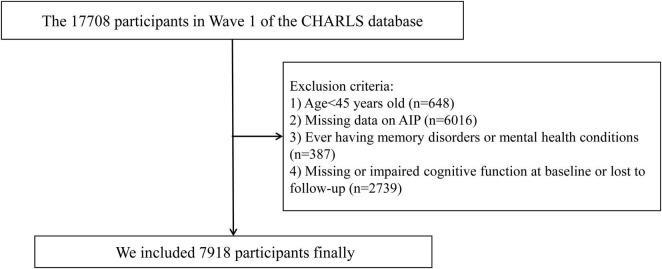
背景:血浆动脉粥样硬化指数(AIP)已被提出作为一种新的生物标志物预测血脂异常,并与多种疾病有关。在这项研究中,我们探讨了AIP水平与中老年人群认知障碍之间的关系。方法:本研究利用中国健康与退休纵向研究(CHARLS)的数据,对7,918名年龄在45岁及以上的人进行了研究。AIP以甘油三酯与高密度脂蛋白胆固醇的对数比值计算。为了评估AIP与认知功能障碍之间的关系,我们采用了逻辑回归模型,并通过限制三次样条分析来探索AIP水平与认知功能障碍之间潜在的非线性关联。结果:研究对象平均年龄58.4±8.8岁,女性占49.1%。从2011年到2018年,2911名参与者(36.8%)出现认知障碍。在调整了潜在的混杂因素后,发现AIP与认知障碍显著相关。特别是,高AIP四分位数的参与者(Q2:比值比[OR]: 1.45, 95%置信区间[CI]: 1.24-1.69, P < 0.001, Q3: OR: 1.63, 95% CI: 1.40-1.91, P < 0.001, Q4: OR: 1.68, 95% CI: 1.43-1.98, P < 0.001)与最低四分位数的参与者(Q1)相比,认知障碍的风险增加。此外,AIP水平与认知障碍风险之间存在非线性关系(P为非线性< 0.001)。结论:研究发现,AIP水平升高与中老年人认知障碍风险增加有关,表明控制血脂异常有助于降低这种风险。
Association between atherogenic index of plasma and cognitive impairment in middle-aged and older adults: results from CHARLS.
Background: The atherogenic index of plasma (AIP) has been proposed as a novel biomarker predictor for dyslipidemia and has been linked to various diseases. In this study, we explored the relationship between AIP levels and cognitive impairment in a middle-aged and older population.
Methods: This study utilized data from the China Health and Retirement Longitudinal Study (CHARLS) for 7,918 individuals aged 45 and older. The AIP was calculated as the logarithmic ratio of triglycerides to high-density lipoprotein cholesterol. To assess the relationship between the AIP and cognitive impairment, logistic regression models were employed, while restricted cubic spline analysis was conducted to explore potential non-linear associations between AIP levels and cognitive impairment.
Results: The study participants had a mean age of 58.4 ± 8.8 years, and 49.1% were female. From 2011 to 2018, 2,911 participants (36.8%) developed cognitive impairment. After adjusting for potential confounders, the AIP was found to be significantly associated with cognitive impairment. In particular, participants in the higher AIP quartiles (Q2: odds ratio [OR]: 1.45, 95% confidence interval [CI]: 1.24-1.69, P < 0.001, Q3: OR: 1.63, 95% CI: 1.40-1.91, P < 0.001, and Q4: OR: 1.68, 95% CI: 1.43-1.98, P < 0.001) showed an increased risk of cognitive impairment compared to those in the lowest quartile (Q1). Additionally, a non-linear relationship was observed between AIP levels and cognitive impairment risk (P for nonlinear < 0.001).
Conclusion: The study finds that elevated AIP levels are linked to an increased risk of cognitive impairment in middle-aged and older adults, suggesting that managing dyslipidemia could help reduce this risk.
期刊介绍:
Frontiers in Aging Neuroscience is a leading journal in its field, publishing rigorously peer-reviewed research that advances our understanding of the mechanisms of Central Nervous System aging and age-related neural diseases. Specialty Chief Editor Thomas Wisniewski at the New York University School of Medicine is supported by an outstanding Editorial Board of international researchers. This multidisciplinary open-access journal is at the forefront of disseminating and communicating scientific knowledge and impactful discoveries to researchers, academics, clinicians and the public worldwide.





 京公网安备 11010802042870号
京ICP备2023020795号-1
京公网安备 11010802042870号
京ICP备2023020795号-1

 分享
分享
 求助内容:
求助内容: 应助结果提醒方式:
 扫码关注我们
