{"title":"多不饱和脂肪酸和降低成人低肌肉质量的风险。","authors":"Haiyu Zou, Liangrong Zheng, Chunlai Zeng","doi":"10.3390/nu17050858","DOIUrl":null,"url":null,"abstract":"<p><p><b>Background</b>: We aimed to evaluate the effects of both joint and individual types of fatty acids on low muscle mass in adults. <b>Methods</b>: We enrolled 8842 adults selected from the National Health and Nutrition Examination Survey (NHANES). Multivariate adjusted weighted logistic regression models were employed to evaluate the connection between fatty acids and low muscle mass. We used restricted cubic splines (RCSs) to determine whether the relationship is linear or non-linear, while stratified analyses and interaction effects were also assessed. Weighted quantile sum (WQS) analysis assessed the impact of joint and individual types of fatty acids on low muscle mass. Additionally, mediation analysis determined the direct and indirect implications of polyunsaturated fatty acids on low muscle mass. <b>Results</b>: A total of 8842 participants were included in this study, of which 705 were identified as having low muscle mass. The logistic regression analyses identified a significant linear correlation between all three types of fatty acids and low-muscle-mass risk. Additionally, the WQS analysis demonstrated that a fatty acid mixture was inversely associated with low-muscle-mass risk, with polyunsaturated fatty acids being recognized as the principal component. Moreover, inflammation may mediate the relationship between polyunsaturated fatty acids and low muscle mass, accounting for 3.75% of the effect size (<i>p</i> < 0.001) through white blood cell count. We further examined linoleic acid (LA) and alpha-linolenic acid (ALA), and each unit increase in LA and ALA intake was linked to a decrease in low-muscle-mass risk by 0.29 (95% CI: 0.64-0.79, <i>p</i> < 0.001) and 0.27 (95% CI: 0.66-0.81, <i>p</i> < 0.001), respectively. <b>Conclusions</b>: These findings indicate that polyunsaturated fatty acids (especially LA and ALA) may effectively mitigate low-muscle-mass risk.</p>","PeriodicalId":19486,"journal":{"name":"Nutrients","volume":"17 5","pages":""},"PeriodicalIF":5.0000,"publicationDate":"2025-02-28","publicationTypes":"Journal Article","fieldsOfStudy":null,"isOpenAccess":false,"openAccessPdf":"https://www.ncbi.nlm.nih.gov/pmc/articles/PMC11902165/pdf/","citationCount":"0","resultStr":"{\"title\":\"Polyunsaturated Fatty Acids and Reduced Risk of Low Muscle Mass in Adults.\",\"authors\":\"Haiyu Zou, Liangrong Zheng, Chunlai Zeng\",\"doi\":\"10.3390/nu17050858\",\"DOIUrl\":null,\"url\":null,\"abstract\":\"<p><p><b>Background</b>: We aimed to evaluate the effects of both joint and individual types of fatty acids on low muscle mass in adults. <b>Methods</b>: We enrolled 8842 adults selected from the National Health and Nutrition Examination Survey (NHANES). Multivariate adjusted weighted logistic regression models were employed to evaluate the connection between fatty acids and low muscle mass. We used restricted cubic splines (RCSs) to determine whether the relationship is linear or non-linear, while stratified analyses and interaction effects were also assessed. Weighted quantile sum (WQS) analysis assessed the impact of joint and individual types of fatty acids on low muscle mass. Additionally, mediation analysis determined the direct and indirect implications of polyunsaturated fatty acids on low muscle mass. <b>Results</b>: A total of 8842 participants were included in this study, of which 705 were identified as having low muscle mass. The logistic regression analyses identified a significant linear correlation between all three types of fatty acids and low-muscle-mass risk. Additionally, the WQS analysis demonstrated that a fatty acid mixture was inversely associated with low-muscle-mass risk, with polyunsaturated fatty acids being recognized as the principal component. Moreover, inflammation may mediate the relationship between polyunsaturated fatty acids and low muscle mass, accounting for 3.75% of the effect size (<i>p</i> < 0.001) through white blood cell count. We further examined linoleic acid (LA) and alpha-linolenic acid (ALA), and each unit increase in LA and ALA intake was linked to a decrease in low-muscle-mass risk by 0.29 (95% CI: 0.64-0.79, <i>p</i> < 0.001) and 0.27 (95% CI: 0.66-0.81, <i>p</i> < 0.001), respectively. <b>Conclusions</b>: These findings indicate that polyunsaturated fatty acids (especially LA and ALA) may effectively mitigate low-muscle-mass risk.</p>\",\"PeriodicalId\":19486,\"journal\":{\"name\":\"Nutrients\",\"volume\":\"17 5\",\"pages\":\"\"},\"PeriodicalIF\":5.0000,\"publicationDate\":\"2025-02-28\",\"publicationTypes\":\"Journal Article\",\"fieldsOfStudy\":null,\"isOpenAccess\":false,\"openAccessPdf\":\"https://www.ncbi.nlm.nih.gov/pmc/articles/PMC11902165/pdf/\",\"citationCount\":\"0\",\"resultStr\":null,\"platform\":\"Semanticscholar\",\"paperid\":null,\"PeriodicalName\":\"Nutrients\",\"FirstCategoryId\":\"3\",\"ListUrlMain\":\"https://doi.org/10.3390/nu17050858\",\"RegionNum\":2,\"RegionCategory\":\"医学\",\"ArticlePicture\":[],\"TitleCN\":null,\"AbstractTextCN\":null,\"PMCID\":null,\"EPubDate\":\"\",\"PubModel\":\"\",\"JCR\":\"Q1\",\"JCRName\":\"NUTRITION & DIETETICS\",\"Score\":null,\"Total\":0}","platform":"Semanticscholar","paperid":null,"PeriodicalName":"Nutrients","FirstCategoryId":"3","ListUrlMain":"https://doi.org/10.3390/nu17050858","RegionNum":2,"RegionCategory":"医学","ArticlePicture":[],"TitleCN":null,"AbstractTextCN":null,"PMCID":null,"EPubDate":"","PubModel":"","JCR":"Q1","JCRName":"NUTRITION & DIETETICS","Score":null,"Total":0}
引用次数: 0
摘要
背景:我们旨在评估关节和个体类型脂肪酸对成人低肌肉质量的影响。方法:从全国健康与营养调查(NHANES)中选择8842名成年人。采用多变量调整加权logistic回归模型来评估脂肪酸与低肌肉质量之间的关系。我们使用限制三次样条(RCSs)来确定关系是线性还是非线性,同时还评估了分层分析和相互作用效应。加权分位数和(WQS)分析评估了关节和个体类型脂肪酸对低肌肉质量的影响。此外,中介分析确定了多不饱和脂肪酸对低肌肉质量的直接和间接影响。结果:本研究共纳入8842名参与者,其中705人被确定为肌肉质量低。逻辑回归分析确定了所有三种脂肪酸与低肌肉质量风险之间的显著线性相关。此外,WQS分析表明,脂肪酸混合物与低肌肉质量风险呈负相关,其中多不饱和脂肪酸被认为是主要成分。此外,炎症可能介导多不饱和脂肪酸与低肌肉质量之间的关系,通过白细胞计数占效应量的3.75% (p < 0.001)。我们进一步检查了亚油酸(LA)和α -亚麻酸(ALA),发现每单位增加的LA和ALA摄入量分别与低肌肉质量风险降低0.29 (95% CI: 0.64-0.79, p < 0.001)和0.27 (95% CI: 0.66-0.81, p < 0.001)相关。结论:这些发现表明,多不饱和脂肪酸(尤其是LA和ALA)可以有效减轻低肌肉质量风险。
Polyunsaturated Fatty Acids and Reduced Risk of Low Muscle Mass in Adults.
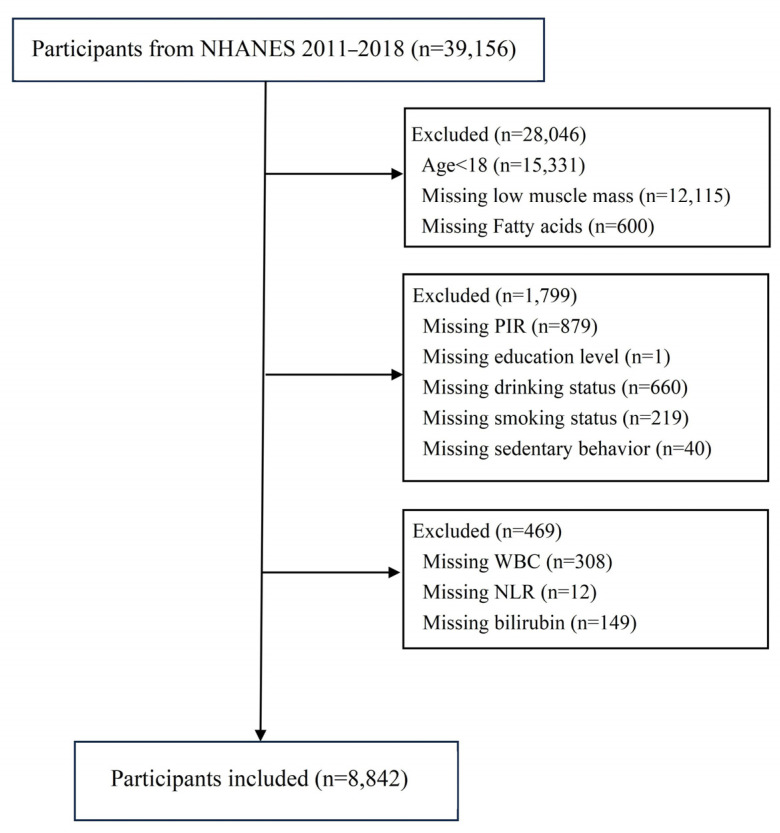
Background: We aimed to evaluate the effects of both joint and individual types of fatty acids on low muscle mass in adults. Methods: We enrolled 8842 adults selected from the National Health and Nutrition Examination Survey (NHANES). Multivariate adjusted weighted logistic regression models were employed to evaluate the connection between fatty acids and low muscle mass. We used restricted cubic splines (RCSs) to determine whether the relationship is linear or non-linear, while stratified analyses and interaction effects were also assessed. Weighted quantile sum (WQS) analysis assessed the impact of joint and individual types of fatty acids on low muscle mass. Additionally, mediation analysis determined the direct and indirect implications of polyunsaturated fatty acids on low muscle mass. Results: A total of 8842 participants were included in this study, of which 705 were identified as having low muscle mass. The logistic regression analyses identified a significant linear correlation between all three types of fatty acids and low-muscle-mass risk. Additionally, the WQS analysis demonstrated that a fatty acid mixture was inversely associated with low-muscle-mass risk, with polyunsaturated fatty acids being recognized as the principal component. Moreover, inflammation may mediate the relationship between polyunsaturated fatty acids and low muscle mass, accounting for 3.75% of the effect size (p < 0.001) through white blood cell count. We further examined linoleic acid (LA) and alpha-linolenic acid (ALA), and each unit increase in LA and ALA intake was linked to a decrease in low-muscle-mass risk by 0.29 (95% CI: 0.64-0.79, p < 0.001) and 0.27 (95% CI: 0.66-0.81, p < 0.001), respectively. Conclusions: These findings indicate that polyunsaturated fatty acids (especially LA and ALA) may effectively mitigate low-muscle-mass risk.
期刊介绍:
Nutrients (ISSN 2072-6643) is an international, peer-reviewed open access advanced forum for studies related to Human Nutrition. It publishes reviews, regular research papers and short communications. Our aim is to encourage scientists to publish their experimental and theoretical results in as much detail as possible. There is no restriction on the length of the papers. The full experimental details must be provided so that the results can be reproduced.






 京公网安备 11010802042870号
京ICP备2023020795号-1
京公网安备 11010802042870号
京ICP备2023020795号-1

 分享
分享
 求助内容:
求助内容: 应助结果提醒方式:
 扫码关注我们
