{"title":"2019冠状病毒病前/后日本员工因精神障碍导致的远程工作和长期病假趋势","authors":"Yasuhiko Deguchi, Shinichi Iwasaki, Yuki Uesaka, Yutaro Okawa, Shohei Okura, Kunio Maekubo, Ayaka Matsunaga, Yuki Kageyama, Koki Inoue","doi":"10.1371/journal.pone.0319825","DOIUrl":null,"url":null,"abstract":"<p><strong>Aims: </strong>The aim of this study was to ascertain whether there has been an increase in the number of workers with long-term sickness absence due to mental disorders (LTSA-MD) and determine the impact of remote work on new LTSA-MD cases.</p><p><strong>Methods: </strong>A web-based questionnaire was sent to 2,552 company offices with 150 or more workers in Osaka Prefecture. Data were obtained on the number of workers with LTSA-MD between April 1, 2019, and March 31, 2020 (fiscal year 2019) and between April 1, 2020, and March 31, 2021 (fiscal year 2020), along with their MD diagnoses (adjustment disorder [AD], depressive disorder [DEP], etc.). The difference in the number of new LTSA-MD, LTSA-AD, and LTSA-DEP cases between the fiscal years was evaluated, as well as the number of LTSA-MD cases per 100 employees. An independent t-test was used to compare the groups.</p><p><strong>Results: </strong>DEP was the most prevalent condition, followed by AD. The number of workers with LTSA-MD nominally decreased from fiscal 2019 to fiscal year 2020, with no significant difference. There were no significant differences between fiscal year 2020 and fiscal year 2019 regarding LTSA-MD, LTSA-AD, and LTSA-DEP in offices with and without a remote work model.</p><p><strong>Conclusions: </strong>The number of non-public workers with LTSA-MD did not increase during the COVID-19 pandemic, with no significant difference observed between offices with and without a remote work model. This provides preliminary evidence of a potential protective effect of remote work against LTSA-DEP.</p>","PeriodicalId":20189,"journal":{"name":"PLoS ONE","volume":"20 3","pages":"e0319825"},"PeriodicalIF":2.6000,"publicationDate":"2025-03-12","publicationTypes":"Journal Article","fieldsOfStudy":null,"isOpenAccess":false,"openAccessPdf":"https://www.ncbi.nlm.nih.gov/pmc/articles/PMC11902284/pdf/","citationCount":"0","resultStr":"{\"title\":\"Remote work and long-term sickness absence due to mental disorder trends among Japanese workers pre/post COVID-19.\",\"authors\":\"Yasuhiko Deguchi, Shinichi Iwasaki, Yuki Uesaka, Yutaro Okawa, Shohei Okura, Kunio Maekubo, Ayaka Matsunaga, Yuki Kageyama, Koki Inoue\",\"doi\":\"10.1371/journal.pone.0319825\",\"DOIUrl\":null,\"url\":null,\"abstract\":\"<p><strong>Aims: </strong>The aim of this study was to ascertain whether there has been an increase in the number of workers with long-term sickness absence due to mental disorders (LTSA-MD) and determine the impact of remote work on new LTSA-MD cases.</p><p><strong>Methods: </strong>A web-based questionnaire was sent to 2,552 company offices with 150 or more workers in Osaka Prefecture. Data were obtained on the number of workers with LTSA-MD between April 1, 2019, and March 31, 2020 (fiscal year 2019) and between April 1, 2020, and March 31, 2021 (fiscal year 2020), along with their MD diagnoses (adjustment disorder [AD], depressive disorder [DEP], etc.). The difference in the number of new LTSA-MD, LTSA-AD, and LTSA-DEP cases between the fiscal years was evaluated, as well as the number of LTSA-MD cases per 100 employees. An independent t-test was used to compare the groups.</p><p><strong>Results: </strong>DEP was the most prevalent condition, followed by AD. The number of workers with LTSA-MD nominally decreased from fiscal 2019 to fiscal year 2020, with no significant difference. There were no significant differences between fiscal year 2020 and fiscal year 2019 regarding LTSA-MD, LTSA-AD, and LTSA-DEP in offices with and without a remote work model.</p><p><strong>Conclusions: </strong>The number of non-public workers with LTSA-MD did not increase during the COVID-19 pandemic, with no significant difference observed between offices with and without a remote work model. This provides preliminary evidence of a potential protective effect of remote work against LTSA-DEP.</p>\",\"PeriodicalId\":20189,\"journal\":{\"name\":\"PLoS ONE\",\"volume\":\"20 3\",\"pages\":\"e0319825\"},\"PeriodicalIF\":2.6000,\"publicationDate\":\"2025-03-12\",\"publicationTypes\":\"Journal Article\",\"fieldsOfStudy\":null,\"isOpenAccess\":false,\"openAccessPdf\":\"https://www.ncbi.nlm.nih.gov/pmc/articles/PMC11902284/pdf/\",\"citationCount\":\"0\",\"resultStr\":null,\"platform\":\"Semanticscholar\",\"paperid\":null,\"PeriodicalName\":\"PLoS ONE\",\"FirstCategoryId\":\"103\",\"ListUrlMain\":\"https://doi.org/10.1371/journal.pone.0319825\",\"RegionNum\":3,\"RegionCategory\":\"综合性期刊\",\"ArticlePicture\":[],\"TitleCN\":null,\"AbstractTextCN\":null,\"PMCID\":null,\"EPubDate\":\"2025/1/1 0:00:00\",\"PubModel\":\"eCollection\",\"JCR\":\"Q1\",\"JCRName\":\"MULTIDISCIPLINARY SCIENCES\",\"Score\":null,\"Total\":0}","platform":"Semanticscholar","paperid":null,"PeriodicalName":"PLoS ONE","FirstCategoryId":"103","ListUrlMain":"https://doi.org/10.1371/journal.pone.0319825","RegionNum":3,"RegionCategory":"综合性期刊","ArticlePicture":[],"TitleCN":null,"AbstractTextCN":null,"PMCID":null,"EPubDate":"2025/1/1 0:00:00","PubModel":"eCollection","JCR":"Q1","JCRName":"MULTIDISCIPLINARY SCIENCES","Score":null,"Total":0}
Remote work and long-term sickness absence due to mental disorder trends among Japanese workers pre/post COVID-19.
Aims: The aim of this study was to ascertain whether there has been an increase in the number of workers with long-term sickness absence due to mental disorders (LTSA-MD) and determine the impact of remote work on new LTSA-MD cases.
Methods: A web-based questionnaire was sent to 2,552 company offices with 150 or more workers in Osaka Prefecture. Data were obtained on the number of workers with LTSA-MD between April 1, 2019, and March 31, 2020 (fiscal year 2019) and between April 1, 2020, and March 31, 2021 (fiscal year 2020), along with their MD diagnoses (adjustment disorder [AD], depressive disorder [DEP], etc.). The difference in the number of new LTSA-MD, LTSA-AD, and LTSA-DEP cases between the fiscal years was evaluated, as well as the number of LTSA-MD cases per 100 employees. An independent t-test was used to compare the groups.
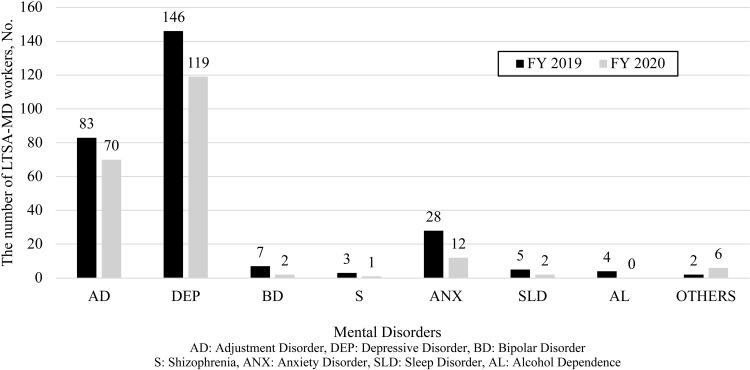
Results: DEP was the most prevalent condition, followed by AD. The number of workers with LTSA-MD nominally decreased from fiscal 2019 to fiscal year 2020, with no significant difference. There were no significant differences between fiscal year 2020 and fiscal year 2019 regarding LTSA-MD, LTSA-AD, and LTSA-DEP in offices with and without a remote work model.
Conclusions: The number of non-public workers with LTSA-MD did not increase during the COVID-19 pandemic, with no significant difference observed between offices with and without a remote work model. This provides preliminary evidence of a potential protective effect of remote work against LTSA-DEP.
期刊介绍:
PLOS ONE is an international, peer-reviewed, open-access, online publication. PLOS ONE welcomes reports on primary research from any scientific discipline. It provides:
* Open-access—freely accessible online, authors retain copyright
* Fast publication times
* Peer review by expert, practicing researchers
* Post-publication tools to indicate quality and impact
* Community-based dialogue on articles
* Worldwide media coverage






 京公网安备 11010802042870号
京ICP备2023020795号-1
京公网安备 11010802042870号
京ICP备2023020795号-1

 分享
分享
 求助内容:
求助内容: 应助结果提醒方式:
 扫码关注我们
