{"title":"成人生活环境与院外心脏骤停风险的关系:日常生活背景的视角","authors":"Yitong Liao, Hui Chen, Shuli Zhou, Yuanwei Fu, Qiangrong Zhai, Qingbian Ma, Yan Xiong, Suhong Zhou","doi":"10.1186/s13690-025-01556-w","DOIUrl":null,"url":null,"abstract":"<p><strong>Background: </strong>Studying the spatial pattern of out-of-hospital cardiac arrest (OHCA) and its environmental impactors is crucial for both providing timely medical assistance and implementing preventative measures. Existing researches have mainly focused on natural and sociodemographic environments, usually at a macro- or meso-scale, while giving less attention to understanding the association between environment and OHCA risk from the perspective of daily-life contexts.</p><p><strong>Methods: </strong>In this study, we utilized 1843 eligible OHCA cases from core districts of Beijing in 2020 and employed modified Besag-York-Mollié (BYM2) Bayesian models to investigate the association between living environment (consisting of food environment, physical activity environment, healthcare environment and leisure environment) and adult OHCA risk, as well as its age disparities, at a 1 × 1 km<sup>2</sup> cell resolution.</p><p><strong>Results: </strong>The results show that: (1) Fewer living environment factors are associated with the OHCA risk in the young/middle-aged group compared to the elderly group. (2) Unhealthy food destination like barbecue restaurants in living area is associated with increased OHCA risk in both age groups. (3) Facility inducing sedentary activity like chess rooms and healthcare facilities are associated with increased OHCA risk, but only among the elderly groups. (4) The decreased OHCA risk in the young/middle-aged group is related to public gathering places for socialization and relaxation in living area like coffee shops, while for the elder groups, decreased OHCA risk is associated with more green spaces in the living area.</p><p><strong>Conclusions: </strong>The findings suggest that living environment may impact adult OHCA risk through shaping daily habits or providing access to health resources, with the underlying mechanism varying across different age groups. Future planning should fully consider and leverage the impact of living environment in order to effectively reduce OHCA risk.</p>","PeriodicalId":48578,"journal":{"name":"Archives of Public Health","volume":"83 1","pages":"67"},"PeriodicalIF":3.2000,"publicationDate":"2025-03-13","publicationTypes":"Journal Article","fieldsOfStudy":null,"isOpenAccess":false,"openAccessPdf":"https://www.ncbi.nlm.nih.gov/pmc/articles/PMC11905481/pdf/","citationCount":"0","resultStr":"{\"title\":\"The association between living environment and out-of-hospital cardiac arrest risk in adults: the perspective of daily-life contexts.\",\"authors\":\"Yitong Liao, Hui Chen, Shuli Zhou, Yuanwei Fu, Qiangrong Zhai, Qingbian Ma, Yan Xiong, Suhong Zhou\",\"doi\":\"10.1186/s13690-025-01556-w\",\"DOIUrl\":null,\"url\":null,\"abstract\":\"<p><strong>Background: </strong>Studying the spatial pattern of out-of-hospital cardiac arrest (OHCA) and its environmental impactors is crucial for both providing timely medical assistance and implementing preventative measures. Existing researches have mainly focused on natural and sociodemographic environments, usually at a macro- or meso-scale, while giving less attention to understanding the association between environment and OHCA risk from the perspective of daily-life contexts.</p><p><strong>Methods: </strong>In this study, we utilized 1843 eligible OHCA cases from core districts of Beijing in 2020 and employed modified Besag-York-Mollié (BYM2) Bayesian models to investigate the association between living environment (consisting of food environment, physical activity environment, healthcare environment and leisure environment) and adult OHCA risk, as well as its age disparities, at a 1 × 1 km<sup>2</sup> cell resolution.</p><p><strong>Results: </strong>The results show that: (1) Fewer living environment factors are associated with the OHCA risk in the young/middle-aged group compared to the elderly group. (2) Unhealthy food destination like barbecue restaurants in living area is associated with increased OHCA risk in both age groups. (3) Facility inducing sedentary activity like chess rooms and healthcare facilities are associated with increased OHCA risk, but only among the elderly groups. (4) The decreased OHCA risk in the young/middle-aged group is related to public gathering places for socialization and relaxation in living area like coffee shops, while for the elder groups, decreased OHCA risk is associated with more green spaces in the living area.</p><p><strong>Conclusions: </strong>The findings suggest that living environment may impact adult OHCA risk through shaping daily habits or providing access to health resources, with the underlying mechanism varying across different age groups. Future planning should fully consider and leverage the impact of living environment in order to effectively reduce OHCA risk.</p>\",\"PeriodicalId\":48578,\"journal\":{\"name\":\"Archives of Public Health\",\"volume\":\"83 1\",\"pages\":\"67\"},\"PeriodicalIF\":3.2000,\"publicationDate\":\"2025-03-13\",\"publicationTypes\":\"Journal Article\",\"fieldsOfStudy\":null,\"isOpenAccess\":false,\"openAccessPdf\":\"https://www.ncbi.nlm.nih.gov/pmc/articles/PMC11905481/pdf/\",\"citationCount\":\"0\",\"resultStr\":null,\"platform\":\"Semanticscholar\",\"paperid\":null,\"PeriodicalName\":\"Archives of Public Health\",\"FirstCategoryId\":\"3\",\"ListUrlMain\":\"https://doi.org/10.1186/s13690-025-01556-w\",\"RegionNum\":3,\"RegionCategory\":\"医学\",\"ArticlePicture\":[],\"TitleCN\":null,\"AbstractTextCN\":null,\"PMCID\":null,\"EPubDate\":\"\",\"PubModel\":\"\",\"JCR\":\"Q2\",\"JCRName\":\"PUBLIC, ENVIRONMENTAL & OCCUPATIONAL HEALTH\",\"Score\":null,\"Total\":0}","platform":"Semanticscholar","paperid":null,"PeriodicalName":"Archives of Public Health","FirstCategoryId":"3","ListUrlMain":"https://doi.org/10.1186/s13690-025-01556-w","RegionNum":3,"RegionCategory":"医学","ArticlePicture":[],"TitleCN":null,"AbstractTextCN":null,"PMCID":null,"EPubDate":"","PubModel":"","JCR":"Q2","JCRName":"PUBLIC, ENVIRONMENTAL & OCCUPATIONAL HEALTH","Score":null,"Total":0}
引用次数: 0
摘要
背景:研究院外心脏骤停(OHCA)的空间格局及其环境影响因素对于提供及时的医疗援助和实施预防措施至关重要。现有的研究主要集中在宏观或中观的自然环境和社会人口环境,而很少从日常生活环境的角度来理解环境与OHCA风险之间的关系。方法:利用北京市核心区2020年1843例OHCA病例,采用改进的besag - york - molli (BYM2)贝叶斯模型,在1 × 1 km2单元分辨率下,研究生活环境(包括食物环境、体育活动环境、医疗保健环境和休闲环境)与成人OHCA风险的关系及其年龄差异。结果:结果表明:(1)中青年人群与OHCA风险相关的生活环境因素较少。(2)生活区烧烤店等不健康食品目的地与两年龄组OHCA风险增加有关。(3)棋牌室、保健设施等诱发久坐活动的设施与OHCA风险增加相关,但仅在老年人群体中存在。(4)中青年人群OHCA风险降低与生活区咖啡屋等公共社交休闲场所有关,老年人OHCA风险降低与生活区绿化空间增加有关。结论:研究结果表明,生活环境可能通过塑造日常习惯或提供卫生资源来影响成人OHCA风险,其潜在机制在不同年龄组之间存在差异。未来规划应充分考虑和利用居住环境的影响,以有效降低OHCA风险。
The association between living environment and out-of-hospital cardiac arrest risk in adults: the perspective of daily-life contexts.
Background: Studying the spatial pattern of out-of-hospital cardiac arrest (OHCA) and its environmental impactors is crucial for both providing timely medical assistance and implementing preventative measures. Existing researches have mainly focused on natural and sociodemographic environments, usually at a macro- or meso-scale, while giving less attention to understanding the association between environment and OHCA risk from the perspective of daily-life contexts.
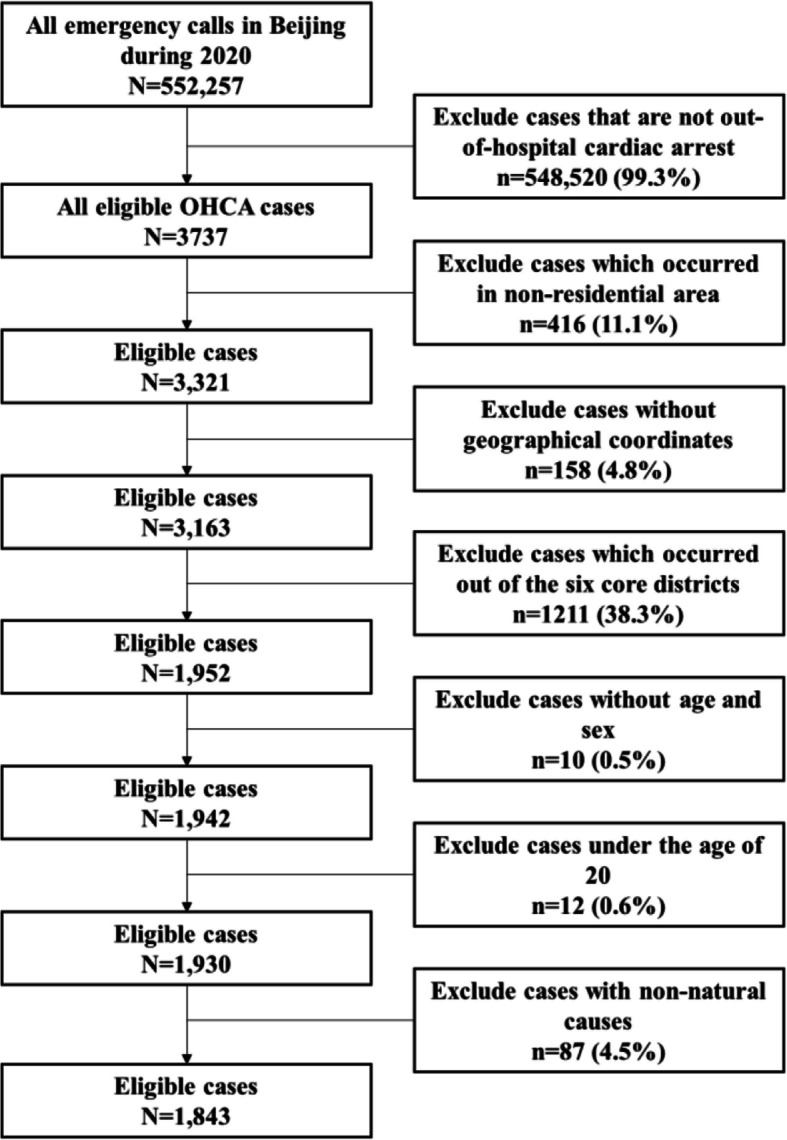
Methods: In this study, we utilized 1843 eligible OHCA cases from core districts of Beijing in 2020 and employed modified Besag-York-Mollié (BYM2) Bayesian models to investigate the association between living environment (consisting of food environment, physical activity environment, healthcare environment and leisure environment) and adult OHCA risk, as well as its age disparities, at a 1 × 1 km2 cell resolution.
Results: The results show that: (1) Fewer living environment factors are associated with the OHCA risk in the young/middle-aged group compared to the elderly group. (2) Unhealthy food destination like barbecue restaurants in living area is associated with increased OHCA risk in both age groups. (3) Facility inducing sedentary activity like chess rooms and healthcare facilities are associated with increased OHCA risk, but only among the elderly groups. (4) The decreased OHCA risk in the young/middle-aged group is related to public gathering places for socialization and relaxation in living area like coffee shops, while for the elder groups, decreased OHCA risk is associated with more green spaces in the living area.
Conclusions: The findings suggest that living environment may impact adult OHCA risk through shaping daily habits or providing access to health resources, with the underlying mechanism varying across different age groups. Future planning should fully consider and leverage the impact of living environment in order to effectively reduce OHCA risk.
期刊介绍:
rchives of Public Health is a broad scope public health journal, dedicated to publishing all sound science in the field of public health. The journal aims to better the understanding of the health of populations. The journal contributes to public health knowledge, enhances the interaction between research, policy and practice and stimulates public health monitoring and indicator development. The journal considers submissions on health outcomes and their determinants, with clear statements about the public health and policy implications. Archives of Public Health welcomes methodological papers (e.g., on study design and bias), papers on health services research, health economics, community interventions, and epidemiological studies dealing with international comparisons, the determinants of inequality in health, and the environmental, behavioural, social, demographic and occupational correlates of health and diseases.






 京公网安备 11010802042870号
京ICP备2023020795号-1
京公网安备 11010802042870号
京ICP备2023020795号-1

 分享
分享
 求助内容:
求助内容: 应助结果提醒方式:
 扫码关注我们
