Yawen Wang, Ismail M. Meraz, Md Qudratullah, Sasikumar Kotagiri, Yanyan Han, Yuanxin Xi, Jing Wang, Kadir C. Akdemir, Jack A. Roth, Yonathan Lissanu
{"title":"SMARCA4突变诱导癌细胞增强子景观的内在缺陷和免疫治疗抗性","authors":"Yawen Wang, Ismail M. Meraz, Md Qudratullah, Sasikumar Kotagiri, Yanyan Han, Yuanxin Xi, Jing Wang, Kadir C. Akdemir, Jack A. Roth, Yonathan Lissanu","doi":"10.1158/0008-5472.can-24-2054","DOIUrl":null,"url":null,"abstract":"Cancer genomic studies have identified frequent alterations in genes encoding components of the SWI/SNF chromatin remodeling complex, including SMARCA4 and ARID1A. Importantly, clinical reports indicate that SMARCA4-mutant lung cancers respond poorly to immunotherapy and have dismal prognosis. Here, we corroborated the clinical findings by using immune-humanized, syngeneic, and genetically engineered mouse models of lung cancer harboring SMARCA4 deficiency. Specifically, models with SMARCA4 loss showed decreased response to anti-PD1 immunotherapy associated with significantly reduced infiltration of dendritic cells and CD4+ T cells into the tumor microenvironment. SMARCA4 loss in tumor cells led to profound downregulation of STING1, IL1B, and other components of the innate immune system, as well as inflammatory cytokines that are required for efficient recruitment and activity of immune cells. The deregulation of gene expression was caused by cancer cell-intrinsic reprogramming of the enhancer landscape with marked loss of chromatin accessibility at enhancers of genes involved in innate immune response, such as STING1, IL1B, type I interferon, and inflammatory cytokines. Interestingly, the transcription factor NF-κB binding motif was enriched in enhancers that lose accessibility upon SMARCA4 deficiency. Furthermore, SMARCA4 and NF-κB co-occupied the same genomic loci on enhancers associated with STING1 and IFNB1, indicating a functional interplay between SMARCA4 and NF-κB. Taken together, these findings provide the mechanistic basis for the poor response of SMARCA4-mutant tumors to immunotherapy and establish a functional link between SMARCA4 and NF-κB in innate immune and inflammatory gene expression regulation.","PeriodicalId":9441,"journal":{"name":"Cancer research","volume":"183 1","pages":""},"PeriodicalIF":16.6000,"publicationDate":"2025-03-13","publicationTypes":"Journal Article","fieldsOfStudy":null,"isOpenAccess":false,"openAccessPdf":"","citationCount":"0","resultStr":"{\"title\":\"Mutation of SMARCA4 Induces Cancer Cell-Intrinsic Defects in the Enhancer Landscape and Resistance to Immunotherapy\",\"authors\":\"Yawen Wang, Ismail M. Meraz, Md Qudratullah, Sasikumar Kotagiri, Yanyan Han, Yuanxin Xi, Jing Wang, Kadir C. Akdemir, Jack A. Roth, Yonathan Lissanu\",\"doi\":\"10.1158/0008-5472.can-24-2054\",\"DOIUrl\":null,\"url\":null,\"abstract\":\"Cancer genomic studies have identified frequent alterations in genes encoding components of the SWI/SNF chromatin remodeling complex, including SMARCA4 and ARID1A. Importantly, clinical reports indicate that SMARCA4-mutant lung cancers respond poorly to immunotherapy and have dismal prognosis. Here, we corroborated the clinical findings by using immune-humanized, syngeneic, and genetically engineered mouse models of lung cancer harboring SMARCA4 deficiency. Specifically, models with SMARCA4 loss showed decreased response to anti-PD1 immunotherapy associated with significantly reduced infiltration of dendritic cells and CD4+ T cells into the tumor microenvironment. SMARCA4 loss in tumor cells led to profound downregulation of STING1, IL1B, and other components of the innate immune system, as well as inflammatory cytokines that are required for efficient recruitment and activity of immune cells. The deregulation of gene expression was caused by cancer cell-intrinsic reprogramming of the enhancer landscape with marked loss of chromatin accessibility at enhancers of genes involved in innate immune response, such as STING1, IL1B, type I interferon, and inflammatory cytokines. Interestingly, the transcription factor NF-κB binding motif was enriched in enhancers that lose accessibility upon SMARCA4 deficiency. Furthermore, SMARCA4 and NF-κB co-occupied the same genomic loci on enhancers associated with STING1 and IFNB1, indicating a functional interplay between SMARCA4 and NF-κB. Taken together, these findings provide the mechanistic basis for the poor response of SMARCA4-mutant tumors to immunotherapy and establish a functional link between SMARCA4 and NF-κB in innate immune and inflammatory gene expression regulation.\",\"PeriodicalId\":9441,\"journal\":{\"name\":\"Cancer research\",\"volume\":\"183 1\",\"pages\":\"\"},\"PeriodicalIF\":16.6000,\"publicationDate\":\"2025-03-13\",\"publicationTypes\":\"Journal Article\",\"fieldsOfStudy\":null,\"isOpenAccess\":false,\"openAccessPdf\":\"\",\"citationCount\":\"0\",\"resultStr\":null,\"platform\":\"Semanticscholar\",\"paperid\":null,\"PeriodicalName\":\"Cancer research\",\"FirstCategoryId\":\"3\",\"ListUrlMain\":\"https://doi.org/10.1158/0008-5472.can-24-2054\",\"RegionNum\":1,\"RegionCategory\":\"医学\",\"ArticlePicture\":[],\"TitleCN\":null,\"AbstractTextCN\":null,\"PMCID\":null,\"EPubDate\":\"\",\"PubModel\":\"\",\"JCR\":\"Q1\",\"JCRName\":\"ONCOLOGY\",\"Score\":null,\"Total\":0}","platform":"Semanticscholar","paperid":null,"PeriodicalName":"Cancer research","FirstCategoryId":"3","ListUrlMain":"https://doi.org/10.1158/0008-5472.can-24-2054","RegionNum":1,"RegionCategory":"医学","ArticlePicture":[],"TitleCN":null,"AbstractTextCN":null,"PMCID":null,"EPubDate":"","PubModel":"","JCR":"Q1","JCRName":"ONCOLOGY","Score":null,"Total":0}
Mutation of SMARCA4 Induces Cancer Cell-Intrinsic Defects in the Enhancer Landscape and Resistance to Immunotherapy
Cancer genomic studies have identified frequent alterations in genes encoding components of the SWI/SNF chromatin remodeling complex, including SMARCA4 and ARID1A. Importantly, clinical reports indicate that SMARCA4-mutant lung cancers respond poorly to immunotherapy and have dismal prognosis. Here, we corroborated the clinical findings by using immune-humanized, syngeneic, and genetically engineered mouse models of lung cancer harboring SMARCA4 deficiency. Specifically, models with SMARCA4 loss showed decreased response to anti-PD1 immunotherapy associated with significantly reduced infiltration of dendritic cells and CD4+ T cells into the tumor microenvironment. SMARCA4 loss in tumor cells led to profound downregulation of STING1, IL1B, and other components of the innate immune system, as well as inflammatory cytokines that are required for efficient recruitment and activity of immune cells. The deregulation of gene expression was caused by cancer cell-intrinsic reprogramming of the enhancer landscape with marked loss of chromatin accessibility at enhancers of genes involved in innate immune response, such as STING1, IL1B, type I interferon, and inflammatory cytokines. Interestingly, the transcription factor NF-κB binding motif was enriched in enhancers that lose accessibility upon SMARCA4 deficiency. Furthermore, SMARCA4 and NF-κB co-occupied the same genomic loci on enhancers associated with STING1 and IFNB1, indicating a functional interplay between SMARCA4 and NF-κB. Taken together, these findings provide the mechanistic basis for the poor response of SMARCA4-mutant tumors to immunotherapy and establish a functional link between SMARCA4 and NF-κB in innate immune and inflammatory gene expression regulation.
期刊介绍:
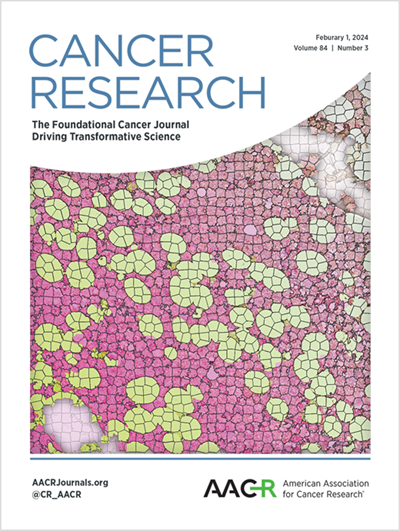
Cancer Research, published by the American Association for Cancer Research (AACR), is a journal that focuses on impactful original studies, reviews, and opinion pieces relevant to the broad cancer research community. Manuscripts that present conceptual or technological advances leading to insights into cancer biology are particularly sought after. The journal also places emphasis on convergence science, which involves bridging multiple distinct areas of cancer research.
With primary subsections including Cancer Biology, Cancer Immunology, Cancer Metabolism and Molecular Mechanisms, Translational Cancer Biology, Cancer Landscapes, and Convergence Science, Cancer Research has a comprehensive scope. It is published twice a month and has one volume per year, with a print ISSN of 0008-5472 and an online ISSN of 1538-7445.
Cancer Research is abstracted and/or indexed in various databases and platforms, including BIOSIS Previews (R) Database, MEDLINE, Current Contents/Life Sciences, Current Contents/Clinical Medicine, Science Citation Index, Scopus, and Web of Science.




 京公网安备 11010802042870号
京ICP备2023020795号-1
京公网安备 11010802042870号
京ICP备2023020795号-1

 分享
分享
 求助内容:
求助内容: 应助结果提醒方式:
 扫码关注我们
