Xinyu Zhang , Zhenyu Sun , Ping Li , Yuan Zhang , Yiqiang Wu , Yingfeng Zuo
{"title":"PAMAM/环氧树脂/硅酸钠构建的双网络互联拓扑结构增强了杉木的性能","authors":"Xinyu Zhang , Zhenyu Sun , Ping Li , Yuan Zhang , Yiqiang Wu , Yingfeng Zuo","doi":"10.1016/j.indcrop.2025.120835","DOIUrl":null,"url":null,"abstract":"<div><div>To meet the growing demand for solid wood products and efficiently utilize artificial forest resources while protecting natural forests, this study addresses the issues of low density, poor dimensional stability, and inferior water resistance and durability in fast-growing Chinese fir wood. The study uses non-toxic sodium silicate (SS), formaldehyde-free waterborne epoxy resin (WEP), and polyamide-amine dendritic macromolecules (PAMAM) as impregnation agents to prepare composite-modified wood. The findings show that the WEP+PAMAM impregnation system reduces the hydroxyl content in the wood, promotes the formation of Si-O-Si structures, and creates a dual-network interconnected structure. Through Si-O-C connections, the epoxy-amine network created by WEP and PAMAM is connected to the polysilicate network created by SS in the wood. The wood treated with SS/(WEP+PAMAM) composite has much better mechanical and water-resistant qualities. When compared to untreated wood, the hardness, longitudinal compressive strength, and bending strength all improve by 114.92 %, 98.05 %, and 91.96 %, respectively. When compared to SS treated wood, the anti-swelling efficiency (ASE) increases by 95.87 % after 14 days, while the leaching ratio (WLR) and water absorption rate (WAR) fall by 37.52 % and 14.67 %, respectively. This modification process offers a novel way to use fast-growing Chinese fir wood as a high-performance wood material by resolving the problems of chemical loss and poor dimensional stability in SS-modified wood.</div></div>","PeriodicalId":13581,"journal":{"name":"Industrial Crops and Products","volume":"227 ","pages":"Article 120835"},"PeriodicalIF":6.2000,"publicationDate":"2025-05-01","publicationTypes":"Journal Article","fieldsOfStudy":null,"isOpenAccess":false,"openAccessPdf":"","citationCount":"0","resultStr":"{\"title\":\"The PAMAM/epoxy resin/sodium silicate constructed dual-network interconnected topological structure enhances the performance of Chinese fir wood\",\"authors\":\"Xinyu Zhang , Zhenyu Sun , Ping Li , Yuan Zhang , Yiqiang Wu , Yingfeng Zuo\",\"doi\":\"10.1016/j.indcrop.2025.120835\",\"DOIUrl\":null,\"url\":null,\"abstract\":\"<div><div>To meet the growing demand for solid wood products and efficiently utilize artificial forest resources while protecting natural forests, this study addresses the issues of low density, poor dimensional stability, and inferior water resistance and durability in fast-growing Chinese fir wood. The study uses non-toxic sodium silicate (SS), formaldehyde-free waterborne epoxy resin (WEP), and polyamide-amine dendritic macromolecules (PAMAM) as impregnation agents to prepare composite-modified wood. The findings show that the WEP+PAMAM impregnation system reduces the hydroxyl content in the wood, promotes the formation of Si-O-Si structures, and creates a dual-network interconnected structure. Through Si-O-C connections, the epoxy-amine network created by WEP and PAMAM is connected to the polysilicate network created by SS in the wood. The wood treated with SS/(WEP+PAMAM) composite has much better mechanical and water-resistant qualities. When compared to untreated wood, the hardness, longitudinal compressive strength, and bending strength all improve by 114.92 %, 98.05 %, and 91.96 %, respectively. When compared to SS treated wood, the anti-swelling efficiency (ASE) increases by 95.87 % after 14 days, while the leaching ratio (WLR) and water absorption rate (WAR) fall by 37.52 % and 14.67 %, respectively. This modification process offers a novel way to use fast-growing Chinese fir wood as a high-performance wood material by resolving the problems of chemical loss and poor dimensional stability in SS-modified wood.</div></div>\",\"PeriodicalId\":13581,\"journal\":{\"name\":\"Industrial Crops and Products\",\"volume\":\"227 \",\"pages\":\"Article 120835\"},\"PeriodicalIF\":6.2000,\"publicationDate\":\"2025-05-01\",\"publicationTypes\":\"Journal Article\",\"fieldsOfStudy\":null,\"isOpenAccess\":false,\"openAccessPdf\":\"\",\"citationCount\":\"0\",\"resultStr\":null,\"platform\":\"Semanticscholar\",\"paperid\":null,\"PeriodicalName\":\"Industrial Crops and Products\",\"FirstCategoryId\":\"97\",\"ListUrlMain\":\"https://www.sciencedirect.com/science/article/pii/S0926669025003814\",\"RegionNum\":1,\"RegionCategory\":\"农林科学\",\"ArticlePicture\":[],\"TitleCN\":null,\"AbstractTextCN\":null,\"PMCID\":null,\"EPubDate\":\"2025/3/14 0:00:00\",\"PubModel\":\"Epub\",\"JCR\":\"Q1\",\"JCRName\":\"AGRICULTURAL ENGINEERING\",\"Score\":null,\"Total\":0}","platform":"Semanticscholar","paperid":null,"PeriodicalName":"Industrial Crops and Products","FirstCategoryId":"97","ListUrlMain":"https://www.sciencedirect.com/science/article/pii/S0926669025003814","RegionNum":1,"RegionCategory":"农林科学","ArticlePicture":[],"TitleCN":null,"AbstractTextCN":null,"PMCID":null,"EPubDate":"2025/3/14 0:00:00","PubModel":"Epub","JCR":"Q1","JCRName":"AGRICULTURAL ENGINEERING","Score":null,"Total":0}
The PAMAM/epoxy resin/sodium silicate constructed dual-network interconnected topological structure enhances the performance of Chinese fir wood
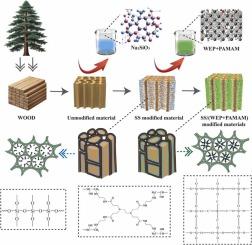
To meet the growing demand for solid wood products and efficiently utilize artificial forest resources while protecting natural forests, this study addresses the issues of low density, poor dimensional stability, and inferior water resistance and durability in fast-growing Chinese fir wood. The study uses non-toxic sodium silicate (SS), formaldehyde-free waterborne epoxy resin (WEP), and polyamide-amine dendritic macromolecules (PAMAM) as impregnation agents to prepare composite-modified wood. The findings show that the WEP+PAMAM impregnation system reduces the hydroxyl content in the wood, promotes the formation of Si-O-Si structures, and creates a dual-network interconnected structure. Through Si-O-C connections, the epoxy-amine network created by WEP and PAMAM is connected to the polysilicate network created by SS in the wood. The wood treated with SS/(WEP+PAMAM) composite has much better mechanical and water-resistant qualities. When compared to untreated wood, the hardness, longitudinal compressive strength, and bending strength all improve by 114.92 %, 98.05 %, and 91.96 %, respectively. When compared to SS treated wood, the anti-swelling efficiency (ASE) increases by 95.87 % after 14 days, while the leaching ratio (WLR) and water absorption rate (WAR) fall by 37.52 % and 14.67 %, respectively. This modification process offers a novel way to use fast-growing Chinese fir wood as a high-performance wood material by resolving the problems of chemical loss and poor dimensional stability in SS-modified wood.
期刊介绍:
Industrial Crops and Products is an International Journal publishing academic and industrial research on industrial (defined as non-food/non-feed) crops and products. Papers concern both crop-oriented and bio-based materials from crops-oriented research, and should be of interest to an international audience, hypothesis driven, and where comparisons are made statistics performed.




 京公网安备 11010802042870号
京ICP备2023020795号-1
京公网安备 11010802042870号
京ICP备2023020795号-1

 分享
分享
 求助内容:
求助内容: 应助结果提醒方式:
 扫码关注我们
