Shaomin Zhou , Xi Zhang , Lulu Zhan , Xianliang Song , Rui Li , Yulong Wu
{"title":"糠醛生产的未来发展:一步和两步策略的比较及生命周期评估","authors":"Shaomin Zhou , Xi Zhang , Lulu Zhan , Xianliang Song , Rui Li , Yulong Wu","doi":"10.1016/j.indcrop.2025.120807","DOIUrl":null,"url":null,"abstract":"<div><div>Furfural (FF) is an important platform chemical that can be produced from lignocellulosic biomass rich in xylan. However, the traditional one-step FF production process produces a large amount of residue rich in sulfuric acid, approximately 15 tons per ton of FF. In this study, a carbon-based solid acid catalyst ZnCS-2 was developed for the two-step catalytic conversion of lignocellulosic biomass to FF. Furfural yields of up to 72.4 % were obtained at 180 °C for 60 min with 10 wt% catalyst ZnCS-2 catalyst. Using this catalytic system, a conceptual process for a two-step FF production system (TSF) was established. With the aim of performing a quantitative comparison with traditional production, a one-step FF production process (OSF) simulation alongside a lifecycle analysis was performed. Comparing the two-step method with the traditional one-step method, the advantages and disadvantages of the two methods and the direction of improvement can be systematically analyzed. The results demonstrated that the TSF process, which employs the ZnCS-2 catalyst and a biphasic solvent system of MIBK/NaCl, achieved a higher furfural yield. Specifically, the final yield of the TSF process exceeded that of the OSF process by 49.9 %. For every ton of furfural produced, the TSF process resulted in reductions of 0.07 kg SO<sub>2</sub> eq, 186.15 kg CO<sub>2</sub> eq, 1 × 10<sup>−5</sup> kg CFC-11 eq, and 66.13 kg 1,4-DB-eq in emissions compared with OSF. Owing to the higher yield and sulfur-free corncob residue, the profitability of TSF process was found to be 6.75 times greater than that of the OSF process.</div></div>","PeriodicalId":13581,"journal":{"name":"Industrial Crops and Products","volume":"227 ","pages":"Article 120807"},"PeriodicalIF":6.2000,"publicationDate":"2025-05-01","publicationTypes":"Journal Article","fieldsOfStudy":null,"isOpenAccess":false,"openAccessPdf":"","citationCount":"0","resultStr":"{\"title\":\"Future development for furfural production: Comparison of one-step and two-step strategies and life cycle assessment\",\"authors\":\"Shaomin Zhou , Xi Zhang , Lulu Zhan , Xianliang Song , Rui Li , Yulong Wu\",\"doi\":\"10.1016/j.indcrop.2025.120807\",\"DOIUrl\":null,\"url\":null,\"abstract\":\"<div><div>Furfural (FF) is an important platform chemical that can be produced from lignocellulosic biomass rich in xylan. However, the traditional one-step FF production process produces a large amount of residue rich in sulfuric acid, approximately 15 tons per ton of FF. In this study, a carbon-based solid acid catalyst ZnCS-2 was developed for the two-step catalytic conversion of lignocellulosic biomass to FF. Furfural yields of up to 72.4 % were obtained at 180 °C for 60 min with 10 wt% catalyst ZnCS-2 catalyst. Using this catalytic system, a conceptual process for a two-step FF production system (TSF) was established. With the aim of performing a quantitative comparison with traditional production, a one-step FF production process (OSF) simulation alongside a lifecycle analysis was performed. Comparing the two-step method with the traditional one-step method, the advantages and disadvantages of the two methods and the direction of improvement can be systematically analyzed. The results demonstrated that the TSF process, which employs the ZnCS-2 catalyst and a biphasic solvent system of MIBK/NaCl, achieved a higher furfural yield. Specifically, the final yield of the TSF process exceeded that of the OSF process by 49.9 %. For every ton of furfural produced, the TSF process resulted in reductions of 0.07 kg SO<sub>2</sub> eq, 186.15 kg CO<sub>2</sub> eq, 1 × 10<sup>−5</sup> kg CFC-11 eq, and 66.13 kg 1,4-DB-eq in emissions compared with OSF. Owing to the higher yield and sulfur-free corncob residue, the profitability of TSF process was found to be 6.75 times greater than that of the OSF process.</div></div>\",\"PeriodicalId\":13581,\"journal\":{\"name\":\"Industrial Crops and Products\",\"volume\":\"227 \",\"pages\":\"Article 120807\"},\"PeriodicalIF\":6.2000,\"publicationDate\":\"2025-05-01\",\"publicationTypes\":\"Journal Article\",\"fieldsOfStudy\":null,\"isOpenAccess\":false,\"openAccessPdf\":\"\",\"citationCount\":\"0\",\"resultStr\":null,\"platform\":\"Semanticscholar\",\"paperid\":null,\"PeriodicalName\":\"Industrial Crops and Products\",\"FirstCategoryId\":\"97\",\"ListUrlMain\":\"https://www.sciencedirect.com/science/article/pii/S092666902500353X\",\"RegionNum\":1,\"RegionCategory\":\"农林科学\",\"ArticlePicture\":[],\"TitleCN\":null,\"AbstractTextCN\":null,\"PMCID\":null,\"EPubDate\":\"2025/3/14 0:00:00\",\"PubModel\":\"Epub\",\"JCR\":\"Q1\",\"JCRName\":\"AGRICULTURAL ENGINEERING\",\"Score\":null,\"Total\":0}","platform":"Semanticscholar","paperid":null,"PeriodicalName":"Industrial Crops and Products","FirstCategoryId":"97","ListUrlMain":"https://www.sciencedirect.com/science/article/pii/S092666902500353X","RegionNum":1,"RegionCategory":"农林科学","ArticlePicture":[],"TitleCN":null,"AbstractTextCN":null,"PMCID":null,"EPubDate":"2025/3/14 0:00:00","PubModel":"Epub","JCR":"Q1","JCRName":"AGRICULTURAL ENGINEERING","Score":null,"Total":0}
引用次数: 0
摘要
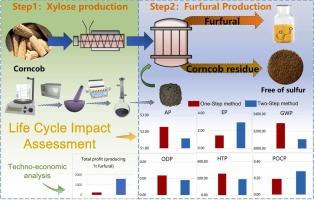
糠醛(FF)是一种重要的平台化学物质,可以从富含木聚糖的木质纤维素生物质中生产。然而,传统的一步法生产FF会产生大量富含硫酸的残渣,每吨FF约有15吨。在本研究中,开发了一种碳基固体酸催化剂ZnCS-2,用于木质纤维素生物质两步催化转化为FF。ZnCS-2催化剂用量为10 wt%,反应温度为180℃,反应时间为60 min,糠醛收率可达72.4 %。利用该催化体系,建立了二步法FF生产系统(TSF)的概念流程。为了与传统生产进行定量比较,进行了一步FF生产过程(OSF)模拟和生命周期分析。将两步法与传统的一步法进行比较,可以系统分析两种方法的优缺点和改进方向。结果表明,采用ZnCS-2催化剂和MIBK/NaCl双相溶剂体系的TSF工艺可获得较高的糠醛收率。具体而言,TSF工艺的最终产率比OSF工艺高出49.9 %。与OSF相比,TSF工艺每生产一吨糠醛,可减少0.07 kg SO2当量、186.15 kg CO2当量、1 × 10⁻⁵ kg CFC-11当量和66.13 kg 1.4 db -当量的排放量。由于TSF工艺产率高,且无硫玉米芯渣,因此TSF工艺的盈利能力是OSF工艺的6.75倍。
Future development for furfural production: Comparison of one-step and two-step strategies and life cycle assessment
Furfural (FF) is an important platform chemical that can be produced from lignocellulosic biomass rich in xylan. However, the traditional one-step FF production process produces a large amount of residue rich in sulfuric acid, approximately 15 tons per ton of FF. In this study, a carbon-based solid acid catalyst ZnCS-2 was developed for the two-step catalytic conversion of lignocellulosic biomass to FF. Furfural yields of up to 72.4 % were obtained at 180 °C for 60 min with 10 wt% catalyst ZnCS-2 catalyst. Using this catalytic system, a conceptual process for a two-step FF production system (TSF) was established. With the aim of performing a quantitative comparison with traditional production, a one-step FF production process (OSF) simulation alongside a lifecycle analysis was performed. Comparing the two-step method with the traditional one-step method, the advantages and disadvantages of the two methods and the direction of improvement can be systematically analyzed. The results demonstrated that the TSF process, which employs the ZnCS-2 catalyst and a biphasic solvent system of MIBK/NaCl, achieved a higher furfural yield. Specifically, the final yield of the TSF process exceeded that of the OSF process by 49.9 %. For every ton of furfural produced, the TSF process resulted in reductions of 0.07 kg SO2 eq, 186.15 kg CO2 eq, 1 × 10⁻⁵ kg CFC-11 eq, and 66.13 kg 1,4-DB-eq in emissions compared with OSF. Owing to the higher yield and sulfur-free corncob residue, the profitability of TSF process was found to be 6.75 times greater than that of the OSF process.
期刊介绍:
Industrial Crops and Products is an International Journal publishing academic and industrial research on industrial (defined as non-food/non-feed) crops and products. Papers concern both crop-oriented and bio-based materials from crops-oriented research, and should be of interest to an international audience, hypothesis driven, and where comparisons are made statistics performed.




 京公网安备 11010802042870号
京ICP备2023020795号-1
京公网安备 11010802042870号
京ICP备2023020795号-1

 分享
分享
 求助内容:
求助内容: 应助结果提醒方式:
 扫码关注我们
