Sheen Mclean Cabaneros , Emma Chapman , Mark Hansen , Ben Williams , Jeanette Rotchell
{"title":"利用深度学习在显微照片中自动预筛选室外空气中的微塑料","authors":"Sheen Mclean Cabaneros , Emma Chapman , Mark Hansen , Ben Williams , Jeanette Rotchell","doi":"10.1016/j.envpol.2025.125993","DOIUrl":null,"url":null,"abstract":"<div><div>Airborne microplastics (AMPs) are prevalent in both indoor and outdoor environments, posing potential health risks to humans. Automating the process of identifying potential particles in micrographs can significantly enhance the research and monitoring of AMPs. Although deep learning has shown substantial promise in microplastics analysis, existing studies have primarily focused on high-resolution images of samples collected from marine and freshwater environments. In contrast, this work introduces a novel approach by employing enhanced U-Net models (Attention U-Net and Dynamic RU-NEXT) along with the Mask Region Convolutional Neural Network (Mask R-CNN) to identify and classify outdoor AMPs in low-resolution micrographs (256 × 256 pixels). A key innovation involves integrating classification directly within the U-Net-based segmentation frameworks, thereby streamlining the workflow and improving computational efficiency. This marks an advancement over previous work where segmentation and classification were performed separately. The enhanced U-Net models attained average classification F1-scores exceeding 85% and segmentation accuracy above 77% on test images. Additionally, the Mask R-CNN model achieved an average bounding box precision of 73.32%, a classification F1-score of 84.29%, and a mask precision of 71.31%. The proposed method provides a faster and more accurate means of identifying AMPs compared to thresholding techniques. It also functions effectively as a pre-screening tool, substantially reducing the number of particles requiring labour-intensive chemical analysis. By integrating advanced deep learning strategies into AMPs research, this study paves the way for more efficient monitoring and characterisation of microplastics.</div></div>","PeriodicalId":311,"journal":{"name":"Environmental Pollution","volume":"372 ","pages":"Article 125993"},"PeriodicalIF":7.3000,"publicationDate":"2025-05-01","publicationTypes":"Journal Article","fieldsOfStudy":null,"isOpenAccess":false,"openAccessPdf":"","citationCount":"0","resultStr":"{\"title\":\"Automatic pre-screening of outdoor airborne microplastics in micrographs using deep learning\",\"authors\":\"Sheen Mclean Cabaneros , Emma Chapman , Mark Hansen , Ben Williams , Jeanette Rotchell\",\"doi\":\"10.1016/j.envpol.2025.125993\",\"DOIUrl\":null,\"url\":null,\"abstract\":\"<div><div>Airborne microplastics (AMPs) are prevalent in both indoor and outdoor environments, posing potential health risks to humans. Automating the process of identifying potential particles in micrographs can significantly enhance the research and monitoring of AMPs. Although deep learning has shown substantial promise in microplastics analysis, existing studies have primarily focused on high-resolution images of samples collected from marine and freshwater environments. In contrast, this work introduces a novel approach by employing enhanced U-Net models (Attention U-Net and Dynamic RU-NEXT) along with the Mask Region Convolutional Neural Network (Mask R-CNN) to identify and classify outdoor AMPs in low-resolution micrographs (256 × 256 pixels). A key innovation involves integrating classification directly within the U-Net-based segmentation frameworks, thereby streamlining the workflow and improving computational efficiency. This marks an advancement over previous work where segmentation and classification were performed separately. The enhanced U-Net models attained average classification F1-scores exceeding 85% and segmentation accuracy above 77% on test images. Additionally, the Mask R-CNN model achieved an average bounding box precision of 73.32%, a classification F1-score of 84.29%, and a mask precision of 71.31%. The proposed method provides a faster and more accurate means of identifying AMPs compared to thresholding techniques. It also functions effectively as a pre-screening tool, substantially reducing the number of particles requiring labour-intensive chemical analysis. By integrating advanced deep learning strategies into AMPs research, this study paves the way for more efficient monitoring and characterisation of microplastics.</div></div>\",\"PeriodicalId\":311,\"journal\":{\"name\":\"Environmental Pollution\",\"volume\":\"372 \",\"pages\":\"Article 125993\"},\"PeriodicalIF\":7.3000,\"publicationDate\":\"2025-05-01\",\"publicationTypes\":\"Journal Article\",\"fieldsOfStudy\":null,\"isOpenAccess\":false,\"openAccessPdf\":\"\",\"citationCount\":\"0\",\"resultStr\":null,\"platform\":\"Semanticscholar\",\"paperid\":null,\"PeriodicalName\":\"Environmental Pollution\",\"FirstCategoryId\":\"93\",\"ListUrlMain\":\"https://www.sciencedirect.com/science/article/pii/S0269749125003665\",\"RegionNum\":2,\"RegionCategory\":\"环境科学与生态学\",\"ArticlePicture\":[],\"TitleCN\":null,\"AbstractTextCN\":null,\"PMCID\":null,\"EPubDate\":\"2025/3/14 0:00:00\",\"PubModel\":\"Epub\",\"JCR\":\"Q1\",\"JCRName\":\"ENVIRONMENTAL SCIENCES\",\"Score\":null,\"Total\":0}","platform":"Semanticscholar","paperid":null,"PeriodicalName":"Environmental Pollution","FirstCategoryId":"93","ListUrlMain":"https://www.sciencedirect.com/science/article/pii/S0269749125003665","RegionNum":2,"RegionCategory":"环境科学与生态学","ArticlePicture":[],"TitleCN":null,"AbstractTextCN":null,"PMCID":null,"EPubDate":"2025/3/14 0:00:00","PubModel":"Epub","JCR":"Q1","JCRName":"ENVIRONMENTAL SCIENCES","Score":null,"Total":0}
Automatic pre-screening of outdoor airborne microplastics in micrographs using deep learning
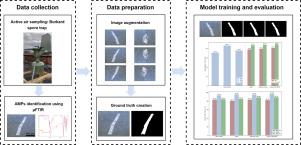
Airborne microplastics (AMPs) are prevalent in both indoor and outdoor environments, posing potential health risks to humans. Automating the process of identifying potential particles in micrographs can significantly enhance the research and monitoring of AMPs. Although deep learning has shown substantial promise in microplastics analysis, existing studies have primarily focused on high-resolution images of samples collected from marine and freshwater environments. In contrast, this work introduces a novel approach by employing enhanced U-Net models (Attention U-Net and Dynamic RU-NEXT) along with the Mask Region Convolutional Neural Network (Mask R-CNN) to identify and classify outdoor AMPs in low-resolution micrographs (256 × 256 pixels). A key innovation involves integrating classification directly within the U-Net-based segmentation frameworks, thereby streamlining the workflow and improving computational efficiency. This marks an advancement over previous work where segmentation and classification were performed separately. The enhanced U-Net models attained average classification F1-scores exceeding 85% and segmentation accuracy above 77% on test images. Additionally, the Mask R-CNN model achieved an average bounding box precision of 73.32%, a classification F1-score of 84.29%, and a mask precision of 71.31%. The proposed method provides a faster and more accurate means of identifying AMPs compared to thresholding techniques. It also functions effectively as a pre-screening tool, substantially reducing the number of particles requiring labour-intensive chemical analysis. By integrating advanced deep learning strategies into AMPs research, this study paves the way for more efficient monitoring and characterisation of microplastics.
期刊介绍:
Environmental Pollution is an international peer-reviewed journal that publishes high-quality research papers and review articles covering all aspects of environmental pollution and its impacts on ecosystems and human health.
Subject areas include, but are not limited to:
• Sources and occurrences of pollutants that are clearly defined and measured in environmental compartments, food and food-related items, and human bodies;
• Interlinks between contaminant exposure and biological, ecological, and human health effects, including those of climate change;
• Contaminants of emerging concerns (including but not limited to antibiotic resistant microorganisms or genes, microplastics/nanoplastics, electronic wastes, light, and noise) and/or their biological, ecological, or human health effects;
• Laboratory and field studies on the remediation/mitigation of environmental pollution via new techniques and with clear links to biological, ecological, or human health effects;
• Modeling of pollution processes, patterns, or trends that is of clear environmental and/or human health interest;
• New techniques that measure and examine environmental occurrences, transport, behavior, and effects of pollutants within the environment or the laboratory, provided that they can be clearly used to address problems within regional or global environmental compartments.





 京公网安备 11010802042870号
京ICP备2023020795号-1
京公网安备 11010802042870号
京ICP备2023020795号-1

 分享
分享
 求助内容:
求助内容: 应助结果提醒方式:
 扫码关注我们
