Juan Wen , Shijie Geng , Juan Mu , Junya Wang , Yongmei Dai , Lingmin Hu
{"title":"五氯酚暴露、血浆代谢组学标志物和妊娠糖尿病:关联和潜在的中介分析","authors":"Juan Wen , Shijie Geng , Juan Mu , Junya Wang , Yongmei Dai , Lingmin Hu","doi":"10.1016/j.envpol.2025.126069","DOIUrl":null,"url":null,"abstract":"<div><div>Pentachlorophenol (PCP) is a pervasive endocrine-disrupting compound present in the environment. Limited research has explored the effects of PCP exposure on gestational diabetes mellitus (GDM), particularly the metabolites-related mechanism. Our study seeks to characterize the interrelationships between PCP exposure, plasma metabolomic markers, and GDM, aiming to elucidate the metabolomic profile mediating PCP-GDM relationship. From a prospective cohort in Changzhou, China, a nested case-control study was conducted, involving 154 GDM cases and 308 controls. We collected fasting blood samples before 16 weeks of gestation and determined PCP levels by UPLC-MS/MS. Plasma metabolomic markers were identified using untargeted metabolomics. Multivariate logistic regression and mediation analysis were used to examine the relationships among PCP exposure, metabolomic markers, and GDM. Using the Mann-Whitney <em>U</em> test, we found that serum PCP levels were significantly higher in GDM cases (median: 0.43 ng/mL, IQR: 0.28–0.77) compared to controls (median: 0.38 ng/mL, IQR: 0.24–0.64; <em>P</em> = 0.041). In the fully adjusted model, which additionally accounted for dietary patterns, the OR (95 %CI) values for GDM across tertiles of serum PCP were 1 (reference), 1.24 (0.73, 2.11), and 2.17 (1.28, 3.68), respectively, indicating a potential dose-response relationship (<em>P</em> trend = 0.004). Furthermore, 152 differential metabolites were identified between groups (FDR <0.05), implicating 4 metabolic pathways: \"Nitrogen metabolism\", \"Alanine, aspartate and glutamate metabolism\", \"Glycerophospholipid metabolism\", and \"Pyrimidine metabolism\" (FDR <0.1). Mediation analysis revealed that 5 metabolomic markers (such as N-Acetylalanine and 4-Acetamidobutyric acid) significantly mediated the association between PCP and GDM (FDR <0.05), with mediated proportions ranging from 0.15 to 0.31. Together, pregnant women in Eastern China exhibit widespread PCP exposure, with serum PCP levels positively associated with GDM risk. PCP exposure-related metabolomic changes may partially mediate the link between PCP and GDM.</div></div>","PeriodicalId":311,"journal":{"name":"Environmental Pollution","volume":"372 ","pages":"Article 126069"},"PeriodicalIF":7.3000,"publicationDate":"2025-05-01","publicationTypes":"Journal Article","fieldsOfStudy":null,"isOpenAccess":false,"openAccessPdf":"","citationCount":"0","resultStr":"{\"title\":\"Pentachlorophenol exposure, plasma metabolomic markers, and gestational diabetes mellitus: Association and potential mediation analyses\",\"authors\":\"Juan Wen , Shijie Geng , Juan Mu , Junya Wang , Yongmei Dai , Lingmin Hu\",\"doi\":\"10.1016/j.envpol.2025.126069\",\"DOIUrl\":null,\"url\":null,\"abstract\":\"<div><div>Pentachlorophenol (PCP) is a pervasive endocrine-disrupting compound present in the environment. Limited research has explored the effects of PCP exposure on gestational diabetes mellitus (GDM), particularly the metabolites-related mechanism. Our study seeks to characterize the interrelationships between PCP exposure, plasma metabolomic markers, and GDM, aiming to elucidate the metabolomic profile mediating PCP-GDM relationship. From a prospective cohort in Changzhou, China, a nested case-control study was conducted, involving 154 GDM cases and 308 controls. We collected fasting blood samples before 16 weeks of gestation and determined PCP levels by UPLC-MS/MS. Plasma metabolomic markers were identified using untargeted metabolomics. Multivariate logistic regression and mediation analysis were used to examine the relationships among PCP exposure, metabolomic markers, and GDM. Using the Mann-Whitney <em>U</em> test, we found that serum PCP levels were significantly higher in GDM cases (median: 0.43 ng/mL, IQR: 0.28–0.77) compared to controls (median: 0.38 ng/mL, IQR: 0.24–0.64; <em>P</em> = 0.041). In the fully adjusted model, which additionally accounted for dietary patterns, the OR (95 %CI) values for GDM across tertiles of serum PCP were 1 (reference), 1.24 (0.73, 2.11), and 2.17 (1.28, 3.68), respectively, indicating a potential dose-response relationship (<em>P</em> trend = 0.004). Furthermore, 152 differential metabolites were identified between groups (FDR <0.05), implicating 4 metabolic pathways: \\\"Nitrogen metabolism\\\", \\\"Alanine, aspartate and glutamate metabolism\\\", \\\"Glycerophospholipid metabolism\\\", and \\\"Pyrimidine metabolism\\\" (FDR <0.1). Mediation analysis revealed that 5 metabolomic markers (such as N-Acetylalanine and 4-Acetamidobutyric acid) significantly mediated the association between PCP and GDM (FDR <0.05), with mediated proportions ranging from 0.15 to 0.31. Together, pregnant women in Eastern China exhibit widespread PCP exposure, with serum PCP levels positively associated with GDM risk. PCP exposure-related metabolomic changes may partially mediate the link between PCP and GDM.</div></div>\",\"PeriodicalId\":311,\"journal\":{\"name\":\"Environmental Pollution\",\"volume\":\"372 \",\"pages\":\"Article 126069\"},\"PeriodicalIF\":7.3000,\"publicationDate\":\"2025-05-01\",\"publicationTypes\":\"Journal Article\",\"fieldsOfStudy\":null,\"isOpenAccess\":false,\"openAccessPdf\":\"\",\"citationCount\":\"0\",\"resultStr\":null,\"platform\":\"Semanticscholar\",\"paperid\":null,\"PeriodicalName\":\"Environmental Pollution\",\"FirstCategoryId\":\"93\",\"ListUrlMain\":\"https://www.sciencedirect.com/science/article/pii/S0269749125004427\",\"RegionNum\":2,\"RegionCategory\":\"环境科学与生态学\",\"ArticlePicture\":[],\"TitleCN\":null,\"AbstractTextCN\":null,\"PMCID\":null,\"EPubDate\":\"2025/3/14 0:00:00\",\"PubModel\":\"Epub\",\"JCR\":\"Q1\",\"JCRName\":\"ENVIRONMENTAL SCIENCES\",\"Score\":null,\"Total\":0}","platform":"Semanticscholar","paperid":null,"PeriodicalName":"Environmental Pollution","FirstCategoryId":"93","ListUrlMain":"https://www.sciencedirect.com/science/article/pii/S0269749125004427","RegionNum":2,"RegionCategory":"环境科学与生态学","ArticlePicture":[],"TitleCN":null,"AbstractTextCN":null,"PMCID":null,"EPubDate":"2025/3/14 0:00:00","PubModel":"Epub","JCR":"Q1","JCRName":"ENVIRONMENTAL SCIENCES","Score":null,"Total":0}
Pentachlorophenol exposure, plasma metabolomic markers, and gestational diabetes mellitus: Association and potential mediation analyses
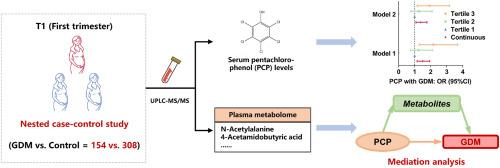
Pentachlorophenol (PCP) is a pervasive endocrine-disrupting compound present in the environment. Limited research has explored the effects of PCP exposure on gestational diabetes mellitus (GDM), particularly the metabolites-related mechanism. Our study seeks to characterize the interrelationships between PCP exposure, plasma metabolomic markers, and GDM, aiming to elucidate the metabolomic profile mediating PCP-GDM relationship. From a prospective cohort in Changzhou, China, a nested case-control study was conducted, involving 154 GDM cases and 308 controls. We collected fasting blood samples before 16 weeks of gestation and determined PCP levels by UPLC-MS/MS. Plasma metabolomic markers were identified using untargeted metabolomics. Multivariate logistic regression and mediation analysis were used to examine the relationships among PCP exposure, metabolomic markers, and GDM. Using the Mann-Whitney U test, we found that serum PCP levels were significantly higher in GDM cases (median: 0.43 ng/mL, IQR: 0.28–0.77) compared to controls (median: 0.38 ng/mL, IQR: 0.24–0.64; P = 0.041). In the fully adjusted model, which additionally accounted for dietary patterns, the OR (95 %CI) values for GDM across tertiles of serum PCP were 1 (reference), 1.24 (0.73, 2.11), and 2.17 (1.28, 3.68), respectively, indicating a potential dose-response relationship (P trend = 0.004). Furthermore, 152 differential metabolites were identified between groups (FDR <0.05), implicating 4 metabolic pathways: "Nitrogen metabolism", "Alanine, aspartate and glutamate metabolism", "Glycerophospholipid metabolism", and "Pyrimidine metabolism" (FDR <0.1). Mediation analysis revealed that 5 metabolomic markers (such as N-Acetylalanine and 4-Acetamidobutyric acid) significantly mediated the association between PCP and GDM (FDR <0.05), with mediated proportions ranging from 0.15 to 0.31. Together, pregnant women in Eastern China exhibit widespread PCP exposure, with serum PCP levels positively associated with GDM risk. PCP exposure-related metabolomic changes may partially mediate the link between PCP and GDM.
期刊介绍:
Environmental Pollution is an international peer-reviewed journal that publishes high-quality research papers and review articles covering all aspects of environmental pollution and its impacts on ecosystems and human health.
Subject areas include, but are not limited to:
• Sources and occurrences of pollutants that are clearly defined and measured in environmental compartments, food and food-related items, and human bodies;
• Interlinks between contaminant exposure and biological, ecological, and human health effects, including those of climate change;
• Contaminants of emerging concerns (including but not limited to antibiotic resistant microorganisms or genes, microplastics/nanoplastics, electronic wastes, light, and noise) and/or their biological, ecological, or human health effects;
• Laboratory and field studies on the remediation/mitigation of environmental pollution via new techniques and with clear links to biological, ecological, or human health effects;
• Modeling of pollution processes, patterns, or trends that is of clear environmental and/or human health interest;
• New techniques that measure and examine environmental occurrences, transport, behavior, and effects of pollutants within the environment or the laboratory, provided that they can be clearly used to address problems within regional or global environmental compartments.





 京公网安备 11010802042870号
京ICP备2023020795号-1
京公网安备 11010802042870号
京ICP备2023020795号-1

 分享
分享
 求助内容:
求助内容: 应助结果提醒方式:
 扫码关注我们
