Yingzhao Jin, Isaac T. Cheng, Ho So, Billy T. Lai, Shirley K. Ying, Kitty Y. Kwok, James Griffith, Vivian Hung, Cheuk-Chun Szeto, Jack J. Lee, Ling Qin, Lai-Shan Tam
{"title":"secukinumab对银屑病关节炎并发溃疡和糜烂进展的影响——一项为期一年的双盲、随机、安慰剂对照试验,利用高分辨率外周定量计算机断层扫描","authors":"Yingzhao Jin, Isaac T. Cheng, Ho So, Billy T. Lai, Shirley K. Ying, Kitty Y. Kwok, James Griffith, Vivian Hung, Cheuk-Chun Szeto, Jack J. Lee, Ling Qin, Lai-Shan Tam","doi":"10.1002/art.43154","DOIUrl":null,"url":null,"abstract":"<div>\n \n <section>\n \n <h3> Objective</h3>\n \n <p>This study aimed to ascertain the effect of secukinumab on erosion and enthesiophyte progression in psoriatic arthritis (PsA) by using high-resolution peripheral quantitative computed tomography (HR-pQCT).</p>\n </section>\n \n <section>\n \n <h3> Methods</h3>\n \n <p>This was a phase 4, double-blind, randomized, placebo-controlled trial. Patients with active PsA and ≥1 erosion in metacarpophalangeal joints (MCPJs) 2 to 4 were randomly assigned in a 1:1 ratio to subcutaneous secukinumab or placebo. HR-pQCT of MCPJs 2 to 4 were performed at baseline, week 24, and week 48. The primary outcome was the changes in the volume of erosions on MCPJs 2 to 4 measured by HR-pQCT at 24 and 48 weeks.</p>\n </section>\n \n <section>\n \n <h3> Results</h3>\n \n <p>Forty patients (mean ± SD age 51.9 ± 13.4 years, 20 [50%] male, mean ± SD disease duration 4.7 ± 6.7 years) were recruited. Thirty-four patients who completed study treatment were included in the per-protocol analysis. At baseline, week 24, and week 48, the secukinumab group showed a significant reduction in erosion volume, whereas no changes were observed in the placebo group (median change in the secukinumab group −0.1 [interquartile range −0.5 to 0.0] vs 0.0 [interquartile range −0.2 to 0.4] in the placebo group, <i>P</i> = 0.004). A similar trend was observed for enthesiophyte volume changes in the secukinumab group, whereas no differences were noted in the placebo group (median change in the secukinumab group −0.1 [interquartile range −0.8 to 0.0] vs 0.0 [interquartile range −0.4 to 1.3] in the placebo group, <i>P</i> = 0.067). Generalized estimating equations results showed that the odds ratio (OR) for enthesiophyte progression in the secukinumab group was 0.264 (95% confidence interval [CI] 0.080–0.878, <i>P</i> = 0.030), whereas the OR for partial erosion healing in the secukinumab group was 2.882 (95% CI 1.130–7.349, <i>P</i> = 0.027).</p>\n </section>\n \n <section>\n \n <h3> Conclusion</h3>\n \n <p>Secukinumab demonstrates a potential benefit in facilitating partial erosion repair and preventing enthesiophyte progression in PsA.</p>\n \n <div>\n <figure>\n <div><picture>\n <source></source></picture><p></p>\n </div>\n </figure>\n </div>\n </section>\n </div>","PeriodicalId":129,"journal":{"name":"Arthritis & Rheumatology","volume":"77 8","pages":"1015-1025"},"PeriodicalIF":9.9000,"publicationDate":"2025-07-30","publicationTypes":"Journal Article","fieldsOfStudy":null,"isOpenAccess":false,"openAccessPdf":"https://onlinelibrary.wiley.com/doi/epdf/10.1002/art.43154","citationCount":"0","resultStr":"{\"title\":\"Effects of Secukinumab on Enthesiophyte and Erosion Progression in Psoriatic Arthritis: A One-Year Double-Blind, Randomized, Placebo-Controlled Trial Using High-Resolution Peripheral Quantitative Computed Tomography\",\"authors\":\"Yingzhao Jin, Isaac T. Cheng, Ho So, Billy T. Lai, Shirley K. Ying, Kitty Y. Kwok, James Griffith, Vivian Hung, Cheuk-Chun Szeto, Jack J. Lee, Ling Qin, Lai-Shan Tam\",\"doi\":\"10.1002/art.43154\",\"DOIUrl\":null,\"url\":null,\"abstract\":\"<div>\\n \\n <section>\\n \\n <h3> Objective</h3>\\n \\n <p>This study aimed to ascertain the effect of secukinumab on erosion and enthesiophyte progression in psoriatic arthritis (PsA) by using high-resolution peripheral quantitative computed tomography (HR-pQCT).</p>\\n </section>\\n \\n <section>\\n \\n <h3> Methods</h3>\\n \\n <p>This was a phase 4, double-blind, randomized, placebo-controlled trial. Patients with active PsA and ≥1 erosion in metacarpophalangeal joints (MCPJs) 2 to 4 were randomly assigned in a 1:1 ratio to subcutaneous secukinumab or placebo. HR-pQCT of MCPJs 2 to 4 were performed at baseline, week 24, and week 48. The primary outcome was the changes in the volume of erosions on MCPJs 2 to 4 measured by HR-pQCT at 24 and 48 weeks.</p>\\n </section>\\n \\n <section>\\n \\n <h3> Results</h3>\\n \\n <p>Forty patients (mean ± SD age 51.9 ± 13.4 years, 20 [50%] male, mean ± SD disease duration 4.7 ± 6.7 years) were recruited. Thirty-four patients who completed study treatment were included in the per-protocol analysis. At baseline, week 24, and week 48, the secukinumab group showed a significant reduction in erosion volume, whereas no changes were observed in the placebo group (median change in the secukinumab group −0.1 [interquartile range −0.5 to 0.0] vs 0.0 [interquartile range −0.2 to 0.4] in the placebo group, <i>P</i> = 0.004). A similar trend was observed for enthesiophyte volume changes in the secukinumab group, whereas no differences were noted in the placebo group (median change in the secukinumab group −0.1 [interquartile range −0.8 to 0.0] vs 0.0 [interquartile range −0.4 to 1.3] in the placebo group, <i>P</i> = 0.067). Generalized estimating equations results showed that the odds ratio (OR) for enthesiophyte progression in the secukinumab group was 0.264 (95% confidence interval [CI] 0.080–0.878, <i>P</i> = 0.030), whereas the OR for partial erosion healing in the secukinumab group was 2.882 (95% CI 1.130–7.349, <i>P</i> = 0.027).</p>\\n </section>\\n \\n <section>\\n \\n <h3> Conclusion</h3>\\n \\n <p>Secukinumab demonstrates a potential benefit in facilitating partial erosion repair and preventing enthesiophyte progression in PsA.</p>\\n \\n <div>\\n <figure>\\n <div><picture>\\n <source></source></picture><p></p>\\n </div>\\n </figure>\\n </div>\\n </section>\\n </div>\",\"PeriodicalId\":129,\"journal\":{\"name\":\"Arthritis & Rheumatology\",\"volume\":\"77 8\",\"pages\":\"1015-1025\"},\"PeriodicalIF\":9.9000,\"publicationDate\":\"2025-07-30\",\"publicationTypes\":\"Journal Article\",\"fieldsOfStudy\":null,\"isOpenAccess\":false,\"openAccessPdf\":\"https://onlinelibrary.wiley.com/doi/epdf/10.1002/art.43154\",\"citationCount\":\"0\",\"resultStr\":null,\"platform\":\"Semanticscholar\",\"paperid\":null,\"PeriodicalName\":\"Arthritis & Rheumatology\",\"FirstCategoryId\":\"3\",\"ListUrlMain\":\"https://onlinelibrary.wiley.com/doi/10.1002/art.43154\",\"RegionNum\":1,\"RegionCategory\":\"医学\",\"ArticlePicture\":[],\"TitleCN\":null,\"AbstractTextCN\":null,\"PMCID\":null,\"EPubDate\":\"2025/4/23 0:00:00\",\"PubModel\":\"Epub\",\"JCR\":\"Q1\",\"JCRName\":\"RHEUMATOLOGY\",\"Score\":null,\"Total\":0}","platform":"Semanticscholar","paperid":null,"PeriodicalName":"Arthritis & Rheumatology","FirstCategoryId":"3","ListUrlMain":"https://onlinelibrary.wiley.com/doi/10.1002/art.43154","RegionNum":1,"RegionCategory":"医学","ArticlePicture":[],"TitleCN":null,"AbstractTextCN":null,"PMCID":null,"EPubDate":"2025/4/23 0:00:00","PubModel":"Epub","JCR":"Q1","JCRName":"RHEUMATOLOGY","Score":null,"Total":0}
Effects of Secukinumab on Enthesiophyte and Erosion Progression in Psoriatic Arthritis: A One-Year Double-Blind, Randomized, Placebo-Controlled Trial Using High-Resolution Peripheral Quantitative Computed Tomography
Objective
This study aimed to ascertain the effect of secukinumab on erosion and enthesiophyte progression in psoriatic arthritis (PsA) by using high-resolution peripheral quantitative computed tomography (HR-pQCT).
Methods
This was a phase 4, double-blind, randomized, placebo-controlled trial. Patients with active PsA and ≥1 erosion in metacarpophalangeal joints (MCPJs) 2 to 4 were randomly assigned in a 1:1 ratio to subcutaneous secukinumab or placebo. HR-pQCT of MCPJs 2 to 4 were performed at baseline, week 24, and week 48. The primary outcome was the changes in the volume of erosions on MCPJs 2 to 4 measured by HR-pQCT at 24 and 48 weeks.
Results
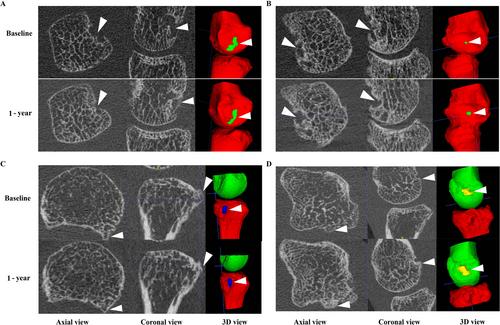
Forty patients (mean ± SD age 51.9 ± 13.4 years, 20 [50%] male, mean ± SD disease duration 4.7 ± 6.7 years) were recruited. Thirty-four patients who completed study treatment were included in the per-protocol analysis. At baseline, week 24, and week 48, the secukinumab group showed a significant reduction in erosion volume, whereas no changes were observed in the placebo group (median change in the secukinumab group −0.1 [interquartile range −0.5 to 0.0] vs 0.0 [interquartile range −0.2 to 0.4] in the placebo group, P = 0.004). A similar trend was observed for enthesiophyte volume changes in the secukinumab group, whereas no differences were noted in the placebo group (median change in the secukinumab group −0.1 [interquartile range −0.8 to 0.0] vs 0.0 [interquartile range −0.4 to 1.3] in the placebo group, P = 0.067). Generalized estimating equations results showed that the odds ratio (OR) for enthesiophyte progression in the secukinumab group was 0.264 (95% confidence interval [CI] 0.080–0.878, P = 0.030), whereas the OR for partial erosion healing in the secukinumab group was 2.882 (95% CI 1.130–7.349, P = 0.027).
Conclusion
Secukinumab demonstrates a potential benefit in facilitating partial erosion repair and preventing enthesiophyte progression in PsA.
期刊介绍:
Arthritis & Rheumatology is the official journal of the American College of Rheumatology and focuses on the natural history, pathophysiology, treatment, and outcome of rheumatic diseases. It is a peer-reviewed publication that aims to provide the highest quality basic and clinical research in this field. The journal covers a wide range of investigative areas and also includes review articles, editorials, and educational material for researchers and clinicians. Being recognized as a leading research journal in rheumatology, Arthritis & Rheumatology serves the global community of rheumatology investigators and clinicians.






 京公网安备 11010802042870号
京ICP备2023020795号-1
京公网安备 11010802042870号
京ICP备2023020795号-1

 分享
分享
 求助内容:
求助内容: 应助结果提醒方式:
 扫码关注我们
