Yu Jie Lim , Naeem Nadzri , Qiang Xue , Can Li , Rong Wang
{"title":"研究TFC膜结构和压实对高压反渗透超盐水脱盐性能的影响","authors":"Yu Jie Lim , Naeem Nadzri , Qiang Xue , Can Li , Rong Wang","doi":"10.1016/j.desal.2025.118793","DOIUrl":null,"url":null,"abstract":"<div><div>Recent works on high-pressure reverse osmosis (HPRO, applied pressure ΔP ≥ 120 bar) seek to understand the impact of compaction on thin-film composite (TFC) polyamide membranes. However, previous studies have primarily focused on commercial membranes to identify key traits for HPRO operation, leaving a gap in guidance on how to fabricate resilient TFC membranes, particularly in terms of the support and polyamide selective layers. In this work, we synthesized four types of TFC membranes with customized support and polyamide structures to determine the optimal composite design for HPRO operation. Our results indicate that a TFC membrane with a dense polyamide layer (featuring low protuberances and a high degree of crosslinking), synthesized atop a sponge-like support layer (17 wt% Polysulfone), exhibits greater resistance to compaction (denoted as TFC-17-L<sub>protub</sub>). In SWRO test (ΔP: 55 bar, 35 g/L NaCl feed), the TFC-17-L<sub>protub</sub> membrane demonstrated a water permeability of 0.80 Lm<sup>−2</sup>h<sup>−1</sup>bar<sup>−1</sup> with 99.2 % salt rejection. This performance decreased to 0.39 Lm<sup>−2</sup>h<sup>−1</sup>bar<sup>−1</sup> with 98.6 % salt rejection during the desalination of hypersaline brine via HPRO (ΔP: 150 bar, 70 g/L NaCl feed). Post-compaction analysis showed a compression of the support layer's surface, with a 28 % reduction in pore diameter and a 54 % decrease in cross-sectional thickness. In contrast, the polyamide surface morphology and cross-sectional height remained unchanged at approximately 190 nm. This study enhances the understanding of the compaction behavior of TFC membranes under high pressure and explores the potential benefits of incorporating an HPRO stage in the context of SWRO brine management.</div></div>","PeriodicalId":299,"journal":{"name":"Desalination","volume":"607 ","pages":"Article 118793"},"PeriodicalIF":9.8000,"publicationDate":"2025-07-15","publicationTypes":"Journal Article","fieldsOfStudy":null,"isOpenAccess":false,"openAccessPdf":"","citationCount":"0","resultStr":"{\"title\":\"Investigating the impact of TFC membrane structure and compaction on performance in hypersaline brine desalination via high-pressure reverse osmosis\",\"authors\":\"Yu Jie Lim , Naeem Nadzri , Qiang Xue , Can Li , Rong Wang\",\"doi\":\"10.1016/j.desal.2025.118793\",\"DOIUrl\":null,\"url\":null,\"abstract\":\"<div><div>Recent works on high-pressure reverse osmosis (HPRO, applied pressure ΔP ≥ 120 bar) seek to understand the impact of compaction on thin-film composite (TFC) polyamide membranes. However, previous studies have primarily focused on commercial membranes to identify key traits for HPRO operation, leaving a gap in guidance on how to fabricate resilient TFC membranes, particularly in terms of the support and polyamide selective layers. In this work, we synthesized four types of TFC membranes with customized support and polyamide structures to determine the optimal composite design for HPRO operation. Our results indicate that a TFC membrane with a dense polyamide layer (featuring low protuberances and a high degree of crosslinking), synthesized atop a sponge-like support layer (17 wt% Polysulfone), exhibits greater resistance to compaction (denoted as TFC-17-L<sub>protub</sub>). In SWRO test (ΔP: 55 bar, 35 g/L NaCl feed), the TFC-17-L<sub>protub</sub> membrane demonstrated a water permeability of 0.80 Lm<sup>−2</sup>h<sup>−1</sup>bar<sup>−1</sup> with 99.2 % salt rejection. This performance decreased to 0.39 Lm<sup>−2</sup>h<sup>−1</sup>bar<sup>−1</sup> with 98.6 % salt rejection during the desalination of hypersaline brine via HPRO (ΔP: 150 bar, 70 g/L NaCl feed). Post-compaction analysis showed a compression of the support layer's surface, with a 28 % reduction in pore diameter and a 54 % decrease in cross-sectional thickness. In contrast, the polyamide surface morphology and cross-sectional height remained unchanged at approximately 190 nm. This study enhances the understanding of the compaction behavior of TFC membranes under high pressure and explores the potential benefits of incorporating an HPRO stage in the context of SWRO brine management.</div></div>\",\"PeriodicalId\":299,\"journal\":{\"name\":\"Desalination\",\"volume\":\"607 \",\"pages\":\"Article 118793\"},\"PeriodicalIF\":9.8000,\"publicationDate\":\"2025-07-15\",\"publicationTypes\":\"Journal Article\",\"fieldsOfStudy\":null,\"isOpenAccess\":false,\"openAccessPdf\":\"\",\"citationCount\":\"0\",\"resultStr\":null,\"platform\":\"Semanticscholar\",\"paperid\":null,\"PeriodicalName\":\"Desalination\",\"FirstCategoryId\":\"5\",\"ListUrlMain\":\"https://www.sciencedirect.com/science/article/pii/S0011916425002681\",\"RegionNum\":1,\"RegionCategory\":\"工程技术\",\"ArticlePicture\":[],\"TitleCN\":null,\"AbstractTextCN\":null,\"PMCID\":null,\"EPubDate\":\"2025/3/8 0:00:00\",\"PubModel\":\"Epub\",\"JCR\":\"Q1\",\"JCRName\":\"ENGINEERING, CHEMICAL\",\"Score\":null,\"Total\":0}","platform":"Semanticscholar","paperid":null,"PeriodicalName":"Desalination","FirstCategoryId":"5","ListUrlMain":"https://www.sciencedirect.com/science/article/pii/S0011916425002681","RegionNum":1,"RegionCategory":"工程技术","ArticlePicture":[],"TitleCN":null,"AbstractTextCN":null,"PMCID":null,"EPubDate":"2025/3/8 0:00:00","PubModel":"Epub","JCR":"Q1","JCRName":"ENGINEERING, CHEMICAL","Score":null,"Total":0}
Investigating the impact of TFC membrane structure and compaction on performance in hypersaline brine desalination via high-pressure reverse osmosis
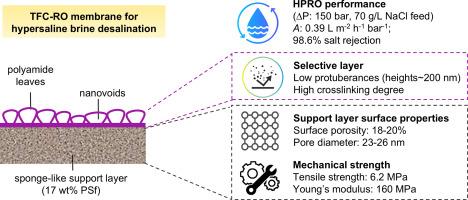
Recent works on high-pressure reverse osmosis (HPRO, applied pressure ΔP ≥ 120 bar) seek to understand the impact of compaction on thin-film composite (TFC) polyamide membranes. However, previous studies have primarily focused on commercial membranes to identify key traits for HPRO operation, leaving a gap in guidance on how to fabricate resilient TFC membranes, particularly in terms of the support and polyamide selective layers. In this work, we synthesized four types of TFC membranes with customized support and polyamide structures to determine the optimal composite design for HPRO operation. Our results indicate that a TFC membrane with a dense polyamide layer (featuring low protuberances and a high degree of crosslinking), synthesized atop a sponge-like support layer (17 wt% Polysulfone), exhibits greater resistance to compaction (denoted as TFC-17-Lprotub). In SWRO test (ΔP: 55 bar, 35 g/L NaCl feed), the TFC-17-Lprotub membrane demonstrated a water permeability of 0.80 Lm−2h−1bar−1 with 99.2 % salt rejection. This performance decreased to 0.39 Lm−2h−1bar−1 with 98.6 % salt rejection during the desalination of hypersaline brine via HPRO (ΔP: 150 bar, 70 g/L NaCl feed). Post-compaction analysis showed a compression of the support layer's surface, with a 28 % reduction in pore diameter and a 54 % decrease in cross-sectional thickness. In contrast, the polyamide surface morphology and cross-sectional height remained unchanged at approximately 190 nm. This study enhances the understanding of the compaction behavior of TFC membranes under high pressure and explores the potential benefits of incorporating an HPRO stage in the context of SWRO brine management.
期刊介绍:
Desalination is a scholarly journal that focuses on the field of desalination materials, processes, and associated technologies. It encompasses a wide range of disciplines and aims to publish exceptional papers in this area.
The journal invites submissions that explicitly revolve around water desalting and its applications to various sources such as seawater, groundwater, and wastewater. It particularly encourages research on diverse desalination methods including thermal, membrane, sorption, and hybrid processes.
By providing a platform for innovative studies, Desalination aims to advance the understanding and development of desalination technologies, promoting sustainable solutions for water scarcity challenges.




 京公网安备 11010802042870号
京ICP备2023020795号-1
京公网安备 11010802042870号
京ICP备2023020795号-1

 分享
分享
 求助内容:
求助内容: 应助结果提醒方式:
 扫码关注我们
